

The Enduring Legacy of Prague Castle
Perched atop a sandstone hill in Prague, Czechia, the Castle has occupied this site since the 9th century. What began as a fortified settlement has expanded into a sprawling complex of 70,000 square meters. This scale reflects centuries of continuous occupation and adaptation. In 1992, the site was designated a UNESCO World Heritage site, recognizing its historical weight and architectural evolution. It remains a central presence in the city, functioning today as the official residence and workplace of the President of the Czech Republic.
The presence of the Castle is felt through its layers of history, from its early foundations under the Premyslid Dynasty to its modern political role. The site contains a multitude of structures that have witnessed the shifting tides of European power. Within these walls, the transition from a royal seat to a modern administrative center is visible in the very stones of the complex. It is a place where the weight of the past meets the functions of the present.
- Hermes and Athena, about 1585 - Bartholomeus Spranger
A Tapestry of Architectural Styles
The architectural evolution of the complex reveals a layering of Romanesque solidity, Gothic ambition, Renaissance elegance, and Baroque opulence. This accumulation of styles reflects centuries of continuous adaptation. St. Vitus Cathedral dominates the skyline as a monumental Gothic structure. Its construction began in 1344 under Charles IV, establishing a verticality that defines the surrounding landscape. The cathedral remains a central presence, its soaring vaults and intricate stained-glass windows anchoring the spiritual weight of the site.
Within the palace walls, the transition between eras is marked by specific structural details. The Old Royal Palace contains the Vladislav Hall, where the ribbed vaulting creates a complex geometric rhythm overhead. Nearby, the Golden Lane offers a different scale of existence; these tiny houses once provided a residence for artisans and goldsmiths. The architecture here shifts from the grandiosity of royal halls to the intimate proportions of a working street.
The Baroque influence is most evident in the San Vitus Chapel. This space features elaborate stucco work and frescoes that characterize the 18th-century aesthetic. The interplay of light and shadow across these decorative surfaces provides a contrast to the more austere lines found in the older sections of the castle. Each era has left a physical imprint, creating a site where different historical movements exist in a single, continuous space.
The Spiritual and Royal Collections
The spiritual weight of the complex is anchored by St. Vitus Cathedral, where the presence of history is felt through the tombs of Bohemian kings, emperors, and national heroes. Within this sacred space, the Chapel of St. Wenceslas holds the crown jewels of Bohemia, a collection of gold, silver, and precious stones that remains central to the nation's identity. These objects exist not as mere artifacts, but as the physical remnants of a long-standing sovereignty.
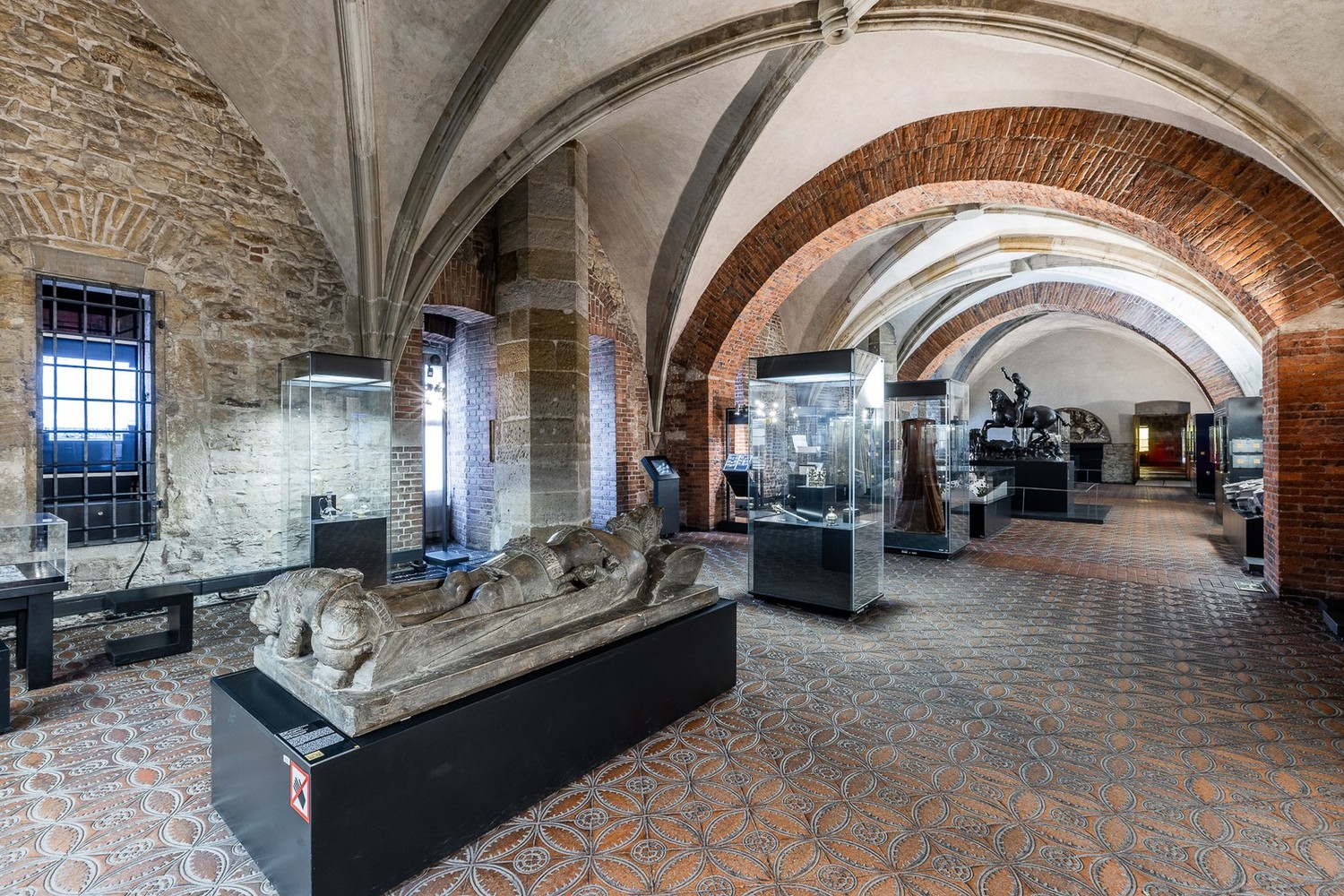
In the Riding Hall, the St. Vitus treasure is displayed alongside rare medieval manuscripts. Among these items is a golden cross, measuring half a meter in length, which was crafted in the mid-14th century under Emperor Charles IV. This object, which contains relics associated with the Passion, remains one of the most significant items held within the castle's walls. The collection is further defined by the Royal Armoury, which preserves the material history of the region's defense and nobility.
Masterpieces of the Castle Collection
The presence of the St. Vitus treasure offers a direct encounter with the sacred history of the region. Among these objects, the coronation or reliquary cross, crafted in the mid-14th century under Emperor Charles IV, holds a central place. This golden cross, which was moved from Karlštejn Castle in the 17th century, contains fragments associated with the Passion, including thorns from the crown and a nail traditionally linked to the crucifixion. It remains one of the most significant objects held within the cathedral.
The written word finds physical form in rare medieval manuscripts that have survived through the centuries. The missal of Jan of Středa, chancellor to Charles IV, exists alongside the gradual of Prague Archbishop Arnošt of Pardubice. These liturgical books represent the intellectual and religious continuity of the Bohemian lands. They are held within the castle's collections, preserved as tangible links to the medieval era.
In the realm of painting, the work Hermes and Athena, painted about 1585 by Bartholomeus Spranger, provides a window into the Mannerist style. The figures possess a specific grace that defines the artistic evolution of the period. It is a work that invites a quiet, sustained observation of form and movement.
Exhibitions and Cultural Programs
The castle functions as a living center for art and sound, hosting a wide range of exhibitions, concerts, and events. Within the Riding Hall, the Fragments of Memory exhibition creates a dialogue between eras by combining medieval artifacts with contemporary artworks. This specific arrangement allows for a direct encounter between the past and the present. The display includes works from prominent 20th-century artists, such as Francis Bacon and Joseph Beuys, placed alongside historical treasures.
Beyond these scheduled programs, the site offers rare opportunities to observe the interior of St. Vitus Cathedral. Limited tours provide access to areas of the cathedral that are seldom open to the public. These excursions allow for a closer inspection of the architectural details and the quiet spaces held within the structure. The presence of historical objects, such as the mid-14th century golden cross, provides a physical connection to the era of Charles IV.

