A Sanctuary of Stone and Spirit: Exploring the Basilica di Sant'Ambrogio
Nestled within the heart of Milan, a city pulsating with fashion, finance, and artistic innovation, stands the Basilica di Sant’Ambrogio – a monument not merely to architectural prowess but to centuries of faith, power struggles, and evolving beauty. More than just a church, it is a palimpsest, layered with the echoes of Roman martyrs, the fervent devotion of early Christians, and the masterful artistry of generations of artisans. This ancient sanctuary offers a profound journey through Milanese history, inviting visitors to contemplate its enduring significance as both a sacred space and a testament to the city’s complex past.
The Basilica's origins are deeply intertwined with the very foundations of Milan. Established in the 4th century on the site of Roman martyr cemeteries, it was conceived by St. Ambrose himself – a pivotal figure in the early Christianization of Italy. He envisioned this space as a beacon of faith amidst the waning influence of the Roman Empire, a place to honor those who had died for their beliefs and to solidify Milan’s allegiance to the burgeoning Christian community. The initial structure, known as the Basilica Martyrum, was built upon these hallowed grounds, immediately establishing a connection to the city's earliest spiritual roots. The subsequent centuries witnessed a continuous process of adaptation and expansion, reflecting the evolving needs and aspirations of the basilica’s inhabitants – from the dedicated canons who maintained its sanctity to the monastic orders that flourished within its walls.
Architecturally, the Basilica is a stunning example of Romanesque design, showcasing a remarkable blend of solidity and grace. The exterior, constructed primarily from brick and stone, immediately commands attention with its robust massing and imposing towers – the Torre dei Monaci (Tower of the Monks) and its later northern counterpart. These aren’t simply decorative elements; they represent a crucial aspect of the basilica's history as a shared space for both monastic orders and canon communities. For centuries, these distinct groups coexisted within the complex, each maintaining their own traditions and identities, a fascinating duality subtly reflected in the building’s very structure. The 9th-century atrium, a vast forecourt leading to the sacred interior, serves as a deliberate transition zone, offering a moment of quiet contemplation before entering the heart of the basilica. Inside, the nave is dominated by soaring rib vaults – a breathtaking feat of medieval engineering that draws the eye upwards towards the heavens and emphasizes the grandeur of the space.
Treasures Within: Art and Relics
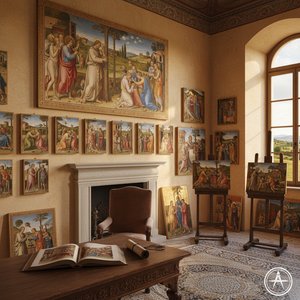
The Basilica di Sant’Ambrogio safeguards an extraordinary collection of artistic treasures, each telling a story about Milan's rich cultural heritage. Perhaps the most celebrated masterpiece is Sandro Botticelli’s *Sant’Ambrogio Altarpiece*, originally commissioned for this very space. Though portions are now housed in other museums, its legacy remains inextricably linked to the basilica’s identity – a poignant reminder of the artistic patronage that flourished within these walls. Equally captivating is the Golden Altar Front, a dazzling example of Carolingian goldsmith work dating back to the 9th century. Its intricate details and shimmering surfaces offer a glimpse into the opulent craftsmanship of an era long past. Furthermore, the Basilica houses the Sarcophagus of Stilicho, believed to contain the remains of the Vandal general who served as a prominent military leader in the late Roman Empire – a tangible link to Milan’s tumultuous history and its role in shaping the destiny of the Western Roman world.
A Crossroads of History and Faith
Beyond its artistic treasures, the Basilica di Sant'Ambrogio holds a significant place in Milanese history as a site of pivotal events. Most notably, it was within these walls that the “Peace of St. Ambrose” was signed in 1528 – an accord between warring factions that temporarily brought stability to the city amidst a period of intense political turmoil. This event underscores the basilica’s role not only as a religious center but also as a neutral ground for negotiation and reconciliation, solidifying its position as a symbol of Milanese resilience and unity. The Basilica has been a witness to countless historical moments, from royal ceremonies to civic gatherings, cementing its place as a central hub within the city's social and political landscape.
Notable Exhibitions and Ongoing Significance
While the Basilica itself is perpetually open for contemplation, it regularly hosts temporary exhibitions that delve deeper into specific aspects of its history and art. These events often feature scholarly research, rare artifacts, and interactive displays designed to engage visitors of all ages. The museum within the basilica showcases a rotating collection of liturgical objects, historical documents, and artistic works related to the Basilica’s past. The ongoing restoration efforts, meticulously preserving the building's historic fabric, are also frequently highlighted through public presentations and educational programs. Today, the Basilica di Sant’Ambrogio remains an active place of worship and pilgrimage, drawing visitors from across Italy and around the world seeking solace, inspiration, and a connection to centuries of faith.
Unique Aspects & Architectural Details
What truly distinguishes the Basilica di Sant'Ambrogio is not merely its age or its artistic treasures but also the intricate details that reveal the layers of history embedded within its walls. The two distinct towers – the Torre dei Monaci and its northern counterpart – are a testament to the basilica’s unique dual identity as a shared space for canons and monastic orders. The 9th-century atrium, with its expansive scale and serene atmosphere, provides a crucial transitional zone between the bustling city outside and the contemplative sanctity within. The meticulously crafted sculpted ambon (pulpit) offers a focal point for liturgical readings and sermons throughout the ages. Furthermore, the basilica’s ribbed vaults – a remarkable feat of medieval engineering – create an awe-inspiring sense of space and draw the eye upwards towards the heavens. The Basilica di Sant'Ambrogio is more than just a building; it is a living testament to Milanese history, faith, and artistic expression.