Portrait of Yoko Ono

The 12 Most Famous Yoko Ono Paintings, a Gallery Selection

Updated November 2026 · ranked by our popularity score (searches, visits and orders for each work) · 12 works by Yoko Ono in our catalogue

In short

Of all the originals Yoko Ono left, the most famous is Yoko Ono preparing for her exhibition, Have you seen the horizon lately?, in the collection of the Modern Art Oxford, Oxford. Close behind it come Have You Seen The Horizon Lately? and Yoko Ono with Museum of Modern Art Oxford Director, Kerry Brougher. Our catalog holds 12 works by Yoko Ono; the gallery has kept the 12 the world admires most, each shown with its date, its museum and its story.

born 1933, Tokyo Conceptual art Most works: Modern Art Oxford

Yoko Ono's top 10 paintings: the gallery's choice

1
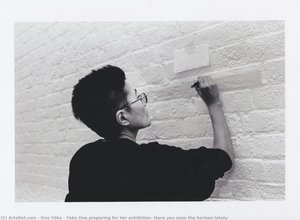
Yoko Ono preparing for her exhibition, Have you seen the horizon lately? by Yoko Ono

Yoko Ono preparing for her exhibition, Have you seen the horizon lately?

Black and White Photography · Modern Art Oxford, Oxford

The photograph captures Yoko Ono in profile, positioned on the right side of the frame. She is shown from the mid-torso upwards, her body angled toward a textured wall. Her arm reaches out to affix an object to the surface, a movement that suggests the physical labor involved in exhibition preparation. The image is rendered in black and white, utilizing a grayscale palette that relies on tonal variations rather than…

2
Have You Seen The Horizon Lately? by Yoko Ono

Have You Seen The Horizon Lately?

Black and White Photography · Modern Art Oxford, Oxford

The photograph presents a black and white view of Yoko Ono’s installation, Have You Seen The Horizon Lately? Within a gallery space characterized by white walls and subtle shadows, a large wooden floor slopes upward toward a distant wall. This incline creates a diagonal line that directs the eye through the depth of the room. At the foreground, a significant pile of dark, rounded objects—resembling stones or pebbles—is arranged in…

3
Yoko Ono with Museum of Modern Art Oxford Director, Kerry Brougher by Yoko Ono

Yoko Ono with Museum of Modern Art Oxford Director, Kerry Brougher

Acrylic On Canvas · Modern Art Oxford, Oxford

The photograph captures a quiet yet profoundly resonant moment within the hallowed halls of Modern Art Oxford, a space dedicated to fostering dialogue between contemporary art and its audience. At the heart of this image stands Yoko Ono, an artist whose career has consistently challenged conventional notions of artistic expression, alongside Kerry Brougher, the director of the museum itself. The scene is framed against a backdrop of a striking portrait…

4
Wish Tree for Bilbao (2014) by Yoko Ono

Wish Tree for Bilbao

2014 · Installation Art · Guggenheim Museum Bilbao, Bilbao

The installation titled Wish Tree for Bilbao is a work by the artist Ono Yōko. It appeared within the walls of the Guggenheim Museum Bilbao as part of a retrospective exhibition titled Yoko Ono. Half-A-Wind Show. This specific presentation occupied the third floor of the museum between March 14 and September 1, 2014.

5
Have You Seen The Horizon Lately? by Yoko Ono

Have You Seen The Horizon Lately?

Black and White Photography · Modern Art Oxford, Oxford

In the quiet, monochrome depths of "Have You Seen The Horizon Lately?", we encounter far more than a mere photographic record of an installation; we enter a profound meditation on awareness and the unseen. This striking black and white work captures a moment of stillness within the avant-garde landscape, documenting Yoko Ono’s groundbreaking conceptual installation. The image presents a starkly beautiful scene where the boundaries between the observer and the…

6
Painting for the Burial by Yoko Ono

Painting for the Burial

Acrylic On Paper · Modern Art Oxford, Oxford

Yoko Ono's "Painting for the Burial," a deceptively simple work executed in 1961, isn’t merely an instruction manual for discarding art; it’s a profound meditation on impermanence, value systems, and the very nature of artistic creation. The photograph capturing this installation – a single sheet of paper bearing typed instructions affixed to a stark white wall – possesses a quiet intensity that belies its minimalist appearance. It's a deliberate rejection…

7
Have you seen the horizon lately? Exhibition invite by Yoko Ono

Have you seen the horizon lately? Exhibition invite

Black and White Photography · Modern Art Oxford, Oxford

In the quiet, monochrome depths of Yoko Ono’s "Have you seen the horizon lately?", we encounter more than just an exhibition invitation; we enter a profound meditation on awareness and the unseen. This striking black and white work presents a cityscape defined by the rhythmic, vertical ascent of chimneys rising from a sea of rooftops. The composition is masterfully balanced, utilizing a wide panoramic view that pits the heavy, horizontal…

8
Liverpool Skyladders (2008) by Yoko Ono

Liverpool Skyladders

2008 · Installation Art · National Museums Liverpool, Liverpool

Yoko Ono’s Liverpool Skyladders isn't merely an installation; it’s a poignant and deeply layered meditation on participation, memory, and the yearning for connection. Created in 2008 for the Liverpool Biennial, this sprawling assemblage of ladders – donated by members of the public – transforms the bombed-out remains of St Luke’s Church into a space brimming with both chaotic abundance and quiet contemplation. The piece draws heavily from Ono's own artistic…

9
Hichiko Happo (2014) by Yoko Ono

Hichiko Happo

2014 · Acrylic On Canvas · Guggenheim Museum Bilbao, Bilbao

Yoko Ono’s Hichiko Happo isn't merely a painting; it’s an invocation, a captured moment of pure action translated onto canvas. Created in 2014 as part of her ambitious “Action Painting” series, this work emerged from a retrospective at the Guggenheim Museum Bilbao – a space already steeped in the legacy of groundbreaking performance and conceptual art. The piece represents a deliberate reversal of fortune, a joyful counterpoint to the samurai’s…

10
Painting to Hammer a Nail by Yoko Ono

Painting to Hammer a Nail

· Modern Art Oxford, Oxford

Yoko Ono’s “Painting to Hammer a Nail,” created in 1961, isn't merely a depiction of an action; it’s an invitation. A deceptively simple arrangement – a stark white wooden board affixed to a weathered brick wall, a solitary hammer suspended beneath, and a small bucket holding nails – belies a profound conceptual depth. This work, born from the fertile ground of early Conceptual Art and Fluxus, speaks volumes about participation,…

The Yoko Ono selection continues, 11 to 12

The subjects that held Yoko Ono's eye

The four subjects that come back most often in these originals, each with its finest example.

The museums that keep Yoko Ono's originals

The 3 museums that hold the most of the paintings on this page.

Museum City Works by Yoko Ono Paintings from this list
Modern Art Oxford, OxfordModern Art Oxford Oxford 9 Yoko Ono preparing for her exhibition, Have you seen the horizon lately?, Have You Seen The Horizon Lately?, Yoko Ono with Museum of Modern Art Oxford Director, Kerry Brougher
Guggenheim Museum Bilbao, BilbaoGuggenheim Museum Bilbao Bilbao 2 Wish Tree for Bilbao, Hichiko Happo
National Museums Liverpool, LiverpoolNational Museums Liverpool Liverpool 1 Liverpool Skyladders

Yoko Ono year by year: the originals that define each

Yoko Ono's dated works in this selection cover only 7 years, from 2008 to 2014: a brief career, shown here year by year.

Works per year

Pick a year to see its originals.

Collectors' questions about Yoko Ono's paintings

Which work is Yoko Ono most famous for?Reveal the answer

Yoko Ono preparing for her exhibition, Have you seen the horizon lately?, Modern Art Oxford, Oxford. Have You Seen The Horizon Lately? and Yoko Ono with Museum of Modern Art Oxford Director, Kerry Brougher come next.

What are the ten most famous Yoko Ono paintings?Reveal the answer

Yoko Ono preparing for her exhibition, Have you seen the horizon lately?, Have You Seen The Horizon Lately?, Yoko Ono with Museum of Modern Art Oxford Director, Kerry Brougher, Wish Tree for Bilbao, Have You Seen The Horizon Lately?, Painting for the Burial, Have you seen the horizon lately? Exhibition invite, Liverpool Skyladders, Hichiko Happo and Painting to Hammer a Nail. The ranking above gives each one's year and museum.

How many paintings did Yoko Ono leave?Reveal the answer

Our catalog holds 12 works by Yoko Ono, dated from 2008 to 2014.

In which museums do Yoko Ono's masterpieces hang?Reveal the answer

Mostly in Modern Art Oxford (Oxford), Guggenheim Museum Bilbao (Bilbao) and National Museums Liverpool (Liverpool). The museum table above lists them all.

In which years did Yoko Ono paint the most famous works?Reveal the answer

In 2014: 2 of the 12 works on this page were made then, Wish Tree for Bilbao among them.

What are the first and the last famous originals of Yoko Ono?Reveal the answer

On this page, the earliest is Liverpool Skyladders (2008) and the latest Wish Tree for Bilbao (2014).

Which subjects did Yoko Ono choose most often?Reveal the answer

Installation (2), Black and white (2) and Instruction (2), across the 12 works on this page.

Which technique did Yoko Ono use most?Reveal the answer

Black and White Photography, for 4 of the 12 works on this page.

To which art movement does Yoko Ono belong?Reveal the answer

Conceptual art, judging by the originals on this page.

Which Yoko Ono works hang at the Modern Art Oxford?Reveal the answer

Yoko Ono preparing for her exhibition, Have you seen the horizon lately?, Have You Seen The Horizon Lately? and Yoko Ono with Museum of Modern Art Oxford Director, Kerry Brougher: the Modern Art Oxford, Oxford holds 9 of the works on this page.

Yoko Ono: life and work

A Life Interwoven with Art and Activism

Yoko Ono, born in Tokyo in 1933, is a figure whose artistic journey transcends easy categorization. Her upbringing within an aristocratic Japanese family provided a foundation of privilege, yet her life was dramatically reshaped by the upheaval of World War II, experiences that instilled a profound sensitivity to human suffering and a commitment to peace—themes that would become central to her art. From a young age, Ono demonstrated a natural inclination towards creative expression, initially through piano studies, but soon expanding into broader artistic explorations. The family’s relocation to New York City in 1952 proved pivotal, immersing her in the burgeoning avant-garde scene and setting the stage for a career that would challenge conventional notions of art itself. Her early education at Sarah Lawrence College provided intellectual grounding, yet it was the vibrant downtown art world that truly ignited her artistic spirit.

Embracing the Avant-Garde: Fluxus and Conceptual Beginnings

Ono quickly found herself drawn to the radical experimentation of the 1960s New York art scene, becoming a key member of the Fluxus movement. This international collective sought to dismantle traditional artistic boundaries, embracing chance, performance, and everyday life as legitimate sources of creative inspiration. Influenced by composers like John Cage—whose embrace of silence and indeterminacy profoundly impacted her approach—and artists such as La Monte Young, Ono began developing a unique artistic vocabulary centered on conceptualism. Her early works weren’t paintings or sculptures in the traditional sense; they were *events*, *happenings*, and instructional pieces designed to provoke thought and engage the audience directly. These performances often defied categorization, prioritizing ideas over aesthetics and blurring the line between artist and spectator. A prime example is her series of “Instruction Paintings,” which presented simple directives for viewers to complete, transforming them from passive observers into active participants in the artwork’s creation. This emphasis on participation foreshadowed a key element that would define much of her later work.

Expanding Artistic Boundaries: From Performance to Peace

Ono's artistic output is remarkably diverse, spanning conceptual art, performance art, music, filmmaking, and tireless peace activism. Her “instructional pieces,” most notably compiled in *Grapefruit* (1964), are perhaps her most iconic contribution to conceptual art. These poetic prompts—ranging from the whimsical (“Imagine a raindrop”) to the profound (“Think of something you want to change”)—invite audiences to actively engage their imaginations and complete the artwork within their own minds. Installations like “Liverpool Skyladders” demonstrate her commitment to public art, creating monumental structures that interact with urban spaces and invite contemplation. The "Wish Tree" series, where visitors write wishes on tags and tie them to branches, embodies themes of hope, collective intention, and a yearning for peace—a recurring motif throughout her career. This desire for global harmony became increasingly prominent following her relationship with John Lennon, beginning in 1966. Their marriage in 1969 was met with intense media scrutiny, but it also provided a powerful platform for their shared activism. Together, they staged iconic protests against the Vietnam War, including the famous “Bed-Ins for Peace,” and formed the Plastic Ono Band, releasing critically acclaimed albums like *Wedding Album* and *Double Fantasy*, which earned them a Grammy Award in 1980.

A Lasting Legacy of Innovation and Advocacy

Following the tragic death of John Lennon in 1980, Yoko Ono dedicated herself to preserving his legacy through initiatives like Strawberry Fields in Central Park and the Imagine Peace Tower in Iceland—a beacon of hope erected as a tribute to peace. She continues to create art and advocate for causes close to her heart: peace, environmental sustainability, and human rights. Her pioneering work has profoundly influenced generations of artists across various disciplines, challenging conventional norms and expanding the possibilities of artistic expression. Ono’s emphasis on conceptualism, audience participation, and social engagement remains remarkably relevant in contemporary art practice. She is recognized not only as a groundbreaking artist but also as a courageous activist who used her platform to promote positive change, leaving an indelible mark on both the art world and the global landscape. Her work reminds us that art can be more than just something to look at; it can be a catalyst for dialogue, healing, and transformation. Yoko Ono’s influence continues to resonate today, inspiring artists and activists alike to envision a more peaceful and equitable world.