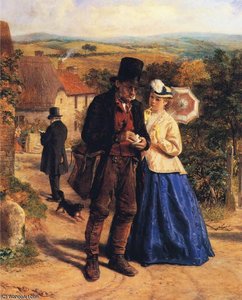
Portrait of William Hemsley

The 12 Most Famous William Hemsley Paintings, Each One of a Kind

Updated November 2026 · ranked by our popularity score (searches, visits and orders for each work) · 12 works by William Hemsley in our catalogue

In short

The Fisherman's Family (1858) is the William Hemsley painting that draws the most eyes; the original belongs to the Wolverhampton Art Gallery, Wolverhampton. After it, the eye goes to Hayfield and Feeding the chicks. Among the 12 works of William Hemsley in our catalog, these 12 are the most famous, each a unique original presented with its year, its museum and the reason it endures.

1819 – 1906, London Most works: Wolverhampton Art Gallery

Top 10 paintings by William Hemsley, through the gallery's eye

1
The Fisherman's Family (1858) by William Hemsley

The Fisherman's Family

1858 · Acrylic On Canvas · Wolverhampton Art Gallery, Wolverhampton

A Window Into Victorian Domesticity: Examining William Hemsley’s “The Fisherman’s Family” William Hemsley's "The Fisherman’s Family," painted in 1858, transcends mere depiction; it embodies the spirit of Victorian England—a period defined by burgeoning industrialization alongside a fervent desire for connection to rural traditions. Currently residing within the Wolverhampton Art Gallery, this oil on canvas masterpiece offers a poignant glimpse into the lives of ordinary families grappling with the complexities of…

2
Hayfield by William Hemsley

Hayfield

A family gathers within a sun-drenched landscape, their presence anchored by the heavy textures of a rural harvest. A man, a woman, and two children occupy the center of the composition, caught in a quiet interval of domestic life amidst the labor of the fields. Scattered objects—a basket to the left, a pile of hay to the right, and bottles near the center—suggest a temporary pause in a day of…

3
Feeding the chicks by William Hemsley

Feeding the chicks

A young woman sits within the threshold of a wooden structure, positioned on the right side of the composition. She wears a blue bodice, a white apron, and a red skirt. Her gaze is directed downward toward several chickens scattered at her feet on the stone steps. The scene is framed by the dark, shadowed interior of the building, which creates a sense of depth against the brightly lit outdoor…

4
The Schoolboy by William Hemsley

The Schoolboy

Oil On Canvas

The Schoolboy is an oil painting by the British artist William Hemsley. Born in London in 1819, Hemsley established himself as a specialist in genre painting, focusing on the intimate details of everyday life. His work often captured domestic and rural scenes, frequently centering on children engaged in simple, quiet activities.

William Hemsley's famous paintings, numbers 11 to 12

The subjects that held William Hemsley's eye

The four subjects that come back most often in these originals, each with its finest example.

The museums that keep William Hemsley's originals

The 2 museums that hold the most of the paintings on this page.

Museum City Works by William Hemsley Paintings from this list
Wolverhampton Art Gallery, WolverhamptonWolverhampton Art Gallery Wolverhampton 1 The Fisherman's Family
Auckland Art Gallery Toi o Tāmaki, AucklandAuckland Art Gallery Toi o Tāmaki Auckland 1 Feeding the chicks

William Hemsley across the years: the unique originals of each

All the dated William Hemsley originals shown here belong to a single year, 1858: they appear in order of fame.

Works per year

Pick a year to see its originals.

William Hemsley's paintings: questions for the gallery

What is the single most famous work of William Hemsley?Reveal the answer

The Fisherman's Family (1858), Wolverhampton Art Gallery, Wolverhampton. Hayfield and Feeding the chicks come next.

At what age did William Hemsley create The Fisherman's Family?Reveal the answer

39 years old: The Fisherman's Family dates from 1858, and William Hemsley was born in 1819.

Which ten paintings by William Hemsley are the most famous?Reveal the answer

The Fisherman's Family, Hayfield, Feeding the chicks, The Schoolboy, No Longer The Baby, Too Hot, Hayfield -, Writing a Letter, Teaching a Lesson and Expectation. The ranking above gives each one's year and museum.

How many works by William Hemsley are known?Reveal the answer

Our catalog holds 12 works by William Hemsley.

Where can the most famous William Hemsley originals be seen?Reveal the answer

Mostly in Wolverhampton Art Gallery (Wolverhampton) and Auckland Art Gallery Toi o Tāmaki (Auckland). The museum table above lists them all.

What subjects did William Hemsley favour?Reveal the answer

Domestic scene (2), Victorian era (2) and Woman (2), across the 12 works on this page.

What materials did William Hemsley paint with most?Reveal the answer

Acrylic On Canvas, for 2 of the 12 works on this page.

William Hemsley: a portrait of the artist

Gustave Courbet: A Revolutionary of the Real

Jean Désiré Gustave Courbet, born in Ornans, eastern France, on June 10, 1819, and tragically dying in La Tour-de-Peilz, Switzerland, on December 31, 1877, was more than just a painter; he was a catalyst. A pivotal figure in the transition from Romanticism to modern art, Courbet fundamentally challenged artistic conventions of his time, rejecting idealized beauty and academic traditions in favor of depicting the realities of everyday life with unflinching honesty. His work wasn’t merely representation; it was a statement – a bold declaration that art could be found not just in grand narratives or mythological scenes, but within the humble experiences of ordinary people.

Courbet's early life instilled a deep connection to the land and its inhabitants. Raised on his family’s farm, he developed an appreciation for the working class – the peasants, laborers, and farmers who formed the bedrock of rural France. This observation would become central to his artistic vision. Initially, Courbet pursued law studies in Paris, but quickly abandoned them for a path dedicated entirely to art. He sought guidance from established masters at the Louvre, meticulously studying Velázquez, Ribera, and other Spanish painters, honing his technical skills through diligent copying before venturing to develop his own unique style.

  • Early Influences: The works of Spanish masters like Velázquez and Ribera profoundly influenced Courbet’s approach to composition, light, and shadow.
  • The Salon Rejection: His early submissions to the official Salon were repeatedly rejected due to their unconventional subject matter and lack of adherence to academic standards. This rejection fueled his determination to forge an independent artistic path.

The Birth of Realism

Courbet’s break came with the acceptance of *Courbet with a Black Dog* in 1844, marking a significant step toward establishing himself as an artist. However, he quickly grew frustrated with the Salon's restrictive rules and the prevailing artistic climate. He began to paint subjects that directly challenged the established order – scenes of rural life, portraits of working-class individuals, and landscapes devoid of romantic embellishment. This marked the birth of Realism in French painting.

His most famous early work, *A Burial at Ornans* (1849–50), exemplifies this shift. Depicting a simple funeral procession in his hometown, Courbet eschewed heroic grandeur and idealized figures, presenting instead a raw, unvarnished portrayal of grief and community. The sheer scale of the painting – unprecedented for a genre scene – further emphasized its significance and challenged viewers to confront the realities of mortality and social life.

Themes and Techniques

Courbet's artistic vision was deeply rooted in his observations of the world around him. He frequently depicted scenes from rural life – harvests, laborers, and landscapes – capturing the textures, colors, and light of the French countryside with remarkable detail. His use of color was particularly striking; he favored earthy tones and muted palettes, creating a sense of realism and immediacy.

Beyond his subject matter, Courbet’s technique was equally innovative. He employed a direct painting method, working directly onto the canvas without preliminary sketches or underpaintings. This approach allowed him to capture fleeting moments and convey a sense of spontaneity. His brushstrokes were often loose and expressive, contributing to the overall dynamism of his compositions.

Notable Techniques:
  • Direct painting method
  • Emphasis on texture and color
  • Large-scale canvases

Legacy and Influence

Despite facing criticism and rejection during his lifetime, Gustave Courbet’s legacy is immense. He paved the way for subsequent generations of artists – Impressionists, Post-Impressionists, and beyond – by demonstrating that art could be a powerful tool for social commentary and personal expression. His commitment to depicting reality without idealization profoundly influenced the course of modern art.

Courbet’s work continues to resonate with audiences today, reminding us of the importance of observing the world around us and challenging conventional notions of beauty and artistic value. He remains a towering figure in the history of art, a revolutionary who dared to paint what he saw – and in doing so, forever changed the way we perceive and appreciate art.