Portrait of Wincenty Smokowski

The 24 Most Famous Wincenty Smokowski Paintings, Each One of a Kind

Updated November 2026 · ranked by our popularity score (searches, visits and orders for each work) · 24 works by Wincenty Smokowski in our catalogue

In short

Conversation (1800) is the Wincenty Smokowski painting that draws the most eyes; the original belongs to the Lithuanian Art Fund, Vilnius. After it, the eye goes to Peasant talk (1800) and Entry of Boleslaus the Brave into Kiev. (1830). Among the 24 works of Wincenty Smokowski in our catalog, these 24 are the most famous, each a unique original presented with its year, its museum and the reason it endures.

1797 – 1876, Vilnius Academicism Most works: Lithuanian Art Fund

Top 10 paintings by Wincenty Smokowski, through the gallery's eye

1
Conversation (1800) by Wincenty Smokowski

Conversation

1800 · Lithograph · Lithuanian Art Fund, Vilnius

This black and white lithograph captures a fleeting social moment through a group of four figures. Rendered with a loose, sketchy quality, the work functions as a preparatory study, prioritizing the immediacy of gesture and character over finished precision. The composition is centered on the group, utilizing an asymmetrical arrangement to create a sense of movement within the quietude of the scene. Lines are used expressively to define the anatomy…
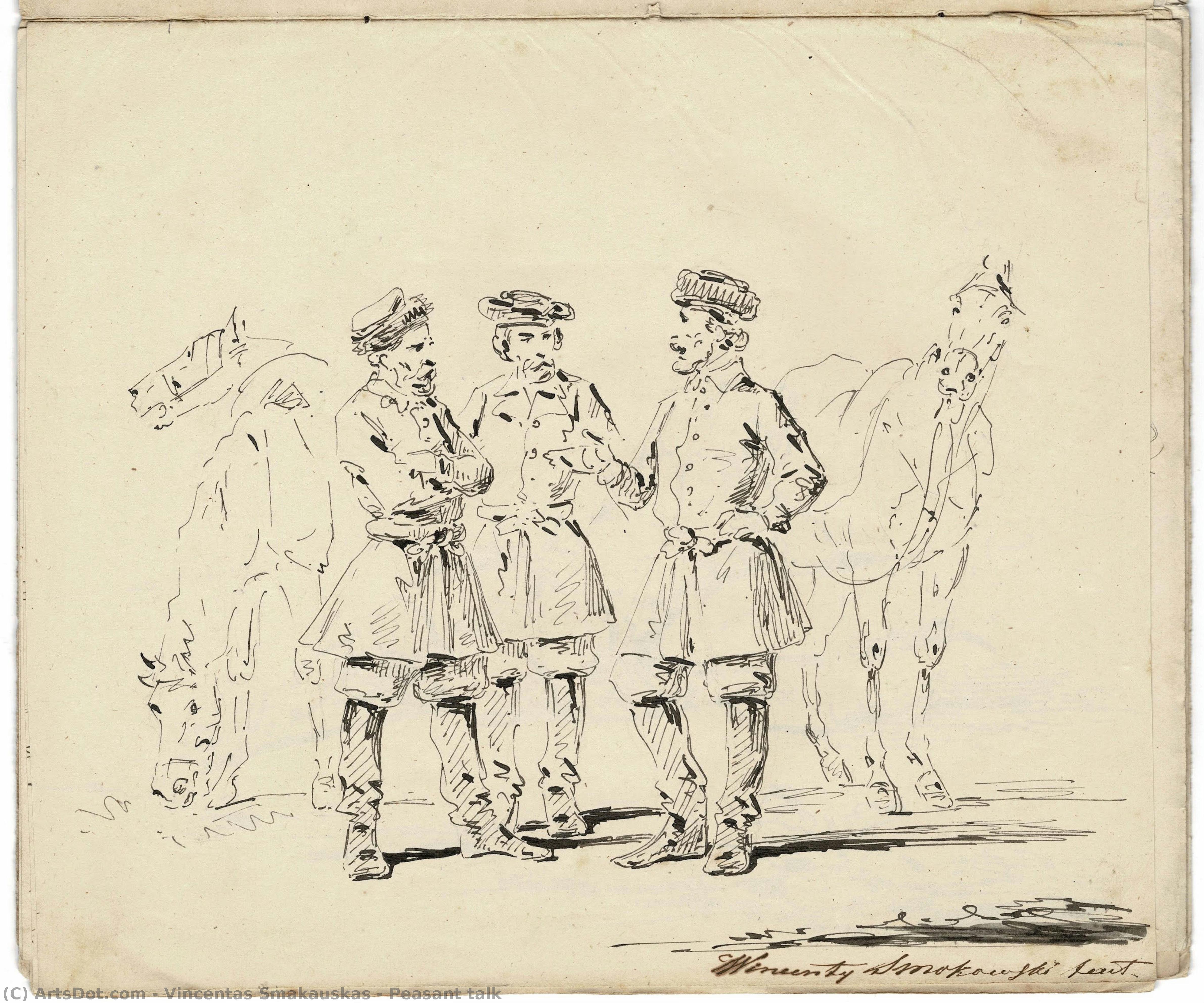
2
Peasant talk (1800) by Wincenty Smokowski

Peasant talk

1800 · Ink On Paper · Lithuanian Art Fund, Vilnius

Four men stand locked in a quiet, urgent circle, their bodies leaning inward as if the very air between them holds a secret. They wear the heavy, structured uniforms of soldiers, yet the rigidity of their attire contrasts with the loose, spontaneous energy of their interaction. This is a study of human connection caught in a fleeting instant. The scene feels less like a formal portrait and more like a…

3
Entry of Boleslaus the Brave into Kiev. (1830) by Wincenty Smokowski

Entry of Boleslaus the Brave into Kiev.

1830 · Oil · National Museum in Warsaw, Warsaw

The composition centers on a white horse carrying a knight, positioned within a crowded, dynamic military procession. This central figure moves through a fortified city gate, framed by an arched upper boundary that directs the eye toward the cavalry. The scene is filled with movement, established by the diagonal placement of horses and the upward gestures of the surrounding crowd. Deep reds appear in the banners and clothing of the…

4
Gypsy encampment upon a creek. (1850) by Wincenty Smokowski

Gypsy encampment upon a creek.

1850 · Oil On Canvas · National Museum in Warsaw, Warsaw

The air feels heavy with the scent of damp earth and woodsmoke as twilight descends upon this secluded forest clearing. Shadows stretch long and deep from the massive, dark tree trunks that frame the scene, creating a sense of profound intimacy within the grove. At the center of this quiet drama, a group of figures gathers on a sandy bank beside a slow-moving creek. The light seems to emanate from…

5
Jewish wedding. (1858) by Wincenty Smokowski

Jewish wedding.

1858 · Oil On Canvas · National Museum in Warsaw, Warsaw

The village street narrows under the weight of a celebration. A wedding procession moves through the earthy landscape, a slow river of humanity flowing between thatched-roof cottages. The air feels thick with the scent of dry straw and the sound of wood and string. Musicians lead the way, their cello and violin carving melodies into the late afternoon light. A bride moves through the center, her attire a quiet contrast…

6
Rest (1800) by Wincenty Smokowski

Rest

1800 · Drawing · Lithuanian Art Fund, Vilnius

The drawing, rendered in black and white, depicts a solitary man lying on the ground in a state of repose. His head rests upon a large, solid stone, which provides a hard contrast to the softer lines of his body. The man's limbs appear heavy, suggesting a state of deep sleep or total exhaustion. The composition is quiet, focusing on the physical contact between the human form and the natural…

7
Domestic scene (Children and nannies) (1800) by Wincenty Smokowski

Domestic scene (Children and nannies)

1800 · Drawing · Lithuanian Art Fund, Vilnius

In the delicate, monochromatic strokes of Vincentas Smakauskas’s 1800 drawing, Domestic scene (Children and nannies), we are invited to step through a portal into the private sanctums of nineteenth-century life. This exquisite work captures a fleeting moment of familial cohesion, where the boundaries between generations blur in a shared space of warmth and togetherness. The composition presents a gathering of at least nine individuals, a tapestry of souls woven together…

8
Domestic scene (noble family) (1800) by Wincenty Smokowski

Domestic scene (noble family)

1800 · Drawing · Lithuanian Art Fund, Vilnius

The year 1800 arrives through a window of ink and shadow. In this black and white drawing, a mother exists as the center of a small, breathing universe. She holds an infant close, her form the anchor for a circle of children who gravitate toward her warmth. There is a stillness here, a held breath in the middle of a domestic afternoon. The light does not shout; it merely traces…

9
Sacrifice for beggar (1800) by Wincenty Smokowski

Sacrifice for beggar

1800 · Ink · Lithuanian Art Fund, Vilnius

Around 1800, Vincentas Smakauskas captured a spirited street dance in this monochromatic drawing. The scene depicts figures moving in synchronized harmony, their forms etched with rhythmic precision. Light and shadow define the dancers, creating a sense of motion that transcends the stillness of the paper. Within the composition, two bowls sit placed in the frame, suggesting a narrative of shared sustenance and communal care. This small 6 x 17 cm…

10
Grief (1800) by Wincenty Smokowski

Grief

1800 · Drawing · Lithuanian Art Fund, Vilnius

The work titled Grief is a creation of Wincenty Smokowski. Born in 1797 in Vilnius, Lithuania, the artist was a prominent Polish-Lithuanian painter and illustrator. His hand moved through the academic and classical styles, seeking to map the contours of the human experience. This specific piece remains a poignant example of his ability to capture such internal weight.

Wincenty Smokowski's famous paintings, numbers 11 to 24

Wincenty Smokowski's famous paintings, period by period

The subjects that held Wincenty Smokowski's eye

The four subjects that come back most often in these originals, each with its finest example.

The museums that keep Wincenty Smokowski's originals

The 2 museums that hold the most of the paintings on this page.

Museum City Works by Wincenty Smokowski Paintings from this list
Lithuanian Art Fund, VilniusLithuanian Art Fund Vilnius 19 Conversation, Peasant talk, Rest
National Museum in Warsaw, WarsawNational Museum in Warsaw Warsaw 5 Entry of Boleslaus the Brave into Kiev., Gypsy encampment upon a creek., Jewish wedding.

Wincenty Smokowski across the decades: one unique original for each

Works per decade

Pick a decade to see the original that defines it.

Wincenty Smokowski's paintings: questions for the gallery

What is the single most famous work of Wincenty Smokowski?Reveal the answer

Conversation (1800), Lithuanian Art Fund, Vilnius. Peasant talk (1800) and Entry of Boleslaus the Brave into Kiev. (1830) come next.

Which ten paintings by Wincenty Smokowski are the most famous?Reveal the answer

Conversation, Peasant talk, Entry of Boleslaus the Brave into Kiev., Gypsy encampment upon a creek., Jewish wedding., Rest, Domestic scene (Children and nannies), Domestic scene (noble family), Sacrifice for beggar and Grief. The ranking above gives each one's year and museum.

How many works by Wincenty Smokowski are known?Reveal the answer

Our catalog holds 24 works by Wincenty Smokowski, dated from 1830 to 1858.

Where can the most famous Wincenty Smokowski originals be seen?Reveal the answer

Mostly in Lithuanian Art Fund (Vilnius) and National Museum in Warsaw (Warsaw). The museum table above lists them all.

During which period did Wincenty Smokowski create the best-known paintings?Reveal the answer

In 1850s: 2 of the 24 works on this page were made then, Gypsy encampment upon a creek. among them.

Which famous Wincenty Smokowski painting is the earliest, and which the latest?Reveal the answer

On this page, the earliest is Entry of Boleslaus the Brave into Kiev. (1830) and the latest Jewish wedding. (1858).

What subjects did Wincenty Smokowski favour?Reveal the answer

People (9), Black and white (9) and Man (6), across the 24 works on this page.

What materials did Wincenty Smokowski paint with most?Reveal the answer

Drawing, for 13 of the 24 works on this page.

Which movement does the work of Wincenty Smokowski belong to?Reveal the answer

Academicism, judging by the originals on this page.

What Wincenty Smokowski originals can I see at the Lithuanian Art Fund?Reveal the answer

Conversation, Peasant talk and Rest: the Lithuanian Art Fund, Vilnius holds 19 of the works on this page.

Wincenty Smokowski: a portrait of the artist

early life and education

vincentas smakauskas, also known as wincenty smokowski, was a prominent polish-lithuanian painter and illustrator born in vilnius, lithuania in 1797. he studied at vilnius university from 1817 to 1822, where he was a pupil of the english engraver and professor of fine art, joseph saunders. smakauskas then continued his education at the imperial academy of arts in saint petersburg from 1823 to 1829, receiving a silver medal in 1825 and a gold medal in 1827 for his version of the death of epaminondas.

artistic career and notable works

smakauskas was known for his portraits, historical scenes, landscapes, and genre works, often featuring unprejudiced portrayals of jews and gypsies. some of his notable paintings include:
  • grief (lithuanian art fund, vilnius, lithuania), a poignant example of his ability to capture the human experience.
  • bathing (lithuanian art fund, vilnius, lithuania), showcasing his skill in depicting everyday scenes.
  • mischievous children (lithunian art fund, vilnius, lithuania), a heartwarming portrayal of childhood innocence.
      these works can be found on OriginalUniqueArt.com's vincentas smakauskas page, which features an extensive collection of his artworks.

      medical career and later life

      in addition to his artistic pursuits, smakauskas graduated from the "vilnius medico-surgical academy" in 1836 and worked as a doctor in the švenčionys area from 1841 to 1856. he then practiced medicine at his wife's estate in krikonys until his death in 1876.

      legacy

      smakauskas' contributions to the art world are not limited to his own works. he also provided illustrations for notable literary pieces, such as konrad wallenrod (1828) and pan tadeusz (1860) by adam mickiewicz. a street in the pašilaičiai district of vilnius is named after him, a testament to his enduring legacy. wikipedia's wincenty smokowski page offers further reading on this fascinating artist. for more information on smakauskas' artworks and other notable artists, visit OriginalUniqueArt.com.