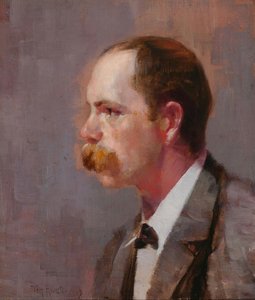
Portrait of Tom Roberts

Tom Roberts Paintings: The 40 Most Famous, Through a Gallery's Eye

Updated October 2026 · ranked by our popularity score (searches, visits and orders for each work) · 40 works by Tom Roberts in our catalogue

In short

To the gallery's eye, Tom Roberts's most famous painting is Slumbering sea, Mentone (1887), whose original hangs in the National Gallery of Victoria, Melbourne. Self portrait (1924) and Portrait of Louis Abrahams (1886) complete the trio every eye recognises. Of the 40 works by Tom Roberts in our catalog, the gallery presents the 40 most famous below, each original with its year, its museum and what makes it unique.

1856 – 1931, Dorchester Impressionism Most works: Art Gallery of New South Wales

The gallery's top 10 Tom Roberts paintings

1
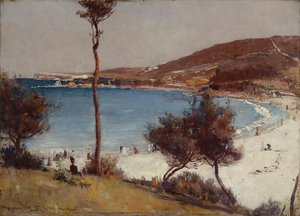
Slumbering sea, Mentone (1887) by Tom Roberts

Slumbering sea, Mentone

1887 · Acrylic On Canvas · National Gallery of Victoria, Melbourne

“Slumbering Sea, Mentone,” painted in 1887 by Tom Roberts, is more than just a depiction of a coastal scene; it's a carefully constructed meditation on light, color, and the burgeoning sense of national identity within Australia. This work, housed at the National Gallery of Victoria, offers a captivating glimpse into the heart of the Heidelberg School’s artistic philosophy – a movement that sought to capture the unique spirit of the…

2
Self portrait (1924) by Tom Roberts

Self portrait

1924 · Oil On Canvas · Art Gallery of New South Wales, Sydney

In this intimate oil on canvas, the artist Tom Roberts presents a "Self portrait" that offers a quiet moment of introspection. Created about 1924, the work captures the artist in his later years, presenting the subject as an elderly man. It is a bust-length portrait, focusing the viewer's attention on the character and presence of the sitter rather than his surroundings.

6
Portrait of Mrs Tom Roberts (1910) by Tom Roberts

Portrait of Mrs Tom Roberts

1910 · Oil On Canvas · National Portrait Gallery, Canberra

Portrait of Mrs Tom Roberts: A Window Into Heidelberg Impressionism The painting “Portrait of Mrs Tom Roberts,” created in 1910 by the celebrated Australian artist Tom Roberts, stands as a testament to the burgeoning Heidelberg School movement and its profound influence on landscape art. More than just a likeness of Elizabeth Sarah (Lillie) Roberts—née Williamson—the portrait embodies a carefully considered aesthetic that reflects both Victorian sensibilities and the revolutionary spirit…

7
Andante (1889) by Tom Roberts

Andante

1889 · Painting · Art Gallery of South Australia, Adelaide

To gaze upon Tom Roberts' "Andante" is to step into a moment suspended in time—a quiet chamber where the only sound seems to be the gentle, melancholic spill of music. This evocative scene captures a man absorbed in the act of playing the piano, his posture suggesting both deep concentration and profound contentment. The composition itself draws the viewer inward, inviting them to share in this private performance. It is…

8
Gray day in spring, Venice (1884) by Tom Roberts

Gray day in spring, Venice

1884 · Oil · National Gallery of Australia, Canberra

In the delicate interplay of shadow and soft illumination, Gray day in spring, Venice emerges as a breathtaking window into a bygone era. Painted by the Australian master Tom Roberts in 1884, this expansive work transports the viewer to the winding canals of Italy during that fleeting, magical hour when dusk begins to settle over the Adriatic. The scene is not merely a depiction of architecture, but an atmospheric study…

9
Turning the soil (Sketch for The charcoal burners) (1886) by Tom Roberts

Turning the soil (Sketch for The charcoal burners)

In the quiet, rhythmic labor of Turning the soil (Sketch for The charcoal burners), we find a profound meditation on the relationship between humanity and the land. Created in 1886 by the visionary Australian Impressionist Tom Roberts, this preparatory sketch serves as a soulful window into a moment of shared toil. The scene unfolds with three figures embedded within a rugged landscape, their bodies engaged in the heavy, essential task…

Tom Roberts paintings, ranked 11 to 40

11Sir William Charles Windeyer (1892) by Tom RobertsSir William Charles Windeyer1892 · National Portrait Gallery 12James T. Donovan (1892) by Tom RobertsJames T. Donovan1892 · National Portrait Gallery 13Mrs Lucy Scot Skirving (1898) by Tom RobertsMrs Lucy Scot Skirving1898 · Art Gallery of New South Wales 14Percy F.S. Spence (1896) by Tom RobertsPercy F.S. Spence1896 · Art Gallery of New South Wales 15Portrait of George Selth Coppin (1895) by Tom RobertsPortrait of George Selth Coppin1895 · National Portrait Gallery 16Sir James Reading Fairfax (1898) by Tom RobertsSir James Reading Fairfax1898 · National Portrait Gallery 17Hutt Valley (1900) by Tom RobertsHutt Valley1900 · Museum of New Zealand Te Papa Tongarewa 18In Quarantine, Wellington (1900) by Tom RobertsIn Quarantine, Wellington1900 · Museum of New Zealand Te Papa Tongarewa 19Mrs W.A.B. Greaves (1899) by Tom RobertsMrs W.A.B. Greaves1899 · Art Gallery of New South Wales 20Edward Trenchard by Tom RobertsEdward TrenchardNational Gallery of Victoria 21Roses (1911) by Tom RobertsRoses1911 · Art Gallery of New South Wales 22Thames barges by Tom RobertsThames bargesArt Gallery of New South Wales 23The first basin (1913) by Tom RobertsThe first basin1913 24Sherbrooke Forest (1924) by Tom RobertsSherbrooke Forest1924 · Art Gallery of New South Wales 25An autumn morning, Milson (1888) by Tom RobertsAn autumn morning, Milson1888 · Art Gallery of New South Wales 26Harbourscape (1890) by Tom RobertsHarbourscape1890 · National Gallery of Australia 27Circular Quay (1989) by Tom RobertsCircular Quay1989 28Holiday sketch at Coogee (1888) by Tom RobertsHoliday sketch at Coogee1888 · Art Gallery of New South Wales 29Cloud study by Tom RobertsCloud studyNational Gallery of Victoria 30Washing day Kallista by Tom RobertsWashing day KallistaArt Gallery of New South Wales 31Grey lady (Mrs Ince) by Tom RobertsGrey lady (Mrs Ince)Art Gallery of New South Wales 32Storm at sea by Tom RobertsStorm at seaArt Gallery of New South Wales 33Opening of the first Parliament of the Australian Commonwealth, 9th May 1901 (1903) by Tom RobertsOpening of the first Parliament of the Australian Commonwealth, 9th May 19011903 · National Portrait Gallery 34Shearing the rams (1890) by Tom RobertsShearing the rams1890 · National Gallery of Victoria 35The Big Picture (1903) by Tom RobertsThe Big Picture1903 · Royal Collection 36Coming South (1886) by Tom RobertsComing South1886 · National Gallery of Victoria 37Bailed up (1927) by Tom RobertsBailed up1927 · Art Gallery of New South Wales 38In a corner on the Macintyre (1895) by Tom RobertsIn a corner on the Macintyre1895 · National Gallery of Australia 39Rejected (1883) by Tom RobertsRejected1883 40The Temple of Dendera, Upper Egypt (1841) by Tom RobertsThe Temple of Dendera, Upper Egypt1841 · Bristol Museum - Art Gallery

The subjects that held Tom Roberts's eye

The four subjects that come back most often in these originals, each with its finest example.

The museums that keep Tom Roberts's originals

The 8 museums that hold the most of the paintings on this page.

Museum City Works by Tom Roberts Paintings from this list
Art Gallery of New South Wales, SydneyArt Gallery of New South Wales Sydney 15 Self portrait, Adagio, Fog, Thames Embankment
National Portrait Gallery, CanberraNational Portrait Gallery Canberra 7 Practising the Minuet (Miss Hilda Spong), Portrait of Mrs Tom Roberts, Sir William Charles Windeyer
National Gallery of Victoria, MelbourneNational Gallery of Victoria Melbourne 5 Slumbering sea, Mentone, Edward Trenchard, Cloud study
National Gallery of Australia, CanberraNational Gallery of Australia Canberra 4 Gray day in spring, Venice, Turning the soil (Sketch for The charcoal burners), Harbourscape
Museum of New Zealand Te Papa Tongarewa, WellingtonMuseum of New Zealand Te Papa Tongarewa Wellington 2 Hutt Valley, In Quarantine, Wellington
Art Gallery of South Australia, AdelaideArt Gallery of South Australia Adelaide 1 Andante
Royal Collection, LondonRoyal Collection London 1 The Big Picture
Bristol Museum - Art Gallery, BristolBristol Museum - Art Gallery Bristol 1 The Temple of Dendera, Upper Egypt

Tom Roberts, one signature painting per decade

Works per decade

Pick a decade to see the original that defines it.

Tom Roberts's paintings: the gallery answers

Which Tom Roberts painting is the most famous of all?Reveal the answer

Slumbering sea, Mentone (1887), National Gallery of Victoria, Melbourne. Self portrait (1924) and Portrait of Louis Abrahams (1886) come next.

How old was Tom Roberts on completing Slumbering sea, Mentone?Reveal the answer

31 years old: Slumbering sea, Mentone dates from 1887, and Tom Roberts was born in 1856.

Which are Tom Roberts's top 10 paintings?Reveal the answer

Slumbering sea, Mentone, Self portrait, Portrait of Louis Abrahams, Adagio, Practising the Minuet (Miss Hilda Spong), Portrait of Mrs Tom Roberts, Andante, Gray day in spring, Venice, Turning the soil (Sketch for The charcoal burners) and Fog, Thames Embankment. The ranking above gives each one's year and museum.

How many works did Tom Roberts create?Reveal the answer

Our catalog holds 40 works by Tom Roberts, dated from 1883 to 1927.

Where do Tom Roberts's most famous originals hang?Reveal the answer

Mostly in Art Gallery of New South Wales (Sydney), National Portrait Gallery (Canberra) and National Gallery of Victoria (Melbourne). The museum table above lists them all.

When did Tom Roberts create the most famous paintings?Reveal the answer

In 1890s: 12 of the 40 works on this page were made then, Adagio among them.

Which are Tom Roberts's earliest and latest famous works?Reveal the answer

On this page, the earliest is Rejected (1883) and the latest Bailed up (1927).

Which subjects did Tom Roberts return to most?Reveal the answer

Landscape (6), Australia (4) and Boats (3), across the 40 works on this page.

Which medium did Tom Roberts work in most?Reveal the answer

Oil On Canvas, for 6 of the 40 works on this page.

Which movement is Tom Roberts associated with?Reveal the answer

Impressionism and Heidelberg school, judging by the originals on this page.

Which Tom Roberts originals does the Art Gallery of New South Wales hold?Reveal the answer

Self portrait, Adagio and Fog, Thames Embankment: the Art Gallery of New South Wales, Sydney holds 15 of the works on this page.

Can I have a Tom Roberts painting reproduced by hand?Reveal the answer

Yes, as a reproduction: the original stays in its museum, but any painting on this page can be painted by hand for you, made to order one at a time, from the painting's own page.

Tom Roberts: the artist

A Pioneer of the Australian Light: The Life and Art of Tom Roberts

Born in Dorchester, England, on March 8th, 1856, Thomas William Roberts would become a pivotal figure in the development of a distinctly Australian artistic identity. His early life was marked by a family migration to Melbourne in 1869, a journey that irrevocably shaped his artistic vision. The vast landscapes and unique light of Australia ignited within him a passion for capturing the essence of his adopted homeland. Initially working as a photographer’s assistant, Roberts honed his observational skills and developed an eye for composition—qualities that would become hallmarks of his celebrated paintings. He simultaneously pursued formal art training, studying under Louis Buvelot, whose influence instilled in him a love for landscape painting and a foundation in traditional techniques. However, it was a sojourn to Europe in 1881 that truly broadened Roberts’ artistic horizons.

Forging an Australian Impressionism

Roberts' time in Europe, particularly his studies at the Royal Academy in London, exposed him to the latest artistic currents, including the burgeoning Impressionist movement. He absorbed the techniques of plein air painting—working outdoors directly from nature—and a focus on capturing fleeting moments of light and atmosphere. Upon returning to Australia in 1885, he brought with him not merely technical skills but a fervent desire to create an art that was authentically Australian. This ambition led him to collaborate with fellow artists Frederick McCubbin, Arthur Streeton, and Charles Conder, forming the core of what would become known as the Heidelberg School, or Australian Impressionism. The group established artist camps at Box Hill and Eaglemont, embracing a lifestyle dedicated to observing and painting the Australian bush. These weren’t simply artistic endeavors; they were statements of cultural independence, rejecting European conventions in favor of celebrating the unique character of their nation. The 1889 “9 by 5 Impression Exhibition,” showcasing small paintings on cedar cigar box lids, was a bold declaration of this new artistic vision—a defiant challenge to established norms and a pivotal moment in Australian art history.

National Narratives and Enduring Legacy

While deeply committed to the principles of Impressionism, Roberts wasn’t content with merely replicating landscapes. He sought to create “national narratives”—paintings that depicted scenes of everyday Australian life and celebrated its people. Shearing the Rams (1890), arguably his most famous work, exemplifies this ambition. The painting is a powerful depiction of rural labor, capturing the energy and camaraderie of shearers at work. It’s not simply a record of an activity; it's a celebration of Australian masculinity and the importance of the pastoral industry. A Break Away! (1891), with its dynamic composition and sun-drenched atmosphere, similarly captures a quintessential moment of Australian life—a group of stockmen driving cattle across the plains. Bailed Up (1895), though less celebratory, offers a compelling glimpse into the realities of frontier life, depicting a stagecoach held up by bushrangers. These works weren’t just aesthetically pleasing; they were attempts to define what it meant to be Australian through art. Beyond these iconic paintings, Roberts also made significant contributions as a portraitist and, in 1903, completed The Big Picture, a monumental work commissioned to commemorate the opening of the first Australian Parliament—a visual record of a nation’s birth.

A Champion for Australian Art

Tom Roberts' influence extended far beyond his own paintings. He was a tireless advocate for the development of an Australian art scene, actively promoting the work of his fellow artists and championing the establishment of national institutions to support and showcase Australian talent. He passionately believed in the importance of creating a distinctly Australian artistic identity—one that reflected the unique landscapes, people, and experiences of the nation. He was the first to publicly advocate for an Australian National Portrait Gallery, recognizing the power of portraiture to capture the spirit of a nation. His dedication to fostering a vibrant art culture cemented his position not only as a leading artist but also as a visionary leader who helped shape the course of Australian art history. His legacy continues to inspire generations of artists and remains a testament to the enduring power of art to define and celebrate national identity.

Collections & Further Exploration

All 40 works by Tom Roberts →