


1


Updated October 2026 · ranked by our popularity score (searches, visits and orders for each work) · 83 works by Pekka Halonen in our catalogue
In short
Of all the originals Pekka Halonen left, the most famous is In the Sauna (1925). Close behind it come Väinämöinen in Tuonela (1890) and Boy on the Shore (1891). Our catalog holds 83 works by Pekka Halonen; the gallery has kept the 83 the world admires most, each shown with its date, its museum and its story.


 In the Stone-Quarry1903 · Hungarian National Gallery
12
 Hour of Rest1905 · Finnish National Gallery
13
 Carrying Water1911 · Finnish National Gallery
14
 Going for a Swim1910
15
 Boat Tarrer II1908 · Tampere Art Museum
16
 Early Spring1911 · EMMA - Espoo Museum of Modern Art
17
 Children reading1916 · EMMA - Espoo Museum of Modern Art
18
 Juhani Siljo1916
19
 Akseli Gallen-Kallela1912
20
 Summer Sport1922
21
 Girls Pushing a Boat1925 · Finnish National Gallery
22
 Girl in a Scarf1889 · Suomen Kansallisgalleria
23
 Riverside1897 · Finnish National Gallery
24
 Still Life1894 · Finnish National Gallery
25
 Holiday in the New House1894
26
 Going to church1902
27
 Titmice in Birch Trees1900 · Finnish National Gallery
28
 Fiesole (Florence)1902 · Finnish National Gallery
29
 Reaper's Grove1902
30
 Myllykylä Sawmill1899
31
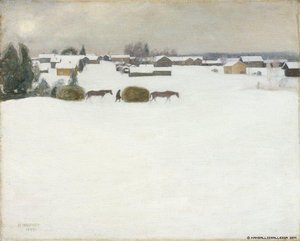 Load of Hay1899 · Suomen Kansallisgalleria
32
 Maija Halonen1905
33
 A Day in March1911 · Hämeenlinna Art Museum
34
 Spring Frost1906 · Szépművészeti Múzeum
35
 Returning from Work1907 · Ostrobothnian Museum
36
 Day in March1910 · Finnish National Gallery
37
 CrucifixionFinnish National Gallery
38
 Sunlight Winter Landscape1911 · Finnish National Gallery
39
 Rowan Tree1908 · Finnish National Gallery
40
 Still Life1909 · Finnish National Gallery
41
 Sallow in Autumn1907 · Finnish National Gallery
42
 Winter landscape1908
43
 Woman in a Red Dress1911
44
 Autumn Landscape1914
45
 Juniper Tree in Snow1917 · Finnish National Gallery
46
 From the Garden1913 · Finnish National Gallery
47
 The Factory of Leppäkoski1917 · Serlachius Manor
48
 Harlu Works1917
49
 Winter landscape1922 · EMMA - Espoo Museum of Modern Art
50
 Cows in Väisälänmäki1918 · Kuopio Art Museum
51
 Winter Landscape1919 · Hermitage Museum
52
 Snow-decked Pine1919 · Finnish National Gallery
53
 Man Fishing1922 · Finnish National Gallery
54
 Two Boys on the Shore1922 · Finnish National Gallery
55
 Winter motif1920
56
 Pine Tree in Snow1928 · Lönnström Art Museum
57
 Winter Landscape1926 · Finnish National Gallery
58
 Woman in a Boat1924 · Finnish National Gallery
59
 Tree in Winter1923 · Finnish National Gallery
60
 First Snow1931
61
 Winter Landscape1931 · Finnish National Gallery
62
 Spring Landscape1929 · Finnish National Gallery
63
 Summer idyll1931
64
 Guitar Player
65
 Landscape
66
 The Short-Cut1892 · Finnish National Gallery
67
 The Violinist1900 · Finnish National Gallery
68
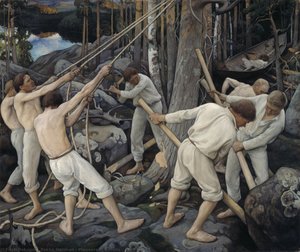 Pioneers in Karelia1900 · Ateneum Art Museum
69
 Washing on the Ice1900 · Ateneum Art Museum
70
 Haymakers1891
71
 Tomatoes1913 · Finnish National Gallery
72
 Väinämöinen playing1897
73
 Winter Landscape, Myllykylä1896 · Finnish National Gallery
74
 Winter Landscape, Kinahmi1923 · Finnish National Gallery
75
 Rowan1894
76
 Lissom Lassies at the Lakeside1895 · Serlachius Manor
77
 Winter Day1895
78
 Meal time1899 · Didrichsen Art Museum
79
 Rock Covered in Ice and Snow1911 · Finnish National Gallery
80
 Self-Portrait1906 · Finnish National Gallery
81
 Snow-Covered Pine Saplings1899 · Ateneum Art Museum
82
 Lynx Hunter1900 · Finnish National Gallery
83
 The Kantele Player1892 · Finnish National Gallery
The four subjects that come back most often in these originals, each with its finest example.
The 8 museums that hold the most of the paintings on this page.
| Museum | City | Works by Pekka Halonen | Paintings from this list |
|---|---|---|---|
 Finnish National Gallery |
Helsinki | 36 | Boy on the Shore, Nude Female Model, Self-Portrait |
 EMMA - Espoo Museum of Modern Art |
Espoo | 3 | Early Spring, Children reading, Winter landscape |
 Ateneum Art Museum |
Helsinki | 3 | Pioneers in Karelia, Washing on the Ice, Snow-Covered Pine Saplings |
 Suomen Kansallisgalleria |
Гельсінкі | 2 | Girl in a Scarf, Load of Hay |
 Serlachius Manor |
Mänttä-Vilppula | 2 | The Factory of Leppäkoski, Lissom Lassies at the Lakeside |
 Hungarian National Gallery |
Budapest | 1 | In the Stone-Quarry |
 Tampere Art Museum |
Tampere | 1 | Boat Tarrer II |
 Hämeenlinna Art Museum |
Hämeenlinna | 1 | A Day in March |
Pick a decade to see the original that defines it.


In the Sauna (1925). Väinämöinen in Tuonela (1890) and Boy on the Shore (1891) come next.
60 years old: In the Sauna dates from 1925, and Pekka Halonen was born in 1865.
In the Sauna, Väinämöinen in Tuonela, Boy on the Shore, Nude Female Model, Self-Portrait, Lumberjacks around a Campfire, Double-Portrait, Girl on the Beach, The Departure of Lemminkäinen from Saari and Fiddler. The ranking above gives each one's year and museum.
Our catalog holds 83 works by Pekka Halonen, dated from 1889 to 1931.
Mostly in Finnish National Gallery (Helsinki), EMMA - Espoo Museum of Modern Art (Espoo) and Ateneum Art Museum (Helsinki). The museum table above lists them all.
In 1890s: 22 of the 83 works on this page were made then, Väinämöinen in Tuonela among them.
On this page, the earliest is Girl in a Scarf (1889) and the latest First Snow (1931).
Winter landscape (2), Snowy scene (2) and Rural life (2), across the 83 works on this page.
Oil On Canvas, for 3 of the 83 works on this page.
Impressionism, judging by the originals on this page.
Boy on the Shore, Nude Female Model and Self-Portrait: the Finnish National Gallery, Helsinki holds 36 of the works on this page.
Yes, as a reproduction: the original stays in its museum, but any painting on this page can be painted by hand for you, made to order one at a time, from the painting's own page.
To step into a painting by Pekka Halonen is to enter a world where the silence of the Finnish forest speaks as loudly as any human voice. A cornerstone of the National Romantic era, Halonen possessed a rare ability to capture not just the physical geography of his homeland, but its very spirit. His work serves as a profound visual chronicle of a nation finding its identity at the turn of the twentieth century, blending a meticulous realist eye with the ethereal, light-drenched sensibilities of Impressionism. Through his brush, the rugged landscapes of Finland—from the biting frost of winter to the golden warmth of summer—became symbols of resilience and national pride.
The seeds of Halonen’s artistic devotion were sown in the fertile soil of Linnasalmi, Lapinlahti. Born on September 23rd, 1865, he was raised in an environment where art and nature were inextricably linked. His father, Olli Halonen, was a farmer whose hands were equally skilled in the craft of decorative painting for local churches. Growing up alongside his father’s seasonal commissions, young Pekka learned to observe the subtle shifts in light and the intricate textures of the natural world. This early exposure to craftsmanship instilled in him a lifelong reverence for the organic beauty of the Finnish landscape and the quiet dignity of the people who inhabited it.
While his roots were firmly planted in Finnish soil, Halonen’s artistic horizons expanded far beyond the borders of his birthplace. After honing his foundational skills at the Helsinki Art Society's Drawing School, he sought the vibrant intellectual currents of Europe. His arrival in Paris in 1890 marked a pivotal metamorphosis in his style. Enrolling at the Académie Julian and later studying under the legendary Paul Gauguin at the Académie Vitti, Halonen was thrust into the heart of the Post-Impressionist movement. It was here that he encountered groundbreaking theories on color and expressive brushwork that would forever alter his approach to the canvas.
The influence of French masters allowed Halonen to move beyond mere topographical accuracy. He began to experiment with how light could dissolve form and how a palette of muted, atmospheric tones could evoke deep emotional resonance. Yet, despite the cosmopolitan allure of Paris, his heart remained tethered to the North. He did not seek to replicate the sun-soaked scenes of France; instead, he utilized these modern techniques to illuminate the unique, pearlesical light of the Finnish winter and the soft, amber glows of its summer twilights. This synthesis of international technique and local subject matter became his greatest artistic triumph.
Halonen’s oeuvre is a tapestry of Finnish life, ranging from grand landscapes to intimate domestic scenes. His mastery is perhaps most evident in works such as Washing on the Ice, where the rhythmic endurance of human labor is set against a crystalline, frozen backdrop. In this and other pieces, he captures a sense of "quiet resilience," portraying the Finnish people not as subjects of struggle, but as integral components of a beautiful, unforgiving wilderness. His ability to find sanctity in the mundane—whether in the focused stillness of Children Reading or the communal strength depicted in Pioneers in Karelia—cemented his role as a painter of the national soul.
The historical significance of Pekka Halonen cannot be overstated. As Finland navigated its path toward independence, his paintings provided a visual language for a burgeoning sense of self. He did not merely paint scenery; he painted a heritage. His legacy lives on in the way we perceive the Finnish landscape today—as a place of profound peace, strength, and enduring beauty. Through his life's work, Halonen ensured that the fleeting light of the North would be captured forever, inviting generations to witness the quiet majesty of the Finnish spirit.