Portrait of Paul Sandby

The 79 Most Famous Paul Sandby Paintings, a Gallery Selection

Updated November 2026 · ranked by our popularity score (searches, visits and orders for each work) · 79 works by Paul Sandby in our catalogue

In short

Of all the originals Paul Sandby left, the most famous is Man standing in a landscape. Close behind it come Horse Fair on Bruntsfield Links, Edinburgh (1750) and London Cries: A Muffin Man (1759). Our catalog holds 79 works by Paul Sandby; the gallery has kept the 79 the world admires most, each shown with its date, its museum and its story.

1798 – 1863, Nottingham Romanticism Most works: Yale Center for British Art

Paul Sandby's top 10 paintings: the gallery's choice

1
Man standing in a landscape by Paul Sandby

Man standing in a landscape

Charcoal

Paul Sandby presents a quiet study in Man standing in a landscape. The work captures a gentleman in period clothing, frozen in a three-quarter pose. He looks toward the left, his figure occupying much of the vertical space against a simplified rural scene. The man remains the central focus, a solitary presence amidst the soft suggestions of buildings and structures on the horizon.

2
Horse Fair on Bruntsfield Links, Edinburgh (1750) by Paul Sandby

Horse Fair on Bruntsfield Links, Edinburgh

1750 · Watercolor · Scottish National Gallery, Edinburgh

Paul Sandby: The Father of Modern Landscape Painting Paul Sandby RA stands as a pivotal figure in the history of British landscape painting, recognized not merely for his artistic skill but for establishing a new aesthetic tradition that profoundly impacted subsequent generations. Born in Nottingham to Thomas Sandby, a textile worker, Paul’s early life was marked by self-education and an innate fascination with observation—qualities that would prove instrumental in shaping…

3
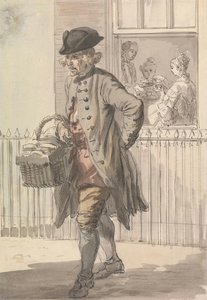
London Cries: A Muffin Man (1759) by Paul Sandby

London Cries: A Muffin Man

1759 · Drawing · Yale Center for British Art, New Haven

This evocative drawing, titled "London Cries: A Muffin Man," transports the modern viewer directly into the bustling, atmospheric heart of 18th-century London. The scene is rendered with a captivating immediacy that speaks volumes about daily commerce and human interaction. At the center moves the muffin man, his basket laden with tempting goods, embodying a moment of everyday ritual. His figure, complete with a distinctive hat and mustache, anchors the composition,…

4
Windsor Castle from the Great Park by Paul Sandby

Windsor Castle from the Great Park

Watercolor

This watercolor on paper, titled Windsor Castle from the Great Park, offers a quiet glimpse into the English landscape through the eyes of Paul Sandby. The work captures the castle as it sits within its surrounding parkland, viewed through a screen of foreground foliage. It is a piece that reflects the artist's deep connection to the terrain, specifically the areas around Windsor where he spent significant time sketching and observing…

5
Miss Marsden - back view by Paul Sandby

Miss Marsden - back view

Chalk

Miss Marsden - back view by Paul Sandby presents a focused portrait study of a woman viewed from behind. The subject is captured in period attire, emphasizing the silhouette and structural details of 19th-century fashion. Her clothing consists of a fitted bodice and a long skirt finished with a ruffled hem.

6
The Laterna Magica (1760) by Paul Sandby

The Laterna Magica

1760 · Watercolor · British Museum, London

Paul Sandby’s “The Laterna Magica,” painted in 1760, isn't merely a depiction of a room; it’s a meticulously crafted illusion, a vibrant snapshot of a world fascinated by the burgeoning technology of optical projection. More than just a charming scene of gentlemen observing a theatrical display, this watercolor offers a profound glimpse into the intellectual and social currents of 18th-century England – a period grappling with scientific advancement, artistic convention,…

7
London Cries: A Man with a Bottle (1759) by Paul Sandby

London Cries: A Man with a Bottle

1759 · Acrylic On Canvas · Yale Center for British Art, New Haven

Paul Sandby's "London Cries: A Man with a Bottle," painted in 1759, isn’t merely a depiction of a street scene; it’s a vibrant, almost theatrical window into the bustling heart of eighteenth-century London. This watercolor, now meticulously reproduced as a hand-painted artwork by WahooArt, captures a moment of everyday commerce and perhaps, a touch of wry observation, offering a glimpse into the lives of ordinary people within the grand tapestry…

8
The Meteor of August 18, 1783, as seen from the East Angle of the North Terrace, Windsor Castle (1783) by Paul Sandby

The Meteor of August 18, 1783, as seen from the East Angle of the North Terrace, Windsor Castle

1783 · Watercolor · Yale Center for British Art, New Haven

Paul Sandby's watercolor, “The Meteor of August 18, 1783,” isn’t merely a depiction of a fleeting astronomical event; it’s a window into the collective wonder and scientific curiosity of late 18th-century England. Painted from the East Angle of the North Terrace at Windsor Castle, the scene captures a pivotal moment – the transit of a meteor across the night sky – as observed by a small group of onlookers. The…

The Paul Sandby selection continues, 11 to 79

11Study of a coachman by Paul SandbyStudy of a coachmanNational Portrait Gallery of Sweden 12Thomas Sandby and His Family by Paul SandbyThomas Sandby and His Family 13A Group of Four Children, with Dogs by Paul SandbyA Group of Four Children, with Dogs 14The Bayswater Road, Paddington by Paul SandbyThe Bayswater Road, Paddington 15Sketch of an elegant lady by Paul SandbySketch of an elegant lady 16Two Coaches with Passengers by Paul SandbyTwo Coaches with Passengers 17View of the Powder Magazine in Hyde Park by Paul SandbyView of the Powder Magazine in Hyde Park 18A riverside landscape by Paul SandbyA riverside landscape 19Back of the Public House near Bayswater by Paul SandbyBack of the Public House near Bayswater 20Windsor Park by Paul SandbyWindsor Park 21A Sleeping Woman; Study of a Head by Paul SandbyA Sleeping Woman; Study of a Head 22Travelers Entering a Town by Paul SandbyTravelers Entering a Town 23Ross Castle, Killarney, with villagers on a ferryboat by Paul SandbyRoss Castle, Killarney, with villagers on a ferryboat 24Windsor Great Park by Paul SandbyWindsor Great Park 25St. George's Gate, Canterbury by Paul SandbySt. George's Gate, Canterbury 26Rochester, Kent by Paul SandbyRochester, Kent 27Views of Windsor Castle by Paul SandbyViews of Windsor Castle 28The Iron Forge between Dolgelli and Barmouth 1 by Paul SandbyThe Iron Forge between Dolgelli and Barmouth 1 29The Light Steps, Hastings by Paul SandbyThe Light Steps, Hastings 30An Italianate landscape with women washing clothes by Paul SandbyAn Italianate landscape with women washing clothes 31The Cemetery Gate of St Augustine's Monastery Canterbury by Paul SandbyThe Cemetery Gate of St Augustine's Monastery Canterbury 32The Encampment in St James's Park by Paul SandbyThe Encampment in St James's Park 33A Boy Crawling on the Floor by Paul SandbyA Boy Crawling on the Floor 34A mother and child seated in a garden by Paul SandbyA mother and child seated in a garden 35A wooded river landscape with figures and cattle, a castle beyond by Paul SandbyA wooded river landscape with figures and cattle, a castle beyond 36The North Terrace of Windsor Castle looking west by Paul SandbyThe North Terrace of Windsor Castle looking west 37Naval post with three soldiers by Paul SandbyNaval post with three soldiers 38Part of the Banqueting Hall of the Royal Palace at Eltham by Paul SandbyPart of the Banqueting Hall of the Royal Palace at Eltham 39Man driving a donkey, and man leading a cart by Paul SandbyMan driving a donkey, and man leading a cart 40Woolwich from the Conduit Hill, the Thames estuary beyond by Paul SandbyWoolwich from the Conduit Hill, the Thames estuary beyond 41Young lady writing at a table by Paul SandbyYoung lady writing at a table 42A rural landscape by Paul SandbyA rural landscape 43A cottage by a river with figures in the foreground by Paul SandbyA cottage by a river with figures in the foreground 44The garden front of Old Somerset House, London by Paul SandbyThe garden front of Old Somerset House, London 45Henry VIII Gateway, Windsor Castle by Paul SandbyHenry VIII Gateway, Windsor Castle 46Young boy on a see-saw by Paul SandbyYoung boy on a see-saw 47Children on a see-saw by Paul SandbyChildren on a see-saw 48Young man, seated, holding a riding crop by Paul SandbyYoung man, seated, holding a riding crop 49Two of the artist's children with their nurse, seated in a garden by Paul SandbyTwo of the artist's children with their nurse, seated in a garden 50The Iron Forge between Dolgelli and Barmouth by Paul SandbyThe Iron Forge between Dolgelli and Barmouth 51View from a London terrace by Paul SandbyView from a London terrace 52Windsor Castle: The Round Tower, Royal Court and Devil (1767) by Paul SandbyWindsor Castle: The Round Tower, Royal Court and Devil1767 · National Gallery of Victoria 53Buildwas by Paul SandbyBuildwas 54View down a valley towards distant buildings, trees in the foreground by Paul SandbyView down a valley towards distant buildings, trees in the foreground 55Derwent Waster by Paul SandbyDerwent Waster 56Edinburgh Castle by Paul SandbyEdinburgh Castle 57View of Tonbridge by Paul SandbyView of Tonbridge 58View of Rackett Lodge, Wandsworth, London by Paul SandbyView of Rackett Lodge, Wandsworth, London 59Study of a donkey by Paul SandbyStudy of a donkey 60Old Windsor Green by Paul SandbyOld Windsor Green 61Middleham Castle, Yorkshire by Paul SandbyMiddleham Castle, Yorkshire 62An extensive river landscape with travellers by Paul SandbyAn extensive river landscape with travellers 63A horse and cart leaving a harbour by Paul SandbyA horse and cart leaving a harbour 64Woolwich from the Conduit Hill, the Thames beyond by Paul SandbyWoolwich from the Conduit Hill, the Thames beyond 65Cows in a Park by Paul SandbyCows in a Park 66Study of a Tree by Paul SandbyStudy of a Tree 67Trees and house seen from a meadow - Bishopgate by Paul SandbyTrees and house seen from a meadow - Bishopgate 68A shepherd driving his flock before a Scottish castle by Paul SandbyA shepherd driving his flock before a Scottish castle 69South East View of Windsor Castle From the Park by Paul SandbySouth East View of Windsor Castle From the Park 70A horse by Paul SandbyA horse 71An old grey horse tethered to a tree, a boy resting nearby by Paul SandbyAn old grey horse tethered to a tree, a boy resting nearby 72Foresters In Windsor Great Park by Paul SandbyForesters In Windsor Great Park 73View Of Windsor Castle And Part Of The Town From The Spital Hill by Paul SandbyView Of Windsor Castle And Part Of The Town From The Spital Hill 74An extensive wooded river landscape with an amorous couple making music under a tree by Paul SandbyAn extensive wooded river landscape with an amorous couple making music under a tree 75Sanby paul the spread eagle tavern millbank by Paul SandbySanby paul the spread eagle tavern millbank 76Llangollen, Denbighshire by Paul SandbyLlangollen, Denbighshire 77Part of the Old Bridge at Shrewsbury with two arches of the new one by Paul SandbyPart of the Old Bridge at Shrewsbury with two arches of the new one 78Cow­Girl in the Windsor Great Park by Paul SandbyCow­Girl in the Windsor Great Park 79A Man and a Saddled Horse by Paul SandbyA Man and a Saddled HorseYale Center for British Art

The subjects that held Paul Sandby's eye

The four subjects that come back most often in these originals, each with its finest example.

The museums that keep Paul Sandby's originals

The 5 museums that hold the most of the paintings on this page.

Museum City Works by Paul Sandby Paintings from this list
Yale Center for British Art, New HavenYale Center for British Art New Haven 4 London Cries: A Muffin Man, London Cries: A Man with a Bottle, The Meteor of August 18, 1783, as seen from the East Angle of the North Terrace, Windsor Castle
Scottish National Gallery, EdinburghScottish National Gallery Edinburgh 1 Horse Fair on Bruntsfield Links, Edinburgh
British Museum, LondonBritish Museum London 1 The Laterna Magica
National Portrait Gallery of Sweden, SträngnäsNational Portrait Gallery of Sweden Strängnäs 1 Study of a coachman
National Gallery of Victoria, MelbourneNational Gallery of Victoria Melbourne 1 Windsor Castle: The Round Tower, Royal Court and Devil

Collectors' questions about Paul Sandby's paintings

Which work is Paul Sandby most famous for?Reveal the answer

Man standing in a landscape. Horse Fair on Bruntsfield Links, Edinburgh (1750) and London Cries: A Muffin Man (1759) come next.

What are the ten most famous Paul Sandby paintings?Reveal the answer

Man standing in a landscape, Horse Fair on Bruntsfield Links, Edinburgh, London Cries: A Muffin Man, Windsor Castle from the Great Park, Miss Marsden - back view, The Laterna Magica, London Cries: A Man with a Bottle, The Meteor of August 18, 1783, as seen from the East Angle of the North Terrace, Windsor Castle, Boy with a whip and Study of a woman pointing. The ranking above gives each one's year and museum.

How many paintings did Paul Sandby leave?Reveal the answer

Our catalog holds 79 works by Paul Sandby.

In which museums do Paul Sandby's masterpieces hang?Reveal the answer

Mostly in Yale Center for British Art (New Haven), Scottish National Gallery (Edinburgh) and British Museum (London). The museum table above lists them all.

Which subjects did Paul Sandby choose most often?Reveal the answer

Buildings (16), Landscape (10) and Gardens and parks (10), across the 79 works on this page.

Which technique did Paul Sandby use most?Reveal the answer

Watercolor, for 4 of the 79 works on this page.

To which art movement does Paul Sandby belong?Reveal the answer

Romanticism and Neoclassicism, judging by the originals on this page.

Which Paul Sandby works hang at the Yale Center for British Art?Reveal the answer

London Cries: A Muffin Man, London Cries: A Man with a Bottle and The Meteor of August 18, 1783, as seen from the East Angle of the North Terrace, Windsor Castle: the Yale Center for British Art, New Haven holds 4 of the works on this page.

Paul Sandby: life and work

The Father of Modern Landscape Painting

Paul Sandby stands as a pivotal figure in the history of British landscape painting, recognized not merely for his artistic skill but for establishing a new aesthetic tradition that profoundly impacted subsequent generations. Born in Nottingham to Thomas Sandby, a textile worker, Paul’s early life was marked by self-education and an innate fascination with observation—qualities that would prove instrumental in shaping his extraordinary career as both a mapmaker and painter. Unlike many artists of his time who pursued formal training, Sandby honed his craft independently, immersing himself in the natural world and meticulously documenting its beauty through watercolor.

His formative years instilled within him a deep appreciation for detail and accuracy, skills that would later translate seamlessly into his cartographic endeavors. His brother Thomas, also a draughtsman, fostered this artistic inclination, encouraging experimentation and fostering a collaborative spirit. Together, they established an academy in Nottingham, attracting aspiring artists eager to learn from their expertise. Their distinctive style—characterized by luminous washes of color and a masterful depiction of atmospheric perspective—became instantly recognizable and profoundly influential across the British Isles.

Topography and the Spirit of the Land

Sandby’s professional journey was uniquely shaped by his involvement with the military drawing department at the Tower of London. This role propelled him into a position that would expose him to the grandeur of Scotland during the Jacobite Rebellion. Tasked with creating topographical maps and sketches of Highland landscapes, he became a visual recorder of history, transforming from a mere illustrator into one of the foremost landscape artists of his era. This period of service allowed him to blend the precision of a cartographer with the soul of an artist, capturing the rugged majesty of the Scottish terrain with unprecedented clarity.

His body of work reflects a remarkable versatility, ranging from sweeping vistas to intimate urban snapshots. In his celebrated series London Cries, such as the poignant depiction of A Man with a Bottle, Sandby captured the rhythmic pulse of street life in the 18th century. He possessed a rare ability to find beauty in the mundane, documenting the characters and commerce of London with a charming realism that remains captivating to modern eyes. Whether he was painting the tranquil river scenes of Llangollen or the bustling energy of the Horse Fair on Bruntsfield Links, his work always maintained a sense of topographical truth paired with poetic light.

Legacy and Artistic Innovation

As a founding member of the Royal Academy, Sandby played a crucial role in elevating the status of watercolor painting. Before his influence, watercolor was often relegated to preparatory sketches or mere instructional tools; however, through his mastery of the medium, he helped establish it as a respected fine art form capable of profound expression. His use of aquatint engraving further allowed his detailed views to reach a wider audience, spreading the beauty of the British landscape throughout Europe.

The historical significance of Paul Sandby lies in his ability to bridge the gap between scientific documentation and romantic expression. His legacy is found in:

  • The development of the English watercolor tradition: Establishing the technical foundations for future masters of the medium.
  • Topographical excellence: Merging the accuracy of mapmaking with the emotive power of landscape art.
  • Cultural documentation: Preserving the social fabric of 18th-century Britain through his detailed urban and rural observations.

Through his tireless dedication to observing the world, Sandby did more than just paint landscapes; he taught a nation how to see its own beauty.