


1


Updated October 2026 · ranked by our popularity score (searches, visits and orders for each work) · 61 works by Graham Sutherland in our catalogue
In short
Welsh Landscape with Roads (1936) is the Graham Sutherland painting that draws the most eyes. After it, the eye goes to Large Vine Pergola No.2 (1948) and Flying Bomb Depot (verso) (1945). Among the 61 works of Graham Sutherland in our catalog, these 61 are the most famous, each a unique original presented with its year, its museum and the reason it endures.

To stand before Graham Vivian Sutherland's "Large Vine Pergola No.2" is to step into a vibrant, emotionally charged landscape rendered entirely through pigment and gesture. This piece is not merely a depiction; it is an experience—a confluence of organic energy captured at the height of modern artistic expression. The eye is immediately drawn into the heart of the composition, where bold white forms suggest the graceful, almost architectural sweep of…

Graham Vivian Sutherland's “Flying Bomb Depot (verso),” painted in 1945, isn’t merely a depiction of wartime devastation; it’s a profoundly unsettling meditation on the intersection of nature, destruction, and human vulnerability. Created during a period when Britain was grappling with the realities of aerial bombardment and the looming shadow of defeat, this work transcends its immediate subject matter to become a poignant symbol of a world irrevocably altered. The painting…


Graham Vivian Sutherland’s 1941 painting, “Tree Form,” isn’t merely a depiction of a tree; it’s an immersion in primal emotion and a profound exploration of the natural world filtered through the lens of Surrealism. This arresting work, housed within a relatively modest 39 x 31 cm canvas, immediately commands attention with its unsettling yet captivating composition – a colossal, textured creature emerging from a void of deep indigo. It’s a…
 Palm and Wall1948 · The Phillips Collection
12
 Flying Bomb Depot (recto)1945 · Bristol Museum - Art Gallery
13
 Pink Vine Pergola1947 · British Council Collection
14
 The Marshalling Yard at Trappes, France Damage Done by RAF1944 · Leeds Art Gallery
15
 Portuguese-British alliance1957 · Museu do Caramulo
16
 Thorn Tree1946 · British Council Collection
17
 Landscape Undulations with Undergrowth1942 · Metropolitan Museum of Art
18
 Narrow Road between Hedges1939 · New Walk Museum - Art Gallery
19
 The Deposition1947 · Oxford Brookes University
20
 Landscape in the South of France1950 · Pallant House Gallery
21
 Cuthbert Aikman Simpson (1892–1969)
22
 Path through Woods
23
 Welsh Landscape with Roads1936
24
 Estuary with Rocks1938
25
 Miner Probing a Drill Hole1942
26
 Devastation, House in Wales1940
27
 Study for Illustration for 'Poems, 1937–1942' by David Gascoyne1942
28
 Black Landscape1939
29
 Western Hills1941
30
 Entrance to a Lane1939
31
 Fallen Tree against Sunset1940 · Darlington Library
32
 Foundry, Ladle Feeding Furnace1941
33
 Green Tree Form Interior of Woods1940
34
 Tapping a Blast Furnace1941
35
 Devastation, 1941, City, Panorama of Ruin1941
36
 Gorse on a Sea Wall1939
37
 Red Landscape1942
38
 Feeding a Steel Furnace1941
39
 Crucifixion1946
40
 Little Mountain in Wales1944
41
 Bird in Landscape1944
42
 Horned Forms1944
43
 Landscape with Rocks1945
44
 The Laughing Woman (study)1946 · New Walk Museum - Art Gallery
45
 Crucifixion1947 · Pallant House Gallery
46
 Green Lane1945
47
 Cornfield and Stone1944 · Government Art Collection
48
 Head1951 · National Gallery of Canada
49
 Landscape, near Nice1949
50
 Origins of the Land No.11951 · Government Art Collection
51
 Track Junction in the South of France1950 · Pallant House Gallery
52
 Thorn Head1949
53
 Christ Seated (Christ in Glory)1956 · Herbert Art Gallery - Museum
54
 Dark Entrance1959 · The Phillips Collection
55
 Green Tree Form1940 · British Council Collection
56
 Edward Langton Iliffe, 2nd Baron Iliffe of Yattendon (1908-1996)1976 · Basildon Park
57
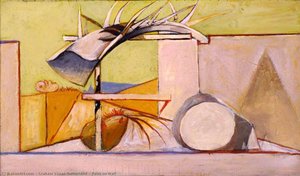 Palm on Wall1948 · British Council Collection
58
 EstuaryAbbot Hall Art Gallery
59
 Welsh mountainsArt Gallery of New South Wales
60
 Fragment of Landscape
61
 Study of a Hand
The four subjects that come back most often in these originals, each with its finest example.
The 8 museums that hold the most of the paintings on this page.
| Museum | City | Works by Graham Sutherland | Paintings from this list |
|---|---|---|---|
 British Council Collection |
London | 5 | Large Vine Pergola No.2, Pink Vine Pergola, Thorn Tree |
 Pallant House Gallery |
Chichester | 3 | Landscape in the South of France, Crucifixion, Track Junction in the South of France |
 Bristol Museum - Art Gallery |
Bristol | 2 | Flying Bomb Depot (verso), Flying Bomb Depot (recto) |
 National Gallery of Canada |
Ottawa | 2 | Large Vine Pergola, Head |
 Leeds Art Gallery |
Leeds | 2 | Tree Form, The Marshalling Yard at Trappes, France Damage Done by RAF |
 The Phillips Collection |
Washington, D.C. | 2 | Palm and Wall, Dark Entrance |
 New Walk Museum - Art Gallery |
Leicester | 2 | Narrow Road between Hedges, The Laughing Woman (study) |
 Government Art Collection |
London | 2 | Cornfield and Stone, Origins of the Land No.1 |
Pick a decade to see the original that defines it.
To stand before Graham Vivian Sutherland's "Large Vine Pergola No.2" is to step into a vibrant, emotionally charged landscape rendered entirely through pigment and gesture. This piece is not merely a depiction; it is an experience—a confluence of organic energy captured at the height of modern artistic expression. The eye is immediately drawn into the heart of the composition, where bold white forms suggest the graceful, almost architectural sweep of…

Welsh Landscape with Roads (1936). Large Vine Pergola No.2 (1948) and Flying Bomb Depot (verso) (1945) come next.
33 years old: Welsh Landscape with Roads dates from 1936, and Graham Sutherland was born in 1903.
Welsh Landscape with Roads, Large Vine Pergola No.2, Flying Bomb Depot (verso), Press for Making Shells, Large Vine Pergola, Flying Bomb Depot The Caverns, Saint Leu d'Esserent, 14 January 1945, Somerset Maugham, Edward Sackville-West, 5th Lord Sackville (1901-1965), Helena Rubinstein in a red brocade Balenciaga gown and Tree Form. The ranking above gives each one's year and museum.
Our catalog holds 61 works by Graham Sutherland, dated from 1936 to 1976.
Mostly in British Council Collection (London), Pallant House Gallery (Chichester) and Bristol Museum - Art Gallery (Bristol). The museum table above lists them all.
In 1940s: 38 of the 61 works on this page were made then, Large Vine Pergola No.2 among them.
On this page, the earliest is Welsh Landscape with Roads (1936) and the latest Edward Langton Iliffe, 2nd Baron Iliffe of Yattendon (1908-1996) (1976).
Landscape (7), British art (5) and Pembrokeshire (3), across the 61 works on this page.
Oil On Canvas, for 5 of the 61 works on this page.
Surrealism, judging by the originals on this page.
Large Vine Pergola No.2, Pink Vine Pergola and Thorn Tree: the British Council Collection, London holds 5 of the works on this page.
Graham Vivian Sutherland, a titan of British Modernism, possessed the rare ability to transform the familiar contours of the natural world into something profoundly unsettling and deeply spiritual. Born in Streatham, London, in 1903, Sutherland’s journey was one of constant metamorphosis. While his early years were shaped by a classical education at Epsom College, his true calling emerged far from the legal circles of his family. His initial foray into the technical world of an apprenticeship at the Midland Railway Locomotive Works provided a foundation of precision that would later manifest in his intricate printmaking and textured oil paintings. As he transitioned to Goldsmiths' School of Art, Sutherland began to move away from traditional representation, finding himself drawn to the evocative power of engraving and etching.
The artist’s early aesthetic was deeply rooted in the romanticism of Samuel Palmer, yet he refused to remain anchored to the past. Instead, Sutherland acted as a bridge between the English pastoral tradition and the radical energy of European avant-garde movements. By absorbing the dreamlike logic of Surrealism and the raw emotionality of Expressionism, he developed a visual language that could capture both the physical landscape and the psychological state. His early prints, characterized by a sense of mystery and organic form, laid the groundwork for a career defined by an obsession with the "strangeness" of nature—a theme that would become his most enduring legacy.
The 1940s marked a pivotal era in Sutherland's development, as his focus shifted from the delicate medium of printmaking to the visceral, impasto textures of oil painting. It was during this period that the rugged, windswept landscapes of Pembrokeshire became his primary muse. In works such as Thorn Tree, one can witness the artist’s mastery in blending botanical reality with surrealist distortion. He did not merely paint trees; he painted the tension, the struggle, and the skeletal architecture of life itself. This period saw him move toward a more abstract, yet deeply symbolic, way of seeing, where thorns, roots, and twisted branches served as metaphors for human vulnerability and resilience.
The Second World War brought a different, more somber dimension to his work. Serving as an official war artist, Sutherland turned his gaze toward the industrial and often haunting scenes of the British home front. His paintings from this era, such as Flying Bomb Depot The Caverns, are masterclasses in atmosphere. Through heavy textures and a palette that evokes both decay and dread, he captured the eerie desolation of wartime interiors. These works were not merely documentation; they were psychological portraits of an era marked by anxiety and the looming presence of destruction, reflecting the fractured reality of a world at war.
In the post-war years, Sutherland’s work ascended to new heights of spiritual and public significance. He began to integrate religious symbolism with his organic motifs, creating a powerful synthesis of the sacred and the natural. This culminated in one of his most monumental achievements: the design of the massive central tapestry for the new Coventry Cathedral, titled Christ in Glory in the Tetramorph. This work, which utilized his ability to manipulate form and color on a grand scale, stands as a testament to his role in the cultural reconstruction of post-war Britain.
Throughout his prolific career, Sutherland’s versatility allowed him to leave an indelible mark across multiple disciplines:
Ultimately, Graham Sutherland remains a cornerstone of 20th-century art because he dared to look beneath the surface of the landscape. He found the surreal within the real and the divine within the organic. His legacy is not just found in museums, but in the way we perceive the hidden, often jagged, beauty of the world around us—a world where every thorn holds a story and every shadow contains a mystery.


