

1


Updated October 2026 · ranked by our popularity score (searches, visits and orders for each work) · 19 works by Erró in our catalogue
In short
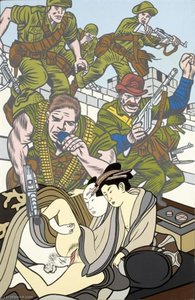
Of all the originals Erró left, the most famous is Marylin monroe. Close behind it come The final selection and The battle of saporro. Our catalog holds 19 works by Erró; the gallery has kept the 19 the world admires most, each shown with its date, its museum and its story.


The museum that holds the most of the paintings on this page.
| Museum | City | Works by Erró | Paintings from this list |
|---|---|---|---|
 Städel Museum |
Frankfurt | 1 | Deux-Magots |
1958 is the year of every dated Erró work in this selection: here they are, ranked by fame.
Pick a year to see its originals.
Marylin monroe. The final selection and The battle of saporro come next.
Marylin monroe, The final selection, The battle of saporro, Baby rockefeller, Deux-Magots, A moi, Life gauguin, Pack of fun, Le journaliste and Pop queen. The ranking above gives each one's year and museum.
Our catalog holds 19 works by Erró.
Mostly in Städel Museum (Frankfurt). The museum table above lists them all.
Pop art, judging by the originals on this page.
Born Gudmundur Gudmundsson in the quiet coastal town of Olafsvik, Iceland, in 1932, the artist known as erro stands as a singular and transformative figure within the landscape of modern art. His journey from the rugged landscapes of his homeland to the vibrant, avant-garde heart of Paris allowed him to forge a visual language that is as much about the subconscious as it is about the socio-political textures of the twentieth century. Erró’s work does not merely depict reality; it deconstructs and reassembles it, creating dreamlike realms where the boundaries between nature, technology, and human myth dissolve into a dense, evocative tapestry.
The foundations of his aesthetic were laid through an early fascination with the radical movements of the early twentieth century. Drawing profound inspiration from Dada and Surrealism—specifically the provocative philosophies of André Breton and Max Ernst—erró embraced the power of the unexpected. He viewed the canvas as a space for exploring the depths of the human psyche, utilizing abstraction to confront societal anxieties and reject the constraints of literal representation. This early intellectual formation instilled in him a lifelong commitment to using symbolism as a tool to challenge conventional perceptions of truth and reality.
As his career progressed, erró developed a highly distinctive technique characterized by the meticulous layering of imagery. He became a master of the collage, a medium that allowed him to synthesize disparate elements of popular culture, history, and nature into cohesive, often jarring, compositions. His work frequently features a striking juxtaposition of themes: the mechanical precision of airplane imagery set against the organic, whimsical presence of stylized frogs inhabiting primordial swamps. This tension between the industrial and the biological serves as a recurring motif, reflecting on the complexities of modern life and the encroachment of technology upon the natural world.
His artistic evolution was further shaped by his time in Paris during the late 1950s and early 1960s. As a participant in the "new figuration" movement, erró utilized a visual vocabulary drawn from everyday life, political events, and even the language of comic strips. This period saw him experimenting with the power of image-making itself, seeking to reveal the manipulative nature of media-constructed clichés. Through his use of collage, he could strip away the myths of consumer society, exposing the underlying structures of power and the manufactured nature of modern identity.
The significance of erró’s contribution to contemporary art is cemented by his presence in some of the world's most prestigious institutions. His inclusion in landmark exhibitions, such as the Tate Modern’s “World Goes Pop,” highlighted his role as a vital voice in an era of globalized visual culture. His ability to bridge the gap between the personal subconscious and the collective political experience has allowed his work to resonate far beyond the borders of Iceland or France.
Today, the works of erró continue to provoke deep contemplation. Whether through the dense, travel-inspired textures of “Collage for Planscape” or the vibrant, emotional abundance found in “Baby Rockefeller,” his art remains a testament to the transformative power of the imagination. He leaves behind a legacy that challenges us to look beneath the surface of the everyday, finding the surreal, the political, and the profound hidden within the layers of our shared reality.


