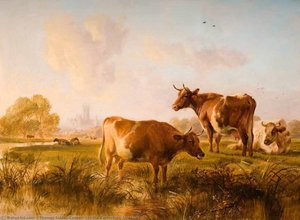
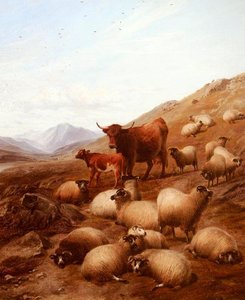
Portrait of Thomas Sidney Cooper

The 99 Most Famous Thomas Sidney Cooper Paintings, a Gallery Selection

Updated November 2026 · ranked by our popularity score (searches, visits and orders for each work) · 103 works by Thomas Sidney Cooper in our catalogue

In short

Of all the originals Thomas Sidney Cooper left, the most famous is An Evening Drink (1897), in the collection of the Bolton Museum And Art Gallery, Bolton. Close behind it come An Evening Scene (1852) and Fording a brook, suburbs of Canterbury (1834). Our catalog holds 103 works by Thomas Sidney Cooper; the gallery has kept the 99 the world admires most, each shown with its date, its museum and its story.

1803 – 1902, Canterbury Romanticism Most works: Sheffield City Art Galleries

Thomas Sidney Cooper's top 10 paintings: the gallery's choice

1
An Evening Drink (1897) by Thomas Sidney Cooper

An Evening Drink

1897 · Oil · Bolton Museum And Art Gallery, Bolton

The quietude of the pastoral world finds a steady presence in An Evening Drink. Painted by Thomas Sidney Cooper, this work captures a fleeting moment of rest within the natural landscape. The scene unfolds with a sense of stillness, as if the day is exhaling its final warmth. It is a piece that invites a slow gaze, drawing the viewer into a tranquil setting where the rhythm of life follows…

2
An Evening Scene (1852) by Thomas Sidney Cooper

An Evening Scene

1852 · Oil On Canvas · Wallace Collection, London

The sun hangs low, casting a heavy, amber glow over a quiet corner of the English countryside. Beneath the twisted, skeletal limbs of a gnarled tree, three cattle rest in the tall grass. Their bodies catch the fading light, creating bright, sharp edges against the deepening shadows of the landscape. The air feels thick and warm, saturated with the colors of ochre and sepia. It is a moment of stillness,…

3
Fording a brook, suburbs of Canterbury (1834) by Thomas Sidney Cooper

Fording a brook, suburbs of Canterbury

1834 · Oil On Canvas · Art Gallery of South Australia, Adelaide

Fording a brook, suburbs of Canterbury is a work by Thomas Sidney Cooper, executed in 1834. This piece reflects the early period of an artist who would eventually become a celebrated figure within the Royal Academy. The painting captures a quiet moment in the landscape, rooted in the specific geography of the artist's origins.

4
The Home Farm (1844) by Thomas Sidney Cooper

The Home Farm

1844 · Oil On Canvas · The Beaney, Canterbury

In "The Home Farm" by Thomas Sidney Cooper, a quiet moment in the English countryside unfolds under a soft, diffused light. Created about 1844, the scene brings together a gathering of farm animals seeking shelter beneath a heavy, thatched roof. The air feels still, as if an overcast sky has paused the movement of the day. Sheep cluster in the foreground, their thick, white wool catching the gentle light, while…

5
Sheep In The Isle of Skye (1877) by Thomas Sidney Cooper

Sheep In The Isle of Skye

1877 · Oil On Canvas

In Sheep In The Isle of Skye, Thomas Sidney Cooper directs our attention toward a large group of sheep that occupies the foreground and midground. These animals rest upon a rugged, rocky outcrop, their presence grounding the composition against the wilder elements of the landscape. The perspective is a low-angle view, looking upward toward the cliffside, which emphasizes the scale of the terrain. This viewpoint creates a sense of height,…

6
An Evening Repose (1877) by Thomas Sidney Cooper

An Evening Repose

1877 · Oil On Canvas

In An Evening Repose by Thomas Sidney Cooper, a tranquil pastoral scene unfolds at the quiet hour of dusk. The air feels heavy with the stillness of the fading day as a herd of cattle and sheep graze peacefully across a wide field. These animals move through the grass with a slow, rhythmic grace, their presence grounding the landscape in a moment of profound rest. It is a quintessential depiction…

7
Cattle and Sheep in a Landscape by Thomas Sidney Cooper

Cattle and Sheep in a Landscape

Oil On Canvas

In the quietude of 1888, Thomas Sidney Cooper captures a moment of rural stillness in his work, Cattle and Sheep in a Landscape. This English landscape painter brings a sense of life to the pastoral scene, focusing his attention on the steady, rhythmic existence of livestock. The animals occupy the heart of the view, existing in a space where the air feels heavy with the scent of damp earth and…

8
The Lord Of The Pastures by Thomas Sidney Cooper

The Lord Of The Pastures

Oil

The quietude of the English countryside finds its voice in The Lord Of The Pastures, a work by the artist Thomas Sidney Cooper. Within this scene, the pastoral life of the nineteenth century remains suspended in a moment of stillness. Thomas Sidney Cooper, who lived from 1803 to 1902, brings a specific, grounded presence to the meadow through his depiction of the animals that inhabit it.

9
Sheep in a Pasture by Thomas Sidney Cooper

Sheep in a Pasture

Oil On Canvas

In the quietude of a rolling landscape, Sheep in a Pasture brings a moment of rural stillness to life. This oil painting by Thomas Sidney Cooper captures a flock of sheep resting upon a grassy hill, their forms nestled under a dramatic, cloudy sky. The scene unfolds with a sense of peace, as the animals cluster in the foreground and middle ground, leading the eye toward a distant, soft horizon.…

The Thomas Sidney Cooper selection continues, 11 to 99

11Cattle by a river (1835) by Thomas Sidney CooperCattle by a river1835 · Fitzwilliam Museum 12The Entrance to Carisbrooke Castle (1837) by Thomas Sidney CooperThe Entrance to Carisbrooke Castle1837 · Royal Collection 13Cattle in a Stream (1841) by Thomas Sidney CooperCattle in a Stream1841 · Birmingham Museum and Art Gallery 14Cattle reposing (1846) (1846) by Thomas Sidney CooperCattle reposing (1846)1846 · Fitzwilliam Museum 15The Victoria Cow (1848) by Thomas Sidney CooperThe Victoria Cow1848 · Royal Collection 16The Halt on the Hills (1847) by Thomas Sidney CooperThe Halt on the Hills1847 · Sheffield City Art Galleries 17Goats and Kids in a Shed (1846) by Thomas Sidney CooperGoats and Kids in a Shed1846 · Nottingham City Museums And Galleries 18Mountain Sheep (1845) by Thomas Sidney CooperMountain Sheep1845 19Mountain Sheep (also known as Morning Mist Clearing Off) (1846) by Thomas Sidney CooperMountain Sheep (also known as Morning Mist Clearing Off)1846 · Nottingham Castle Museum And Art Gallery 20In the Meadows of Fordwich (1840) by Thomas Sidney CooperIn the Meadows of Fordwich1840 21Cattle (1850) by Thomas Sidney CooperCattle1850 · Reading Public Museum 22Landscape with Cows and Sheep (1850) by Thomas Sidney CooperLandscape with Cows and Sheep1850 23The Evening Drink in the Canterbury Meadows (1851) by Thomas Sidney CooperThe Evening Drink in the Canterbury Meadows1851 · Russell 24In the Whitehall Meadows, Canterbury, Kent (1854) by Thomas Sidney CooperIn the Whitehall Meadows, Canterbury, Kent1854 · Sheffield City Art Galleries 25Mountain Sheep (1862) by Thomas Sidney CooperMountain Sheep1862 · Touchstones Rochdale Arts And Heritage Centre 26In the Canterbury Meadows (1863) by Thomas Sidney CooperIn the Canterbury Meadows1863 · Wolverhampton Art Gallery 27Heat Showers in August (1857) by Thomas Sidney CooperHeat Showers in August1857 · Manchester Art Gallery 28Midday Repose (1866) by Thomas Sidney CooperMidday Repose1866 · Laing Art Gallery 29Milking Time in the Meadows (1869) by Thomas Sidney CooperMilking Time in the Meadows1869 30Morning, Canterbury Meadows, Kent (1869) by Thomas Sidney CooperMorning, Canterbury Meadows, Kent1869 · Sheffield City Art Galleries 31In the Kentish Meadows (1868) by Thomas Sidney CooperIn the Kentish Meadows1868 32Five Cows in a Landscape (1874) by Thomas Sidney CooperFive Cows in a Landscape1874 · Kingston Lacy 33A Group of Cattle (1877) by Thomas Sidney CooperA Group of Cattle1877 34Landscape with Cattle and Sheep (1875) by Thomas Sidney CooperLandscape with Cattle and Sheep1875 · Йоркський художній музей 35Landscape with Cattle and Fowl (1874) by Thomas Sidney CooperLandscape with Cattle and Fowl1874 · Wolverhampton Art Gallery 36Clearing the Wood for the Iron Way (1880) by Thomas Sidney CooperClearing the Wood for the Iron Way1880 37Landscape with Cows (1881) by Thomas Sidney CooperLandscape with Cows1881 38Landscape with cattle (1890) by Thomas Sidney CooperLandscape with cattle1890 · National Library of Wales 39Fordwich Meadows, Canterbury, Kent (1889) by Thomas Sidney CooperFordwich Meadows, Canterbury, Kent1889 · Victoria Art Gallery 40Study of a Working Horse (1900) by Thomas Sidney CooperStudy of a Working Horse1900 · Yale Center for British Art 41Village Landscape (from McGuire Scrapbook) by Thomas Sidney CooperVillage Landscape (from McGuire Scrapbook) 42Farm Landscape by Thomas Sidney CooperFarm Landscape 43A Cow and Two Sheep by Thomas Sidney CooperA Cow and Two Sheep 44The Rustic Foot Bath by Thomas Sidney CooperThe Rustic Foot Bath 45A Shepherd With His Flock by Thomas Sidney CooperA Shepherd With His Flock 46Milking Time - Study of a Farm-Yard near Canterbury by Thomas Sidney CooperMilking Time - Study of a Farm-Yard near Canterbury 47Gathering Clouds by Thomas Sidney CooperGathering CloudsAmgueddfa Cymru 48The Chill of Winter by Thomas Sidney CooperThe Chill of Winter 49Cattle Resting By A Brook by Thomas Sidney CooperCattle Resting By A Brook 50Waiting for the Ferry by Thomas Sidney CooperWaiting for the Ferry 51April Showers by Thomas Sidney CooperApril Showers 52Inquiring for the Tilbury Ferry by Thomas Sidney CooperInquiring for the Tilbury Ferry 53Summer Evening by Thomas Sidney CooperSummer Evening 54In the Highlands by Thomas Sidney CooperIn the Highlands 55Four Sheep (1874) by Thomas Sidney CooperFour Sheep1874 · Wolverhampton Art Gallery 56Cattle and Sheep at a Watering Place by Thomas Sidney CooperCattle and Sheep at a Watering Place 57Landscape and Cattle by Thomas Sidney CooperLandscape and Cattle 58The Lowland Herd by Thomas Sidney CooperThe Lowland Herd 59Sheep In An Extensive Landscape by Thomas Sidney CooperSheep In An Extensive Landscape 60Sheep In Winter by Thomas Sidney CooperSheep In Winter 61A Cow And Sheep On The Cliffs by Thomas Sidney CooperA Cow And Sheep On The Cliffs 62The Church Meadows by Thomas Sidney CooperThe Church Meadows 63Sheep At Pasture by Thomas Sidney CooperSheep At Pasture 64Cows In A Meadow 1 by Thomas Sidney CooperCows In A Meadow 1 65A Cow With Sheep In A Landscape by Thomas Sidney CooperA Cow With Sheep In A Landscape 66Leader benjamin williams tintern abbey moonlight on the wye by Thomas Sidney CooperLeader benjamin williams tintern abbey moonlight on the wye 67Canterbury Meadows by Thomas Sidney CooperCanterbury Meadows 68Among the Cumberland Mountains - Mist Clearing Off by Thomas Sidney CooperAmong the Cumberland Mountains - Mist Clearing Off 69In The Highlands by Thomas Sidney CooperIn The Highlands 70Cattle resting beside a river by Thomas Sidney CooperCattle resting beside a river 71Evening In The Meadows by Thomas Sidney CooperEvening In The Meadows 72Dairy Cows Resting by Thomas Sidney CooperDairy Cows Resting 73Cattle Wattering by Thomas Sidney CooperCattle Wattering 74Sheep In A Winter Landscape by Thomas Sidney CooperSheep In A Winter Landscape 75Cattle Watering by Thomas Sidney CooperCattle Watering 76Rams And A Bull In A Highland Landscape by Thomas Sidney CooperRams And A Bull In A Highland Landscape 77Cattle Sheep and Goats by Thomas Sidney CooperCattle Sheep and Goats 78Cattle Resting by Thomas Sidney CooperCattle Resting 79Cows in a Meadow by Thomas Sidney CooperCows in a Meadow 80In The Canterbury Meadows by Thomas Sidney CooperIn The Canterbury Meadows 81Cattle and Sheep Resting in an Extensive Landscape by Thomas Sidney CooperCattle and Sheep Resting in an Extensive Landscape 82Landscape with Sheep by Thomas Sidney CooperLandscape with Sheep 83Highland Cattle by a Stream by Thomas Sidney CooperHighland Cattle by a StreamSunnycroft 84Landscape with Sheep by Thomas Sidney CooperLandscape with SheepAmgueddfa Cymru 85A Wooded Ford by Thomas Sidney CooperA Wooded Ford 86Landscape by Thomas Sidney CooperLandscapeGrundy Art Gallery 87Cattle and Sheep in a Field by Thomas Sidney CooperCattle and Sheep in a Field 88Near Canterbury. a Boy on a Donkey driving Cattle along a Road, the Cathedral beyond by Thomas Sidney CooperNear Canterbury. a Boy on a Donkey driving Cattle along a Road, the Cathedral beyond 89Sheep in the Highlands by Thomas Sidney CooperSheep in the Highlands 90A Bull and Cow with Two Sheep and Goat by Thomas Sidney CooperA Bull and Cow with Two Sheep and Goat 91A Farm in Kent by Thomas Sidney CooperA Farm in Kent 92Friesian Bull in a Landscape by Thomas Sidney CooperFriesian Bull in a LandscapeOwletts 93Cattle and Sheep Probably in Canterbury Meadows by Thomas Sidney CooperCattle and Sheep Probably in Canterbury Meadows 94CATTLE GRAZING IN CANTERBURY MEADOWS by Thomas Sidney CooperCATTLE GRAZING IN CANTERBURY MEADOWS 95Sheep In Canterbury Water Meadows by Thomas Sidney CooperSheep In Canterbury Water Meadows 96Peasants and Sheep by Thomas Sidney CooperPeasants and Sheep 97Meadows Near Canterbury by Thomas Sidney CooperMeadows Near Canterbury 98Landscape with a Flock of Sheep Resting by Thomas Sidney CooperLandscape with a Flock of Sheep Resting 99Sheep in a Moorland Landscape by Thomas Sidney CooperSheep in a Moorland Landscape

Thomas Sidney Cooper's famous paintings, period by period

The subjects that held Thomas Sidney Cooper's eye

The four subjects that come back most often in these originals, each with its finest example.

The museums that keep Thomas Sidney Cooper's originals

The 8 museums that hold the most of the paintings on this page.

Museum City Works by Thomas Sidney Cooper Paintings from this list
Sheffield City Art Galleries, SheffieldSheffield City Art Galleries Sheffield 3 The Halt on the Hills, In the Whitehall Meadows, Canterbury, Kent, Morning, Canterbury Meadows, Kent
Wolverhampton Art Gallery, WolverhamptonWolverhampton Art Gallery Wolverhampton 3 In the Canterbury Meadows, Landscape with Cattle and Fowl, Four Sheep
Birmingham Museum and Art Gallery, BirminghamBirmingham Museum and Art Gallery Birmingham 2 Landscape With Cattle And Sheep, Cattle in a Stream
Fitzwilliam MuseumFitzwilliam Museum 2 Cattle by a river, Cattle reposing (1846)
Royal Collection, LondonRoyal Collection London 2 The Entrance to Carisbrooke Castle, The Victoria Cow
Amgueddfa Cymru, CardiffAmgueddfa Cymru Cardiff 2 Gathering Clouds, Landscape with Sheep
Bolton Museum And Art Gallery, BoltonBolton Museum And Art Gallery Bolton 1 An Evening Drink
Wallace Collection, LondonWallace Collection London 1 An Evening Scene

Thomas Sidney Cooper decade by decade: the original that defines each

Works per decade

Pick a decade to see the original that defines it.

Collectors' questions about Thomas Sidney Cooper's paintings

Which work is Thomas Sidney Cooper most famous for?Reveal the answer

An Evening Drink (1897), Bolton Museum And Art Gallery, Bolton. An Evening Scene (1852) and Fording a brook, suburbs of Canterbury (1834) come next.

What age was Thomas Sidney Cooper when An Evening Drink was made?Reveal the answer

94 years old: An Evening Drink dates from 1897, and Thomas Sidney Cooper was born in 1803.

What are the ten most famous Thomas Sidney Cooper paintings?Reveal the answer

An Evening Drink, An Evening Scene, Fording a brook, suburbs of Canterbury, The Home Farm, Sheep In The Isle of Skye, An Evening Repose, Cattle and Sheep in a Landscape, The Lord Of The Pastures, Sheep in a Pasture and Landscape With Cattle And Sheep. The ranking above gives each one's year and museum.

How many paintings did Thomas Sidney Cooper leave?Reveal the answer

Our catalog holds 103 works by Thomas Sidney Cooper, dated from 1834 to 1900.

In which museums do Thomas Sidney Cooper's masterpieces hang?Reveal the answer

Mostly in Sheffield City Art Galleries (Sheffield), Wolverhampton Art Gallery (Wolverhampton) and Birmingham Museum and Art Gallery (Birmingham). The museum table above lists them all.

In which years did Thomas Sidney Cooper paint the most famous works?Reveal the answer

In 1840s: 9 of the 99 works on this page were made then, The Home Farm among them.

What are the first and the last famous originals of Thomas Sidney Cooper?Reveal the answer

On this page, the earliest is Fording a brook, suburbs of Canterbury (1834) and the latest Study of a Working Horse (1900).

Which subjects did Thomas Sidney Cooper choose most often?Reveal the answer

Animals (22), Landscape (19) and Rural landscape (14), across the 99 works on this page.

Which technique did Thomas Sidney Cooper use most?Reveal the answer

Oil On Canvas, for 7 of the 99 works on this page.

To which art movement does Thomas Sidney Cooper belong?Reveal the answer

Romanticism, judging by the originals on this page.

Which Thomas Sidney Cooper works hang at the Sheffield City Art Galleries?Reveal the answer

The Halt on the Hills, In the Whitehall Meadows, Canterbury, Kent and Morning, Canterbury Meadows, Kent: the Sheffield City Art Galleries, Sheffield holds 3 of the works on this page.

Thomas Sidney Cooper: life and work

The Shepherd of Kent: The Life and Legacy of Thomas Sidney Cooper

In the heart of the English countryside, where the rolling hills of Canterbury meet the soft light of the Kentish sky, the spirit of Thomas Sidney Cooper lives on through his canvases. Known affectionately by his contemporaries as the "cow cooper," Cooper was far more than a mere painter of livestock; he was a poet of the pastoral, a man who possessed the rare ability to breathe life into the silent, grazing masses of sheep and cattle. Born in 1803, his journey began not in the grand studios of London, but through the humble, disciplined observation of nature. Even as a young apprentice to a coach painter at age twelve, his eyes were constantly searching for the subtle textures of the earth and the rhythmic movement of animals, a habit of sketching from life that would eventually define the very essence of his professional identity.

The trajectory of Cooper’s career was marked by a profound transition from local craftsman to a celebrated figure within the Royal Academy. His move to London in his early twenties allowed him to immerse himself in the intellectual and artistic currents of the British Museum, providing him with the historical depth necessary to elevate his work beyond simple realism. While he maintained a deep connection to his roots in Canterbury—serving as a drawing-master and finding stability in the local landscape—it was his ability to blend the rugged reality of rural life with a romanticized, atmospheric grandeur that secured his place in the Victorian canon. His technique was characterized by a deliberate, masterful layering of brushstrokes, creating a sense of depth and moisture in the air that made his landscapes feel as though they were breathing.

A Symbiotic Artistry: Collaboration and Technique

One of the most fascinating chapters in Cooper’s career was his enduring artistic partnership with Frederick Richard Lee. This collaboration allowed for a unique synthesis of styles that became a hallmark of mid-Victorian landscape painting. While Lee focused on the sweeping, monumental vistas and the dramatic architecture of the natural world, Cooper provided the soul of the composition through his meticulous rendering of animals. This synergy is perhaps most brilliantly realized in their shared masterpiece, “The Defeat of Kellermann’s Cuirassiers,” a monumental work commemorating the Battle of Waterloo. In this piece, the grandeur of the landscape meets the poignant, detailed presence of the animals, creating a narrative that is both epic in scale and intimate in detail.

Beyond the grand historical commissions, Cooper’s true passion lay in the quiet moments of rural existence. His works, such as “Cattle and Sheep Resting in an Extensive Landscape,” serve as windows into a vanishing era of English pastoralism. Through his eyes, we see:

  • The mastery of light: How the sun filters through heavy clouds to illuminate a single patch of grazing meadow.
  • The texture of life: The thick, tactile quality of wool and the sturdy, grounded presence of cattle.
  • Atmospheric perspective: The use of soft, hazy horizons to evoke the vastness of the Kentish countryside.

Historical Significance and Enduring Impression

As the Victorian era progressed, Cooper’s work stood as a testament to the enduring beauty of the English landscape amidst the encroaching shadows of the Industrial Revolution. He captured a sense of peace and permanence that resonated deeply with a society undergoing rapid change. His prolific output and consistent presence at the Royal Academy earned him critical acclaim and a lasting reputation as a master of the animalier genre. Even today, his paintings are celebrated not just for their technical precision, but for their ability to evoke a profound emotional connection to the land.

The legacy of Thomas Sidney Cooper is one of dedication to the small, often overlooked details of the natural world. He taught us that there is as much majesty in the steady gaze of a sheep as there is in the most dramatic mountain range. Through his "cow cooper" depictions, he preserved the dignity of rural life, ensuring that the tranquil, pastoral beauty of 19th-century England would remain eternally vibrant for generations to come.