


1


Updated November 2026 · ranked by our popularity score (searches, visits and orders for each work) · 165 works by Stephen Bone in our catalogue
In short
To the gallery's eye, Stephen Bone's most famous painting is Bow Gun, HMS 'Southern Star' (1943). Stormy Evening (1926) and Leamington (1940) complete the trio every eye recognises. Of the 165 works by Stephen Bone in our catalog, the gallery presents the 100 most famous below, each original with its year, its museum and what makes it unique.


 On Board an Escort Carrier Lookout at Dawn, HMS 'Pursuer'1944
12
 Admiralty Trawlers and Drifters1945
13
 A Motor Launch in a Fog1944
14
 HM Submarines 'Voracious', 'Sea Lion' and 'La Cordelière'1944
15
 The Wreck of the 'Tirpitz', June 19451945 · Imperial War Museum
16
 Courseulles Beach1944
17
 Campbeltown Harbour with HMS 'St Modwyn' and HMS 'Samsonia'1944
18
 Drifters at Greenock with Hospital Launches Beyond1944
19
 The Gateway to Europe1944
20
 Air Sea Rescue1943
21
 Railway Men1942
22
 College Road, Hampstead1935 · New College
23
 Sheffield Cathedral
24
 Gibraltar from Gaucín1925
25
 Stockholm in Winter1928
26
 Chrysanthemums1930
27
 Muirhead Bone (1876–1953)1930
28
 Sir Hugh Walpole1930
29
 Llanstephan Castle1936
30
 Hungry Hill, County Cork1936
31
 Ardrossan1944 · Walker Art Gallery
32
 Convoy Leaving Anchorage at Sunrise1943 · Government Art Collection
33
 The Boat Pool, Oban, Argyll, a Wet Day1943
34
 Stornoway Harbour1943
35
 HMS Trawler 'Stella Pegasi'1943
36
 HMS 'Mauritius' and the First Motor Boat1941
37
 Stornoway, Drifters in Harbour, Saturday Afternoon1943
38
 Air Sea Rescue Launch 'D' Type1943
39
 HMS 'Pursuer' The Wet Flight Deck1943 · Ministry of Defence
40
 A Rescue Motor Launch in the Floating Dock, Stornoway1942
41
 Naval Rescue Launches in Loch Road, Isle of Lewis1943 · Wolverhampton Art Gallery
42
 Trawler's Twelve Pounder1943
43
 Air Sea Rescue Launch Being Overhauled1943
44
 Tank Landing Craft On the Bridge at Dawn1943
45
 Oban Bay Asdic Trawlers HMS 'Paul Rykens' and HMS 'Southern Star'1943
46
 HMS 'Paul Rykens' and the Boat Pool, Oban1943
47
 Gas Workers1942
48
 Stornoway Armed Trawlers and a Coasting Vessel Loading Kippers1943
49
 HMS 'Erebus' in Action off Walcheren1943
50
 On Board a Minesweeper Engine Room Men Take a Breath of Fresh Air1943
51
 Royal Air Force Duty Boats and Naval Rescue Launches at Stornoway A Motor Drifter on Its Way to the Fishing Grounds1943
52
 A rescue motor launch at sea1944 · National Maritime Museum
53
 HMS Rodney viewed from behind a cruiser's torpedo tubes1945 · National Maritime Museum
54
 Mulberry harbour, Arromanches: Normandy landing, June 19441944 · National Maritime Museum
55
 HMS 'Roberts'1945
56
 Destroyer off the Normandy Beaches1944 · Harris Museum - Art Gallery
57
 Tromsø Sound1945 · Government Art Collection
58
 Trondheim from the Fjord1945 · Government Art Collection
59
 HMS 'Malaya' in Tow1944
60
 Off the Normandy Beaches1944
61
 Off Walcheren, Sunset, 2 November 19441944 · Government Art Collection
62
 HMS 'Mauritius'1944
63
 Monitor A Snowstorm Approaching1944
64
 Boarding a German U Boat at Loch Eriboll, Sutherlandshire1945
65
 The Guns of the Second Escort Group1944
66
 Convoy Anchorage from Lismore, Argyll1945
67
 Embarking Bulldozers1944
68
 HMS 'Mauritius' Bathing, July 19441944
69
 Stornoway Harbour, Evening, Minesweepers and Coasting Vessels1945
70
 HMS 'Rodney'1946 · National Maritime Museum
71
 Mulberry Harbour1944
72
 Hospital Ship1944 · Laing Art Gallery
73
 HMS 'Truant'1944
74
 Saint Etienne le Vieux, Caen1944
75
 Commander E. G. Martin, OBE, Royal Naval Volunteer Reserve1944
76
 The Gooseberry, Courseulles1944 · National Maritime Museum
77
 Rocket Ships off Walcheren1944
78
 Midget Submarine 'Excelsior'1944
79
 Captain W. G. Agnew, CB, CVO, DSO, of HMS 'Vanguard'1945
80
 Tank Landing Craft Just before Dawn1944
81
 HMS 'Norfolk' and 'Berwick' at Rosyth1945 · National Maritime Museum
82
 Stornoway, 6pm, Drifters Setting Out for the Fishing Grounds1945
83
 Tromsø, 22 June 1945 Russian Ex Prisoners Marching to the Murmansk Ship1945
84
 Midget Submarines at Campbeltown1944 · National Maritime Museum
85
 Motor Launch Passing Drake's Island, Plymouth Sound1945 · Bristol Museum - Art Gallery
86
 Admiral Sir Geoffrey Layton (1884–1964), KCB, KCMG, DSO1945
87
 Mulberry Harbour Arromanches III1944
88
 Convoy The Rendezvous1944
89
 HMS 'Vanguard' in Dock, February 19461946
90
 Shipping at Tromsø1945
91
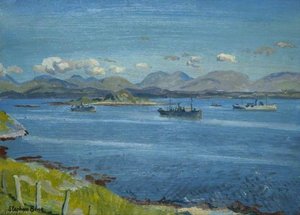 The Convoy Anchorage from Lismore1945
92
 HMS 'Wildgoose' and HMS 'Starling'1944
93
 HMS 'Malaya' Leaving a Protected Anchorage1944
94
 Campbeltown Loch, April 19441944 · National Maritime Museum
95
 HMS 'Mauritius', The 4 Inch Guns1944 · Walker Art Gallery
96
 Three Trawlers1944
97
 Campbeltown Loch Boom Nets and Floats1944 · National Maritime Museum
98
 Home Fleet Cruisers in the Firth of Forth1945
99
 The Shadow of a Balloon1944
100
 'U' Class Submarine at Sea1944
The four subjects that come back most often in these originals, each with its finest example.
The 8 museums that hold the most of the paintings on this page.
| Museum | City | Works by Stephen Bone | Paintings from this list |
|---|---|---|---|
 National Maritime Museum |
London | 28 | MGBs and HMS 'Conn' in Loch Eriboll in 1945, A rescue motor launch at sea, HMS Rodney viewed from behind a cruiser's torpedo tubes |
 Government Art Collection |
London | 7 | Convoy Leaving Anchorage at Sunrise, Tromsø Sound, Trondheim from the Fjord |
 Harris Museum - Art Gallery |
Preston | 3 | HM Rescue Tug 'Samsonia', with Water Boat and HM Yacht 'Martinetta', Destroyer off the Normandy Beaches |
 Walker Art Gallery |
Liverpool | 2 | Ardrossan, HMS 'Mauritius', The 4 Inch Guns |
 Bristol Museum - Art Gallery |
Bristol | 2 | Motor Launch Passing Drake's Island, Plymouth Sound |
 Imperial War Museum |
London | 1 | The Wreck of the 'Tirpitz', June 1945 |
 New College |
Oxford | 1 | College Road, Hampstead |
 Ministry of Defence |
London | 1 | HMS 'Pursuer' The Wet Flight Deck |
Pick a decade to see the original that defines it.

Stephen Bone's "College Road, Hampstead," painted in 1935, isn’t merely a depiction of a London street; it’s an invitation to step into a pocket of serene contemplation. The painting captures a quiet afternoon on a leafy residential road, bathed in the soft, diffused light characteristic of early evening. Bone, a key figure within the British Neo-Romantic landscape movement, eschews dramatic vistas or bold statements in favor of a subtle, almost…
Bow Gun, HMS 'Southern Star' (1943). Stormy Evening (1926) and Leamington (1940) come next.
39 years old: Bow Gun, HMS 'Southern Star' dates from 1943, and Stephen Bone was born in 1904.
Bow Gun, HMS 'Southern Star', Stormy Evening, Leamington, Arisaig, Royal Air Force Air Sea Rescue Launches, Stornoway The Fish Quay Beyond, Camouflaging the Pipeline at the British Aluminium Company's Works at Fort William, October 1941, HM Rescue Tug 'Samsonia', with Water Boat and HM Yacht 'Martinetta', MGBs and HMS 'Conn' in Loch Eriboll in 1945, HM Rescue Tug 'Samsonia' The 20 Inches Manilla Cable and 'H' Class Submarine at Sea. The ranking above gives each one's year and museum.
Our catalog holds 165 works by Stephen Bone, dated from 1925 to 1946.
Mostly in National Maritime Museum (London), Government Art Collection (London) and Harris Museum - Art Gallery (Preston). The museum table above lists them all.
In 1940s: 90 of the 100 works on this page were made then, Bow Gun, HMS 'Southern Star' among them.
On this page, the earliest is Gibraltar from Gaucín (1925) and the latest HMS 'Rodney' (1946).
British landscape (5), Coastal landscape (4) and Coastal scene (3), across the 100 works on this page.
Impressionism and Contemporary realism, judging by the originals on this page.
MGBs and HMS 'Conn' in Loch Eriboll in 1945, A rescue motor launch at sea and HMS Rodney viewed from behind a cruiser's torpedo tubes: the National Maritime Museum, London holds 10 of the works on this page.
