Portrait of Stanislas Lépine

Stanislas Lépine Paintings: The 100 Most Famous, Through a Gallery's Eye

Updated November 2026 · ranked by our popularity score (searches, visits and orders for each work) · 123 works by Stanislas Lépine in our catalogue

In short

To the gallery's eye, Stanislas Lépine's most famous painting is Portrait of Stanisław Potocki (1782-1831). (1788), whose original hangs in the National Museum in Warsaw, Warsaw. Pont de la Tournelle, Paris (1862) and The Tuileries Basin (1877) complete the trio every eye recognises. Of the 123 works by Stanislas Lépine in our catalog, the gallery presents the 100 most famous below, each original with its year, its museum and what makes it unique.

1835 – 1892, Caen Impressionism Most works: Carnavalet Museum

The gallery's top 10 Stanislas Lépine paintings

1
Portrait of Stanisław Potocki (1782-1831). (1788) by Stanislas Lépine

Portrait of Stanisław Potocki (1782-1831).

1788 · Oil On Canvas · National Museum in Warsaw, Warsaw

A young child sits at the heart of this scene, draped in ornate, aristocratic attire that speaks of high status and ceremony. This small figure rides a sturdy brown horse, which is positioned atop a large, golden sled. The arrangement feels both dreamlike and deliberate, as if a moment of play has been frozen in a grand, symbolic gesture. Warm earth tones dominate the view, with deep browns, shimmering golds,…

2
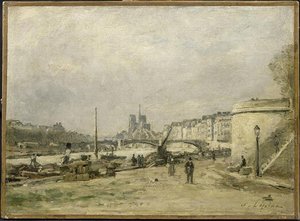
Pont de la Tournelle, Paris (1862) by Stanislas Lépine

Pont de la Tournelle, Paris

1862 · Oil On Canvas · National Gallery of Art, Washington

The oil on canvas depicts a river scene in Paris, centered on the Pont de la Tournelle. The composition follows a horizontal emphasis, established by the expanse of the river and the line of the bridge. Verticality is provided by the architectural forms of the buildings lining the banks. In the foreground and midground, the water's surface reflects the structures above, creating a series of curved lines and light patterns.…

3
The Tuileries Basin (1877) by Stanislas Lépine

The Tuileries Basin

1877 · Sculpture

The work carries the weight of antiquity, appearing as a quiet observer of classical ideals. The composition relies on the interplay between the solid, heavy presence of the stone and the perceived lightness of the figure's upward gaze. There is a sense of weightlessness in the way the drapery falls, despite the material's inherent density. The neutral, seamless background strips away any sense of environment, forcing a direct encounter with…

4
The Rue de Norvins, Montmartre (1878) by Stanislas Lépine

The Rue de Norvins, Montmartre

1878 · Oil · Kelvingrove Art Gallery and Museum, Glasgow

In this 1878 oil painting, we find ourselves standing at the edge of a sloping street in Montmartre. The Rue de Norvins recedes into a soft, hazy distance, drawing the eye through a deep linear perspective toward a pale horizon. There is a stillness here, a sense of a morning caught in a moment of transition. A woman walks in the foreground, accompanied by a child and a small dog,…

5
Rue Mont-Cenis, Montmartre (1872) by Stanislas Lépine

Rue Mont-Cenis, Montmartre

1872 · Oil On Canvas · National Gallery of Ireland, Dublin City

This oil on canvas depicts a narrow, cobblestone street within the Montmartre district of Paris. The composition relies on a strong linear perspective, where the buildings on either side of the road form a receding corridor that directs the eye toward the center of the background. The architecture is rendered in a palette of muted tones, specifically grey, beige, ochre, and soft browns. Above the rooftops, the sky appears as…

6
A Courtyard on the rue de la Fontenelle (1874) by Stanislas Lépine

A Courtyard on the rue de la Fontenelle

1874 · Oil · Norton Simon Museum, Pasadena

The scene is a vertically oriented view of a courtyard, framed by two tall, slender trees on the left and right edges. These trees form a natural archway that directs the eye toward the center of the composition. A solitary woman walks toward the viewer in the foreground, carrying a basket. In the distance, near a dark doorway, smaller and less distinct figures are visible. The ground is a pathway…

7
Country Road (1878) by Stanislas Lépine

Country Road

1878 · Oil On Canvas

In this 1878 oil on canvas, we find ourselves in a serene rural landscape that captures a fleeting instance of rest. Two young men are positioned on a grassy bank, their presence adding a human element to the winding dirt road that leads the eye through a field. A solitary tree rises in the midground, providing a vertical anchor to the composition. The scene is bathed in the soft, diffused…

8
Canal in Saint-Denis, Effect of Moonlight (1876) by Stanislas Lépine

Canal in Saint-Denis, Effect of Moonlight

1876 · Oil On Canvas

The composition centers on a horizontal view of a canal in Saint-Denis under moonlight. The water occupies the foreground and middle ground, acting as a reflective surface for the moon and the surrounding architecture. On the left, a row of buildings lines the canal edge, while trees appear on the right side of the frame. A bridge spans the water in the distance, creating a sense of depth through size…

9
QUAIS DE LA SEINE, PONT MARIE by Stanislas Lépine

QUAIS DE LA SEINE, PONT MARIE

Oil On Canvas

The Seine flows through the center of the frame, a grey ribbon cutting through the heart of Paris. Water moves toward the viewer, carrying the weight of an overcast sky in its ripples. The Pont Marie spans the current, its arches breaking the horizontal rhythm of the riverbanks. Buildings line the quays, their facades rendered in muted tones of beige and brown. A few figures move along the banks, small…

10
Prairies à Tournebouse by Stanislas Lépine

Prairies à Tournebouse

Oil On Canvas

The composition of Prairies à Tournebouse is organized horizontally, emphasizing the breadth of the terrain. In the foreground, tall grasses and wildflowers occupy the lower edge of the frame, rendered with visible, broken brushstrokes that suggest texture and movement. A river curves through the middle ground, its surface reflecting the cool blues of the sky. In the distance, a village is nestled among a cluster of trees, positioned near the…

Stanislas Lépine paintings, ranked 11 to 100

11Caen: Customs (1860) by Stanislas LépineCaen: Customs1860 · Musée Des Beaux 12Landscape with Farm Buildings (1863) by Stanislas LépineLandscape with Farm Buildings1863 · Scottish National Gallery 13Montmartre (1863) by Stanislas LépineMontmartre1863 · Scottish National Gallery 14The Pont de la Tournelle, Paris (1862) by Stanislas LépineThe Pont de la Tournelle, Paris1862 · National Gallery 15The Seine at Sèvres (1862) by Stanislas LépineThe Seine at Sèvres1862 16Entrance to the Port (1858) by Stanislas LépineEntrance to the Port1858 17Ships in Port (1860) by Stanislas LépineShips in Port1860 18The Saint Pierre Basin (1863) by Stanislas LépineThe Saint Pierre Basin1863 19Bridge in a French City (1870) by Stanislas LépineBridge in a French City1870 20The Seine à Bercy (1868) by Stanislas LépineThe Seine à Bercy1868 · National Gallery of Ireland 21Landscape with a Bridge (1871) by Stanislas LépineLandscape with a Bridge1871 · Hermitage Museum 22Nuns and Schoolgirls in the Tuileries Gardens, Paris (1871) by Stanislas LépineNuns and Schoolgirls in the Tuileries Gardens, Paris1871 · National Gallery 23Moonlit River (1868) by Stanislas LépineMoonlit River1868 24The Seine at la Garenne Saint-Denis (1870) by Stanislas LépineThe Seine at la Garenne Saint-Denis1870 25The Seine at Ile Saint-Denis (1870) by Stanislas LépineThe Seine at Ile Saint-Denis1870 26View of the Seine (1870) by Stanislas LépineView of the Seine1870 27Farmyard in Normandy (1868) by Stanislas LépineFarmyard in Normandy1868 28The Marne at Charenton, A Fisherman (1871) by Stanislas LépineThe Marne at Charenton, A Fisherman1871 29Harbor at Low Tide (1873) by Stanislas LépineHarbor at Low Tide1873 30The Seine at La Garenne Saint-Denis (1875) by Stanislas LépineThe Seine at La Garenne Saint-Denis1875 · Ashmolean Museum 31Yacht sur la Riviere (1874) by Stanislas LépineYacht sur la Riviere1874 · Russell-Cotes Art Gallery - Museum 32View on the Seine, Paris (1872) by Stanislas LépineView on the Seine, Paris1872 · Art Institute of Chicago 33View on the Outskirts of Caen (1872) by Stanislas LépineView on the Outskirts of Caen1872 · National Gallery of Art 34View of Brie-sur-Marne (1873) by Stanislas LépineView of Brie-sur-Marne1873 · Musée d'Orsay 35The Pont Neuf, Paris (1875) by Stanislas LépineThe Pont Neuf, Paris1875 · Norton Simon Museum 36The Canal Saint-Denis by Moonlight (1877) by Stanislas LépineThe Canal Saint-Denis by Moonlight1877 · Wallraf-Richartz-Museum 37Montmartre, the rue Cortot (1874) by Stanislas LépineMontmartre, the rue Cortot1874 38A Plow Horse in a Field (1874) by Stanislas LépineA Plow Horse in a Field1874 · National Gallery of Art 39Street in Montmartre, Snow Effect (1878) by Stanislas LépineStreet in Montmartre, Snow Effect1878 40Country Road (1876) by Stanislas LépineCountry Road1876 41The Pont des Arts, Paris (1875) by Stanislas LépineThe Pont des Arts, Paris1875 42Place de la Concord (1878) by Stanislas LépinePlace de la Concord1878 43The Pont de Bercy as seen from the Quai de La Gare (1875) by Stanislas LépineThe Pont de Bercy as seen from the Quai de La Gare1875 44The Seine at Ile Saint-Denis (1877) by Stanislas LépineThe Seine at Ile Saint-Denis1877 45The Pont National as Seen from Quai d'Ivry, Paris (1873) by Stanislas LépineThe Pont National as Seen from Quai d'Ivry, Paris1873 46Montmartre, the Rue Saint-Vincent (1873) by Stanislas LépineMontmartre, the Rue Saint-Vincent1873 47Paris, the Pont des Arts (1878) by Stanislas LépineParis, the Pont des Arts1878 48The Ourcq Canal, Towpath, Moonlight (1876) by Stanislas LépineThe Ourcq Canal, Towpath, Moonlight1876 49The Banks of the Marne (1880) by Stanislas LépineThe Banks of the Marne1880 · Musee des Beaux-Arts 50The Seine, at Passy (1880) by Stanislas LépineThe Seine, at Passy1880 · Carnavalet Museum 51Pont des Arts, View from Pont Royal (1884) by Stanislas LépinePont des Arts, View from Pont Royal1884 · Carnavalet Museum 52Saint-Michel Bridge (1880) by Stanislas LépineSaint-Michel Bridge1880 · Carnavalet Museum 53L'île de la Cité and l'île Saint-Louis, viewed from the Pont d'Austerlitz (1880) by Stanislas LépineL'île de la Cité and l'île Saint-Louis, viewed from the Pont d'Austerlitz1880 · Carnavalet Museum 54The Artesian Well of Grenelle, (place de Breteuil) (1880) by Stanislas LépineThe Artesian Well of Grenelle, (place de Breteuil)1880 · Carnavalet Museum 55Sunset on a River (1880) by Stanislas LépineSunset on a River1880 · Scottish National Gallery 56A Gateway behind Trees (1881) by Stanislas LépineA Gateway behind Trees1881 · National Gallery 57The Apple Market (1880) by Stanislas LépineThe Apple Market1880 · Art Institute of Chicago 58A Stream in France (1880) by Stanislas LépineA Stream in France1880 · Art Institute of Chicago 59The Courtyard (1880) by Stanislas LépineThe Courtyard1880 · Art Institute of Chicago 60View of the Louvre (1883) by Stanislas LépineView of the Louvre1883 · National Gallery of Art 61Canal Saint-Martin (1885) by Stanislas LépineCanal Saint-Martin1885 62The Estacade Bridge (1880) by Stanislas LépineThe Estacade Bridge1880 · Walters Art Museum 63The Pont de l'Estacade, Paris (1880) by Stanislas LépineThe Pont de l'Estacade, Paris1880 · Norton Simon Museum 64River Scene with Ducks (1879) by Stanislas LépineRiver Scene with Ducks1879 65The Seine at Ivry (1885) by Stanislas LépineThe Seine at Ivry1885 66Vue de la Butte, Montmartre (1892) by Stanislas LépineVue de la Butte, Montmartre1892 · City Art Gallery 67A Quarry at Caen (1892) by Stanislas LépineA Quarry at Caen1892 · Musée des Beaux-Arts de Caen 68Le quai aux fleurs (titre attribué) Le quai aux fleurs et le pont d'Arcole (autre titre) by Stanislas LépineLe quai aux fleurs (titre attribué) Le quai aux fleurs et le pont d'Arcole (autre titre) 69La Seine devant Saint Denis (titre attribué) Vue sur la Seine (ancien titre donné sans raison dans les anciens catalogues) by Stanislas LépineLa Seine devant Saint Denis (titre attribué) Vue sur la Seine (ancien titre donné sans raison dans les anciens catalogues) 70The Banks of the Saine at St. Cloud by Stanislas LépineThe Banks of the Saine at St. Cloud 71Farmyard in Normandy by Stanislas LépineFarmyard in Normandy 72CHALAND A QUAI by Stanislas LépineCHALAND A QUAI 73Chantiers navals à Caen by Stanislas LépineChantiers navals à Caen 74La Seine à Saint Ouen by Stanislas LépineLa Seine à Saint Ouen 75QUAI DE LA SEINE A PARIS by Stanislas LépineQUAI DE LA SEINE A PARIS 76MONTMARTRE, RUE SAINT VINCENT by Stanislas LépineMONTMARTRE, RUE SAINT VINCENT 77LE FILS DE L'ARTISTE by Stanislas LépineLE FILS DE L'ARTISTE 78Péniche sur la Seine by Stanislas LépinePéniche sur la SeinePréfecture de L'isère 79Bateaux sur le fleuve, clair de lune (titre attribué) by Stanislas LépineBateaux sur le fleuve, clair de lune (titre attribué) 80La Seine avec vue du Panthéon by Stanislas LépineLa Seine avec vue du Panthéon 81LE MARCHE AUX POMMES by Stanislas LépineLE MARCHE AUX POMMES 82LE PORT DE CAEN by Stanislas LépineLE PORT DE CAEN 83Les bords de la Seine by Stanislas LépineLes bords de la SeineLeeds Art Gallery 84Treescape by Stanislas LépineTreescapeThe Dick Institute 85The Shepherdess by Stanislas LépineThe ShepherdessAberdeen Art Gallery 86La forêt de Fontainebleau, France by Stanislas LépineLa forêt de Fontainebleau, FranceBowes Museum 87View of Paris by Stanislas LépineView of ParisRhode Island School of Design Museum of Art 88The coast of Normandy by Stanislas LépineThe coast of NormandyFitzwilliam Museum 89The Pont de l'Alma near Paris by Stanislas LépineThe Pont de l'Alma near ParisScottish National Gallery 90View of the Seine by Stanislas LépineView of the SeineMuseum of Fine Arts Ghent (MSK) 91Landscape by Stanislas LépineLandscapeMcmanus: Dundee's Art Galleries And Museums 92River Scene by Stanislas LépineRiver SceneTowneley Hall Art Gallery And Museum 93Montmartre by Stanislas LépineMontmartreNational Museum Cardiff 94Landscape with River by Stanislas LépineLandscape with RiverHarvard Art Museums 95Woman by a Stream by Stanislas LépineWoman by a Stream 96The Seine. The Trocadero and the Grenelle Bridge, seen from the javel wharf by Stanislas LépineThe Seine. The Trocadero and the Grenelle Bridge, seen from the javel wharf 97In the Luxembourg Garden by Stanislas LépineIn the Luxembourg Garden 98Les Champs-Elysées by Stanislas LépineLes Champs-Elysées 99FAUBOURG DE PARIS SOUS LA NEIGE by Stanislas LépineFAUBOURG DE PARIS SOUS LA NEIGE 100Les Bords de La Marne. Pêche à l'épervier à la boucle de Saint Maur by Stanislas LépineLes Bords de La Marne. Pêche à l'épervier à la boucle de Saint Maur

Stanislas Lépine's famous paintings, period by period

The subjects that held Stanislas Lépine's eye

The four subjects that come back most often in these originals, each with its finest example.

The museums that keep Stanislas Lépine's originals

The 8 museums that hold the most of the paintings on this page.

Museum City Works by Stanislas Lépine Paintings from this list
Carnavalet Museum, ParisCarnavalet Museum Paris 6 The Seine, at Passy, Pont des Arts, View from Pont Royal, Saint-Michel Bridge
National Gallery of Art, WashingtonNational Gallery of Art Washington 4 Pont de la Tournelle, Paris, View on the Outskirts of Caen, A Plow Horse in a Field
Scottish National Gallery, EdinburghScottish National Gallery Edinburgh 4 Landscape with Farm Buildings, Montmartre, Sunset on a River
Art Institute of Chicago, ChicagoArt Institute of Chicago Chicago 4 View on the Seine, Paris, The Apple Market, A Stream in France
Norton Simon Museum, PasadenaNorton Simon Museum Pasadena 3 A Courtyard on the rue de la Fontenelle, The Pont Neuf, Paris, The Pont de l'Estacade, Paris
National Gallery, LondonNational Gallery London 3 The Pont de la Tournelle, Paris, Nuns and Schoolgirls in the Tuileries Gardens, Paris, A Gateway behind Trees
National Gallery of Ireland, Dublin CityNational Gallery of Ireland Dublin City 2 Rue Mont-Cenis, Montmartre, The Seine à Bercy
National Museum in Warsaw, WarsawNational Museum in Warsaw Warsaw 1 Portrait of Stanisław Potocki (1782-1831).

Stanislas Lépine, one signature painting per decade

Works per decade

Pick a decade to see the original that defines it.

Stanislas Lépine's paintings: the gallery answers

Which Stanislas Lépine painting is the most famous of all?Reveal the answer

Portrait of Stanisław Potocki (1782-1831). (1788), National Museum in Warsaw, Warsaw. Pont de la Tournelle, Paris (1862) and The Tuileries Basin (1877) come next.

Which are Stanislas Lépine's top 10 paintings?Reveal the answer

Portrait of Stanisław Potocki (1782-1831)., Pont de la Tournelle, Paris, The Tuileries Basin, The Rue de Norvins, Montmartre, Rue Mont-Cenis, Montmartre, A Courtyard on the rue de la Fontenelle, Country Road, Canal in Saint-Denis, Effect of Moonlight, QUAIS DE LA SEINE, PONT MARIE and Prairies à Tournebouse. The ranking above gives each one's year and museum.

How many works did Stanislas Lépine create?Reveal the answer

Our catalog holds 123 works by Stanislas Lépine, dated from 1858 to 1892.

Where do Stanislas Lépine's most famous originals hang?Reveal the answer

Mostly in Carnavalet Museum (Paris), National Gallery of Art (Washington) and Scottish National Gallery (Edinburgh). The museum table above lists them all.

When did Stanislas Lépine create the most famous paintings?Reveal the answer

In 1870s: 34 of the 100 works on this page were made then, The Tuileries Basin among them.

Which are Stanislas Lépine's earliest and latest famous works?Reveal the answer

On this page, the earliest is Entrance to the Port (1858) and the latest Vue de la Butte, Montmartre (1892).

Which subjects did Stanislas Lépine return to most?Reveal the answer

Sky (47), Water (43) and River (41), across the 100 works on this page.

Which medium did Stanislas Lépine work in most?Reveal the answer

Oil On Canvas, for 59 of the 100 works on this page.

Which movement is Stanislas Lépine associated with?Reveal the answer

Impressionism, judging by the originals on this page.

Which Stanislas Lépine originals does the Carnavalet Museum hold?Reveal the answer

The Seine, at Passy, Pont des Arts, View from Pont Royal and Saint-Michel Bridge: the Carnavalet Museum, Paris holds 5 of the works on this page.

Stanislas Lépine: the artist

A Quiet Observer of the Seine: The Life and Art of Stanislas Lépine

Stanislas Victor Edouard Lépine, born in Caen, France, in 1835, occupies a fascinating, often understated position within the narrative of 19th-century French painting. While not typically categorized among the core Impressionists, his work served as a crucial bridge between the established traditions of the Barbizon school and the burgeoning innovations that would define modern art. Lépine’s artistic journey was one of quiet dedication, marked by a profound sensitivity to light, atmosphere, and the subtle beauty of the French countryside and urban landscapes—particularly those along the Seine River which became his enduring muse. His early aptitude for art led him toward formal training, but it was an encounter with Camille Corot in Normandy in 1859 that proved truly pivotal. The following year, Lépine formally entered Corot’s studio, initiating a mentorship that profoundly shaped his artistic vision and technique. This relationship instilled within him a deep appreciation for plein air painting—working directly from nature—and a commitment to capturing the fleeting effects of light and atmosphere.

The Painterly Embrace of Light and Atmosphere

Lépine’s paintings are immediately recognizable for their placid mood, delicate luminosity, and often intimate scale. He specialized in landscapes, but his subject matter extended beyond purely rural scenes to encompass the evolving urban environment of Paris. River views dominated his oeuvre; the Seine, with its bustling activity, shimmering reflections, and ever-changing light, provided an inexhaustible source of inspiration. Parisian cityscapes and quieter rural settings also found their place on his canvases, all rendered with a loose, atmospheric brushwork that prioritized capturing the *impression* of a scene rather than meticulous detail. He wasn’t interested in grand narratives or dramatic compositions; instead, Lépine sought to convey a sense of tranquility and realism, inviting viewers into moments of quiet contemplation. His palette tended towards muted tones, skillfully employed to evoke the subtle nuances of light and shadow, creating an atmosphere that is both serene and deeply evocative. This dedication to capturing atmospheric effects aligns him with the Impressionists, yet his approach remained distinctly his own—more restrained and less focused on the radical experimentation with color and form that characterized many of his contemporaries.

A Peripheral Figure in a Revolutionary Movement

In 1874, Lépine participated in the first Impressionist exhibition held at Nadar’s studio, aligning himself briefly with a group of artists who were challenging the conventions of the art world. However, his artistic temperament and stylistic preferences ultimately positioned him somewhat apart from the core tenets of Impressionism. While he embraced plein air painting and shared an interest in capturing fleeting moments, his work lacked the bold experimentation and subjective intensity that defined artists like Monet or Renoir. He remained more grounded in traditional techniques and a more naturalistic approach to representation. This distinction led many critics and historians to view him as a precursor to Impressionism—a transitional figure who helped pave the way for the movement’s emergence, rather than an active participant within it. Nevertheless, his presence at that inaugural exhibition signaled a willingness to engage with new ideas and challenge established norms, solidifying his place in the broader context of 19th-century artistic innovation. He served as a vital link between the Barbizon school's emphasis on direct observation and the Impressionists’ pursuit of capturing subjective experience.

Recognition and Legacy

Throughout his career, Stanislas Lépine exhibited regularly at the Salon and other prestigious venues, gradually earning critical acclaim for his sensitive depictions of the French countryside and urban life. His work resonated with audiences who appreciated its quiet beauty and understated elegance. A significant moment of recognition came in 1889 when he was awarded a gold medal at the Exposition Universelle for his painting *Pont de l'Estacade*. This prestigious award affirmed his standing within the artistic community and brought wider attention to his work. Today, Lépine’s paintings are held in numerous public and private collections worldwide, testament to their enduring appeal and historical significance. While often overshadowed by more celebrated contemporaries, he is increasingly recognized as a master of atmospheric landscape painting—an artist who captured the essence of 19th-century France with remarkable sensitivity and skill. His serene and contemplative scenes offer a valuable glimpse into a bygone era, reminding us of the beauty to be found in the everyday moments of life. He died suddenly in Paris on September 28, 1892, leaving behind a legacy of quiet observation and artistic refinement.

Themes and Recurring Motifs

  • The Seine River: The dominant theme throughout Lépine’s career, representing not just a geographical location but also a symbol of French life and the passage of time.
  • Parisian Cityscapes: Depictions of Parisian streets, bridges, and buildings, capturing the evolving urban landscape of the 19th century.
  • Rural Scenes: Paintings of farmyards, fields, and villages, showcasing the tranquility and simplicity of rural life in Normandy and beyond.
  • Plein Air Painting: A defining characteristic of his technique, emphasizing direct observation of nature and capturing fleeting atmospheric effects.
  • Moonlight Views: Lépine was particularly adept at rendering the subtle nuances of moonlight, creating evocative and ethereal scenes.