In short
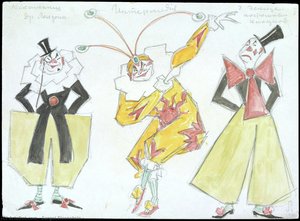
To the gallery's eye, Sergei Eisenstein's most famous painting is Hermes (1914). A Petition (1914) and Harlequin (1921) complete the trio every eye recognises. Of the 41 works by Sergei Eisenstein in our catalog, the gallery presents the 41 most famous below, each original with its year, its museum and what makes it unique.
The gallery's top 10 Sergei Eisenstein paintings
Duncan
This striking black and white line drawing, titled "Duncan," presents a powerful depiction of the crucifixion scene. Eisenstein, renowned for his pioneering work in film montage and cinematic theory, brings a unique visual language to this traditional Christian iconography. The artwork centers on the figure of Christ on the cross, rendered with simplified forms and dramatic lines that emphasize suffering and despair. A large rectangular structure sits beneath him, while…
Sergei Eisenstein paintings, ranked 11 to 41
Sergei Eisenstein's famous paintings, period by period
Early Period
1914 · 4 works in this listMature Period
6 works in this listThe subjects that held Sergei Eisenstein's eye
The four subjects that come back most often in these originals, each with its finest example.
Black and white art 2 works
Sergei Eisenstein, one signature painting per decade
Sergei Eisenstein's paintings: the gallery answers
Which Sergei Eisenstein painting is the most famous of all?Reveal the answer
Hermes (1914). A Petition (1914) and Harlequin (1921) come next.
How old was Sergei Eisenstein on completing Hermes?Reveal the answer
16 years old: Hermes dates from 1914, and Sergei Eisenstein was born in 1898.
Which are Sergei Eisenstein's top 10 paintings?Reveal the answer
Hermes, A Petition, Harlequin, Sam Mangan (Mikhail Visarov),Sketch Nr 6 for, ¡Que viva Mexico, Crucifiction, Alexander Nevsky, Self Portrait, Those Nameless Friends and Duncan. The ranking above gives each one's year and museum.
How many works did Sergei Eisenstein create?Reveal the answer
Our catalog holds 41 works by Sergei Eisenstein, dated from 1914 to 1942.
When did Sergei Eisenstein create the most famous paintings?Reveal the answer
In 1920s: 8 of the 41 works on this page were made then, Harlequin among them.
Which are Sergei Eisenstein's earliest and latest famous works?Reveal the answer
On this page, the earliest is Hermes (1914) and the latest Self Portrait (1942).
Which movement is Sergei Eisenstein associated with?Reveal the answer
Expressionism, judging by the originals on this page.
Sergei Eisenstein: the artist
Early Life and Influences
- Born: Riga, Latvia (then part of the Russian Empire), January 22, 1898
- Family Background: His father, Mikhail Osipovich Eisenstein, was a renowned architect. His mother, Julia Ivanovna Konetskaya, came from a prosperous merchant family.
- Early Interests: Developed an early interest in theatre and visual arts, sketching caricatures and demonstrating a fascination with movement and performance.
- Education: Studied architecture and engineering at the Petrograd Institute of Civil Engineering before shifting his focus to art and theatre.
- Revolutionary Involvement: Joined the Red Army after the Russian Revolution of 1905, contributing to propaganda efforts which sparked an interest in filmmaking.
- Japanese Influence: While serving in Minsk, he studied Japanese culture, learning approximately 300 kanji characters and drawing inspiration from Kabuki theatre for his later cinematic work.
Key Contributions to Film Theory and Technique
- Montage of Attractions: Developed the theory of "montage of attractions," a revolutionary approach that prioritized the juxtaposition of images to create emotional impact rather than relying on traditional narrative flow. This involved deliberately jarring or unexpected image combinations to provoke a visceral response in the audience.
- Dynamic Montage: Pioneered dynamic montage, emphasizing the collision and interaction of shots to generate conflict, tension, and intellectual understanding. He believed that meaning arose not from individual images but from their relationship to one another.
- Sound and Music Integration: Recognized the power of sound and music in film, using them rhythmically and expressively to enhance the emotional impact of his montages. His collaboration with Sergei Prokofiev on *Alexander Nevsky* exemplified this approach.
- Typecasting & Crowd Dynamics: Eisenstein was a master of typecasting actors into roles that emphasized their physical characteristics and social types, and he skillfully choreographed crowd scenes to convey collective emotion and historical significance.
Major Works and Their Significance
- Strike (1925): His first full-length feature film, Strike depicted a workers' strike with powerful imagery and innovative editing techniques, establishing his reputation as a groundbreaking filmmaker.
- Battleship Potemkin (1925): Widely considered his masterpiece, Battleship Potemkin dramatized the mutiny aboard a Russian battleship, employing dynamic montage to create a visceral and emotionally charged depiction of revolution. It remains one of the most influential films in cinematic history.
- October (Ten Days That Shook the World) (1928): A historical epic commemorating the 10th anniversary of the October Revolution, showcasing his ability to portray large-scale events and political upheaval through dynamic editing.
- Alexander Nevsky (1938): A patriotic film celebrating a Russian military hero, demonstrating his skill in combining historical narrative with powerful visual spectacle and musical scoring.
- Ivan the Terrible (1944-1958): An ambitious two-part epic exploring the life of Ivan IV, showcasing Eisenstein's complex approach to historical drama and his exploration of power and tyranny. The film was initially censored and later restored.
Later Career and Legacy
- Hollywood Experience: Briefly worked in Hollywood during the early 1930s but found it creatively restrictive due to differing artistic philosophies and political pressures.
- Stalinist Era Challenges: Faced increasing pressure from Soviet authorities to conform to Socialist Realism, leading to self-criticism and adjustments in his filmmaking style.
- Teaching and Writing: Dedicated significant time to teaching film theory and writing extensively on cinematic techniques, influencing generations of filmmakers.
- Lasting Influence: Sergei Eisenstein's theories and techniques have profoundly impacted the development of film editing, visual storytelling, and documentary filmmaking worldwide. His emphasis on montage continues to inspire filmmakers seeking innovative ways to convey meaning and emotion through image juxtaposition.
Historical Significance
- Pioneer of Montage: Eisenstein is recognized as a pivotal figure in the history of cinema for his groundbreaking work on montage theory and practice.
- Revolutionary Filmmaking: His films challenged conventional narrative structures and explored themes of social justice, revolution, and historical change.
- Influence on Film Theory: His writings and lectures have shaped film studies and continue to be studied by scholars and filmmakers alike.
- Cultural Icon: Eisenstein remains a cultural icon, representing the innovative spirit of Soviet cinema and its impact on global filmmaking.