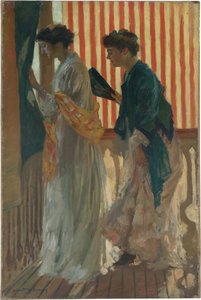
Portrait of Rupert Bunny

Rupert Bunny Paintings: The 20 Most Famous, Through a Gallery's Eye

Updated November 2026 · ranked by our popularity score (searches, visits and orders for each work) · 25 works by Rupert Bunny in our catalogue

In short

To the gallery's eye, Rupert Bunny's most famous painting is Sea idyll (1891), whose original hangs in the National Gallery of Victoria, Melbourne. Tritons (1890) and Angels Descending (1897) complete the trio every eye recognises. Of the 25 works by Rupert Bunny in our catalog, the gallery presents the 20 most famous below, each original with its year, its museum and what makes it unique.

1864 – 1947, Melbourne Symbolism Most works: National Gallery of Victoria

The gallery's top 10 Rupert Bunny paintings

1
Sea idyll (1891) by Rupert Bunny

Sea idyll

1891 · Acrylic On Canvas · National Gallery of Victoria, Melbourne

A Symphony of Color and Myth: Exploring Rupert Bunny’s Sea Idyll Rupert Charles Wulsten Bunny (1864–1947), an Australian painter, stands as a testament to the allure of fin-de-siècle Paris – a city that captivated artists yearning for beauty and intellectual stimulation. Born in St Kilda, Victoria, Bunny’s artistic journey began with foundational training under Calderon and Laurens, equipping him with skills that would propel him to international acclaim as an…

2
Tritons (1890) by Rupert Bunny

Tritons

1890 · Oil On Canvas · Art Gallery of New South Wales, Sydney

In this work, titled Tritons, the artist Rupert Bunny explores the themes of classical mythology. Created about 1890, the painting captures a serene seascape where figures inhabit a shallow ocean setting. The subject matter draws from ancient lore, presenting a scene that feels both mythological and deeply atmospheric.

4
A summer morning (1897) by Rupert Bunny

A summer morning

1897 · Oil On Canvas · Art Gallery of South Australia, Adelaide

A summer morning is an oil on canvas painting by the Australian artist Rupert Bunny. He was born in 1864 and lived until 1947. This specific work emerged from the light of Paris, where the artist refined his vision during the fin-de-siècle era. The canvas captures a quiet, domestic stillness. It was created in 1897.

5
Mermaids dancing (1896) by Rupert Bunny

Mermaids dancing

1896 · Oil On Canvas · National Gallery of Victoria, Melbourne

The scene unfolds in 1896, a moment where the boundary between myth and reality dissolves into the salt spray. In Mermaids dancing, the artist Rupert Bunny brings legendary beings to life amidst the rhythmic pulse of the ocean. These mermaids move through a world of shifting tides, their presence a quiet celebration of leisure amidst the vastness of the sea. The composition captures a sense of movement that feels as…

6
Madame Melba (1902) by Rupert Bunny

Madame Melba

1902 · Oil On Canvas · National Gallery of Victoria, Melbourne

Rupert Bunny painted Madame Melba in 1902. The subject of this portrait is Madame Melba, an Australian operatic lyric coloratura soprano. She was the first Australian to achieve international recognition as a classical musician. The portrait captures the singer in a full-length pose, presenting her as a figure of significant stature.

7
Summer time (1907) by Rupert Bunny

Summer time

1907 · Oil On Canvas · Art Gallery of New South Wales, Sydney

We are looking at Summer time, an oil on canvas painted by Rupert Bunny in 1907. This work captures a specific moment of leisure, rendered with the precision and atmospheric quality characteristic of the artist's time in Paris. The composition centers on a group of women gathered in a sunlit setting, a recurring theme in Bunny's oeuvre that explores the intersection of light and domestic grace.

8
The Rape of Persephone (1913) by Rupert Bunny

The Rape of Persephone

1913 · Oil On Canvas · National Gallery of Australia, Canberra

The Rape of Persephone is a classical allegory rendered in oil on canvas. The work was executed by the Australian painter Rupert Bunny. It captures a moment of mythic upheaval, centering on the struggle between the figures of Hades and Persephone. The scene is a heavy, swirling collision of form and shadow.

9
Maenads (1917) by Rupert Bunny

Maenads

1917 · Oil On Canvas

In this 1917 oil painting, Maenads by Rupert Bunny, a group of figures breaks into a rhythmic, dynamic dance. The scene unfolds within a lush, impressionistic landscape where movement feels constant. Two female figures, likely the Maenads, appear caught in mid-motion, their limbs flowing through the air as they dance. They move with a sense of weightless energy against the greenery.

10
Amymone Rescued by Poseidon (1920) by Rupert Bunny

Amymone Rescued by Poseidon

1920 · Oil On Canvas

Amymone Rescued by Poseidon is a mythological work by the Australian painter Rupert Bunny. Created about 1920, the painting draws upon classical themes to present a scene of divine intervention. The subject matter focuses on the moment Poseidon intervenes to rescue Amymone.

Rupert Bunny paintings, ranked 11 to 20

The subjects that held Rupert Bunny's eye

The four subjects that come back most often in these originals, each with its finest example.

The museums that keep Rupert Bunny's originals

The 4 museums that hold the most of the paintings on this page.

Museum City Works by Rupert Bunny Paintings from this list
National Gallery of Victoria, MelbourneNational Gallery of Victoria Melbourne 6 Sea idyll, Mermaids dancing, Madame Melba
Art Gallery of New South Wales, SydneyArt Gallery of New South Wales Sydney 5 Tritons, Summer time, A summer morning
National Gallery of Australia, CanberraNational Gallery of Australia Canberra 3 The Rape of Persephone, Who comes?, Pastoral
Art Gallery of South Australia, AdelaideArt Gallery of South Australia Adelaide 2 Angels Descending, A summer morning

Rupert Bunny, one signature painting per decade

Works per decade

Pick a decade to see the original that defines it.

Rupert Bunny's paintings: the gallery answers

Which Rupert Bunny painting is the most famous of all?Reveal the answer

Sea idyll (1891), National Gallery of Victoria, Melbourne. Tritons (1890) and Angels Descending (1897) come next.

How old was Rupert Bunny on completing Sea idyll?Reveal the answer

27 years old: Sea idyll dates from 1891, and Rupert Bunny was born in 1864.

Which are Rupert Bunny's top 10 paintings?Reveal the answer

Sea idyll, Tritons, Angels Descending, A summer morning, Mermaids dancing, Madame Melba, Summer time, The Rape of Persephone, Maenads and Amymone Rescued by Poseidon. The ranking above gives each one's year and museum.

How many works did Rupert Bunny create?Reveal the answer

Our catalog holds 25 works by Rupert Bunny, dated from 1890 to 1920.

Where do Rupert Bunny's most famous originals hang?Reveal the answer

Mostly in National Gallery of Victoria (Melbourne), Art Gallery of New South Wales (Sydney) and National Gallery of Australia (Canberra). The museum table above lists them all.

When did Rupert Bunny create the most famous paintings?Reveal the answer

In 1900s: 7 of the 20 works on this page were made then, Madame Melba among them.

Which are Rupert Bunny's earliest and latest famous works?Reveal the answer

On this page, the earliest is Tritons (1890) and the latest Amymone Rescued by Poseidon (1920).

Which subjects did Rupert Bunny return to most?Reveal the answer

Water (7), Woman (7) and Women (5), across the 20 works on this page.

Which medium did Rupert Bunny work in most?Reveal the answer

Oil On Canvas, for 14 of the 20 works on this page.

Which movement is Rupert Bunny associated with?Reveal the answer

Symbolism, judging by the originals on this page.

Which Rupert Bunny originals does the National Gallery of Victoria hold?Reveal the answer

Sea idyll, Mermaids dancing and Madame Melba: the National Gallery of Victoria, Melbourne holds 6 of the works on this page.

Rupert Bunny: the artist

early life and training

rupert charles wulsten bunny, an australian painter, was born in st kilda, victoria, in 1864. he received a traditional and academic education in the arts under calderon and laurens. this foundation would later serve him well in his successful career as an expatriate artist in fin-de-siècle paris.

achievements and accolades

bunny's artistic prowess was recognized early, with an honourable mention at the paris salon of 1890 for his painting tritons. he further solidified his reputation by winning a bronze medal at the paris exposition universelle in 1900 for burial of st catherine of alexandria. the french state acquired 13 of his works, including those now housed in the musée du luxembourg and regional collections.

artistic style and themes

bunny was a 'sumptuous colourist and splendidly erudite painter of ideal themes,' as described by art critics. his work often featured groups of female figures, relaxing, dreaming, or dressing/undressing by expanses of water, showcasing his unique blend of symbolism and aestheticism.

legacy and online presence

today, bunny's works can be found in various museums and online platforms. for those interested in exploring more of his art, [https://OriginalUniqueArt.com/@/rupert-charles-wulsten-bunny](https://OriginalUniqueArt.com/@/rupert-charles-wulsten-bunny) provides an extensive collection of his paintings, including endormies, sea idyll, and pastoral. these works are also available for purchase as museum-quality reproductions through /en/art/show/art-8xyffg-en/

conclusion

rupert charles wulsten bunny, an australian painter from st kilda, victoria, left an indelible mark on the art world with his sumptuous and erudite style. his legacy continues to inspire through his works, now easily accessible via [https://OriginalUniqueArt.com](https://OriginalUniqueArt.com).