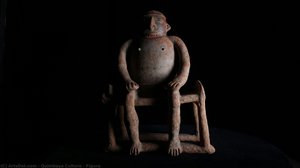
The Legacy of Geometric Mastery: Exploring the Artistry of the Quimbaya Culture
Nestled within the lush, verdant expanses of Colombia’s Cauca River Valley, the Quimbaya culture represents a singular and breathtaking achievement in pre-Columbian artistry. Flourishing from approximately 100 BCE through the era of Spanish contact in the 16th century, this civilization left behind an indelible mark on the cultural heritage of the Andes. Unlike many of their contemporary Andean neighbors, who directed their creative energies toward monumental stone architecture or vast textile works, the Quimbaya focused their genius on the intimate and the meticulous. Their artistic output was not a pursuit of grand, sweeping narratives, but rather an unwavering dedication to capturing the very essence of their environment and spiritual worldview through stylized, masterful representations.
The true soul of Quimbaya artistry is perhaps most vibrantly expressed through their legendary goldwork. They achieved a level of technical accuracy and detailed design that remains a subject of awe for modern scholars. Central to this mastery was their sophisticated use of tumbaga, a unique alloy composed of approximately 70% gold and 30% copper. This specific blend yielded a distinctive, warm reddish hue that set their creations apart from the brighter, yellow golds of surrounding tribes. By utilizing tumbaga, Quimbaya artisans could manipulate metal into remarkably thin sheets and intricate shapes, allowing for a breathtaking delicacy that hammered pure gold could rarely achieve. Through precise hammering and polishing, they produced surfaces as smooth as silk, transforming raw elements into sacred objects like Rodillos (rods), Figuras (figurines), and elaborate masks.
Symbolism and the Ceramic Vision
Beyond the shimmering allure of gold, the Quimbaya expressed their cosmological understanding through a profound mastery of ceramics. Their pottery was far more than utilitarian; it served as a canvas for the spiritual and the symbolic. In these clay forms, one finds a rhythmic repetition of geometric patterns—spirals, triangles, and squares—that acted as a visual language for concepts that are only partially deciphered today. These shapes likely represented the cyclical nature of life, the movement of celestial bodies, or the interconnectedness of the earthly and divine realms.
The artistry of the Quimbaya is characterized by several key elements:
- Technical Precision: The ability to create incredibly fine details in both metal and clay through advanced metallurgical and sculptural techniques.
- Symbolic Depth: The use of recurring geometric motifs to convey complex spiritual and cosmological beliefs.
- Material Innovation: The development of the tumbaga alloy to achieve specific aesthetic and structural goals.
- Natural Integration: A stylistic approach that sought to capture the essence of the natural world through stylized, rather than purely realistic, forms.
Today, the treasures of this ancient culture serve as a luminous gateway into Colombia’s ancestral soul. Found in prestigious institutions such as the Museo del Oro in Bogotá and the Museo Arqueológico MUSA, these artifacts—from the weathered human figures of their ceramic sculptures to the elegant Poporos used for storing lime—continue to whisper tales of a sophisticated society. The Quimbaya legacy remains a testament to a civilization that found divinity in the details, weaving the spirit of the Cauca River Valley into the very fabric of their precious, enduring art.
Questions & Answers
Where can I see Quimbaya Culture's artworks in a 3D gallery?
The 3D Museum of Quimbaya Culture is a page that displays the artist's artworks in a virtual three-dimensional gallery.
What moods do Quimbaya Culture's artworks express?
Quimbaya Culture's works can be browsed by mood on the artist's Mood Room page, which arranges the artworks by their recorded moods.
How popular are Quimbaya Culture's artworks?
Statistics about Quimbaya Culture's works are available on the artist's Stats page.