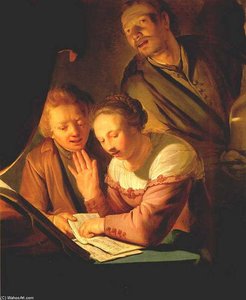
The Master of Haarlem Classicism
In the vibrant tapestry of the Dutch Golden Age, few threads are as elegantly woven as those spun by Pieter de Grebber. Born in 1600 in the historic city of Haarlem, De Grebber emerged from a lineage deeply rooted in both artistry and faith. As the eldest son of the painter and embroiderer Frans Pietersz de Grebber, his apprenticeship began within the intimate confines of a family workshop, where the rhythms of brush and needle were part of daily life. This early immersion in a Catholic artistic household provided him with a unique cultural perspective, one that would later allow him to navigate both the public grandeur of official commissions and the more discreet, spiritual requirements of hidden Catholic churches.
De Grebber’s education was far from provincial; he refined his craft under the guidance of the legendary Hendrick Goltzius, absorbing the sophisticated Mannerist traditions that preceded the rise of classicism. His journey was marked by a remarkable ability to synthesize diverse influences into a singular, personal vision. He drew strength from the dramatic chiaroscuro of the Utrecht Caravaggists, the robust energy of Peter Paul Rubens, and the psychological depth found in the works of Rembrandt. This synthesis allowed him to become a primary architect of Haarlem Classicism, a movement characterized by a refined clarity, well-organized compositions, and a delicate use of light tints that breathed life into every canvas.
A Legacy of Light and Composition
The breadth of De Grebber’s oeuvre is a testament to his versatility as a storyteller through paint. While he was a master of the portrait, capturing the dignity and character of his subjects with a steady hand, it was in his history paintings and landscapes that his true stylistic innovation shone. His work often moved away from the heavy shadows of his predecessors toward a more luminous, balanced aesthetic. This approach made him a sought-after talent for prestigious architectural projects; he contributed significantly to the decoration of the Huis Honselaarsdijk in Naaldwijk and worked upon the Paleis Noordeinde at Huis ten Bosch in The Hague.
Beyond his brushwork, De Grebber was a man of intellectual depth. His commitment to the formal principles of art led him to author the treatise Regulen welcke by... in 1649, a work that sought to codify the rules of painting for future generations. This scholarly pursuit, combined with his role as a teacher to notable pupils such as Nicolaes Pietersz Berchem and Dirck Helmbreeker, ensured that his influence would ripple through the Dutch art scene long after his passing in 1652.
To understand the essence of Pieter de Grebber is to appreciate the following pillars of his career:
- Artistic Lineage: Raised in a prominent Haarlem artistic family, learning directly from his father and the great Goltzius.
- Stylistic Innovation: A pioneer of Haarlem Classicism, blending the drama of Caravaggism with the grace of Rubens.
- Prestigious Commissions: Trusted by the Stadholder Frederik Hendrik to decorate significant royal and state residences.
- Intellectual Contribution: An accomplished theorist who sought to define the formal standards of his era through written treatise.
Though he lived a relatively quiet life in the Haarlem Béguinage during his later years, the impact of his luminous landscapes and structured histories remains indelible. He stands not merely as a painter of his time, but as a bridge between the turbulent energy of the early seventeenth century and the poised, classical elegance that would define the height of Dutch mastery.