The Architect of Illusion: The Life of Pierre Antoine De Machy
Born in Paris, the son of a carpenter, Pierre Antoine De Machy emerged as a master of visual deception and architectural grandeur during the height of the French Enlightenment. His journey into the heart of the Parisian art world began under the tutelage of the renowned scenographer Giovanni Niccolò Servandoni, a mentorship that would profoundly shape his ability to manipulate space and perspective. By 1755, De Machym had achieved formal recognition, being certified as a "Painter of Architecture" by the Académie royale de peinture et de sculpture. This prestigious designation allowed him to weave his artistry into the very fabric of the city, specializing in the delicate art of trompe-l'œil and the evocative depiction of ruins.
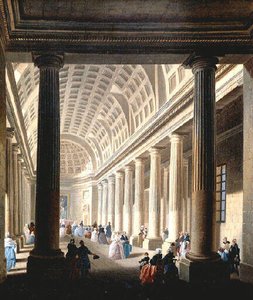
His career was marked by a remarkable ability to blend reality with imagination, creating works that served both decorative and narrative purposes. De Machy’s talent for architectural decoration earned him significant royal appointments, most notably as the decorator of stage sets for the Menus-Plaisirs du Roi. His skill in rendering the textures of stone, the decay of ancient structures, and the grandiosity of classical facades was further demonstrated through his work on the façade of the new Church of Sainte-Geneviève, now known as the Panthéon. These endeavors showcased a painter who could command the eye, using light and shadow to breathe life into static surfaces.
A Vision of Paris: Themes and Technical Mastery
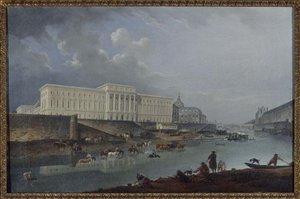
The works of De Machy often serve as a window into the soul of 18th-century Paris, capturing both its bustling commerce and its moments of dramatic transformation. He possessed a unique gift for documenting the city's evolution, from the lively atmosphere of print shops under the Colonnade to the somber, poignant scenes of urban reconstruction following fires or demolitions. His compositions frequently explored the tension between permanence and decay, utilizing meticulous techniques such as cross-hatching and stippling in his engravings to create a palpable sense of physical texture. Whether through the monochrome precision of an engraving or the delicate application of gouache, he invited viewers to contemplate the resilience of the human spirit amidst architectural ruin.
Beyond his local triumphs, De Machy’s reputation extended far beyond the borders of France. The prestige of his artistry was such that he received commissions from international figures, including a notable series of tableaux for Catherine the Great, presented by the Russian Ambassador in Paris. As his career progressed, he became a pillar of the artistic community, eventually managing his own workshop within the Palais du Louvre and teaching at the Académie. His legacy remains etched in the historical imagination of Paris, preserved through works that continue to evoke the grandeur, the shadows, and the enduring architectural spirit of a bygone era.