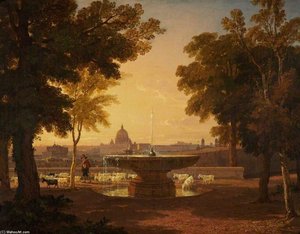
Portrait of Penry Williams

The 81 Most Famous Penry Williams Paintings, a Gallery Selection

Updated November 2026 · ranked by our popularity score (searches, visits and orders for each work) · 84 works by Penry Williams in our catalogue

In short

Of all the originals Penry Williams left, the most famous is Mediterranean Bay Seen Through An Arch. Close behind it come Painting of a young boy riding a pony (1829) and A ferry on the Ninfa, Sermoneta in the distance - a scene in the Pontine marshes, near Rome (1838). Our catalog holds 84 works by Penry Williams; the gallery has kept the 81 the world admires most, each shown with its date, its museum and its story.

1802 – 1885, Merthyr Tydfil Romanticism Most works: National Museum Cardiff

Penry Williams's top 10 paintings: the gallery's choice

1
Mediterranean Bay Seen Through An Arch by Penry Williams

Mediterranean Bay Seen Through An Arch

A heavy stone archway anchors the foreground, its surface textured by time and draped in thick, green ivy. This masonry acts as a threshold, separating the viewer from the expanse of the Mediterranean Sea. Through this opening, the water stretches toward a distant horizon in shifting shades of blue. Small sailboats drift upon the surface, their white shapes punctuating the deep azure. The sunlight hits the stone and the leaves…

2
Painting of a young boy riding a pony (1829) by Penry Williams

Painting of a young boy riding a pony

1829 · Watercolor

There is a certain stillness in this 1829 watercolor that feels almost private, as if we have stumbled upon a fleeting moment of childhood caught in the soft light of an overcast afternoon. A young boy sits atop a pony, his small frame balanced with a natural ease that suggests he is quite at home in this pastoral setting. The pony, rendered in deep shades of brown and black, appears…

3
A ferry on the Ninfa, Sermoneta in the distance - a scene in the Pontine marshes, near Rome (1838) by Penry Williams

A ferry on the Ninfa, Sermoneta in the distance - a scene in the Pontine marshes, near Rome

1838 · Oil On Canvas

The composition centers on a wooden raft navigating the calm waters of the River Ninfa. In the foreground, a group of figures occupies the vessel, their presence grounding the scene in the daily realities of 19th-century rural transport. A man’s pole creates a strong diagonal line, guiding the eye across the water toward the receding shoreline. The landscape unfolds in layers, moving from the immediate ripples of the river to…

4
A peasant family by a fountain in an Italian landscape (1862) by Penry Williams

A peasant family by a fountain in an Italian landscape

1862 · Oil On Canvas

A peasant family by a fountain in an Italian landscape emerges from the brush of Penry Williams, a painter who found his true home amidst the light of the Mediterranean. Born in Merthyr Tydfil, United Kingdom, in 1802, Williams eventually leaves his Welsh roots behind to settle in the heart of Italy. This specific scene, captured about 1862, finds its soul in the quiet rhythms of rural life. The work…

5
Italian peasants in a landscape near lake Nemi (1860) by Penry Williams

Italian peasants in a landscape near lake Nemi

1860 · Oil On Canvas

The oil on canvas captures a specific moment of midday clarity. The light is natural and direct, casting shadows that define the contours of the path and the figures. There is a sense of heat in the colors—the greens of the leaves and the warm tones of the soil suggest a sun-drenched afternoon. The sky is filled with clouds that possess a visible, textured quality, rendered with brushstrokes that suggest…

6
Fisher Boys by Penry Williams

Fisher Boys

Two figures occupy a serene shoreline, their presence anchored by a dark-hulled boat resting upon the sand. To the left, a figure in a white shirt and dark trousers stands in quiet contemplation, while beside them, a companion wears a red hat and light-colored attire typical of traditional maritime life. A single large oar leans against the vessel, a silent indicator of recent labor or the anticipation of departure. The…

7
Waterfall In The Neath Valley by Penry Williams

Waterfall In The Neath Valley

Painting

Waterfall In The Neath Valley is a painting by Penry Williams. The artist, born in 1802 in Merthyr Tydfil, was the son of a house-painter. Although his origins are in Wales, Williams spent much of his life in Rome. His background in the United Kingdom provided the foundation for a career that eventually centered in Italy.

8
Ysgwd or Scwd Fall, Neath Valley (1819) by Penry Williams

Ysgwd or Scwd Fall, Neath Valley

1819

Ysgwd or Scwd Fall, Neath Valley is a painting by Penry Williams. The work is a landscape study of a specific natural feature within the Neath Valley. This piece belongs to a body of work where the artist returned to the landscapes of his native Wales. The painting dates to about 1819.

9
Sgwd yr Henryd, Vale of Neath (1819) by Penry Williams

Sgwd yr Henryd, Vale of Neath

1819 · Oil On Board · National Museum Cardiff, Cardiff

The rushing waters of Sgwd yr Henryd, Vale of Neath find their expression through the hand of Penry Williams. Created in 1819, this work captures a specific moment of natural movement within the Welsh landscape. The artist, Penry Williams, brings a sense of life to the scene, perhaps drawing from the very air and light of the valley itself.

10
Sgwd Gwladys, Vale of Neath (1819) by Penry Williams

Sgwd Gwladys, Vale of Neath

1819 · National Museum Cardiff, Cardiff

Sgwd Gwladys, Vale of Neath is a landscape study by Penry Williams. The artist, born in 1802 in Merthyr Tydfil, United Kingdom, turned his gaze back toward the rugged terrain of his native Wales. This specific work captures a natural feature within the Neath Valley, focusing on the movement of water and the weight of the surrounding earth. It was painted about 1819.

The Penry Williams selection continues, 11 to 81

11Scene In The Roman Campagna by Penry WilliamsScene In The Roman Campagna 12The Visitation by Penry WilliamsThe Visitation 13Italian Peasant Children by Penry WilliamsItalian Peasant Children 14A Passiontide Procession by Penry WilliamsA Passiontide Procession 15The Vision Of Saint Bruno by Penry WilliamsThe Vision Of Saint BrunoMuseo del Prado 16The Temple Of Vesta, Rome by Penry WilliamsThe Temple Of Vesta, Rome 17Tivoli by Penry WilliamsTivoli 18By The Well by Penry WilliamsBy The Well 19An Italian Girl With A Tambourain On A Terrace by Penry WilliamsAn Italian Girl With A Tambourain On A Terrace 20The Shrine - by Penry WilliamsThe Shrine - 21Labourers by Penry WilliamsLabourers 22Mother and Child by Penry WilliamsMother and Child 23Porth Yr Ogof by Penry WilliamsPorth Yr Ogof 24Swansea by Penry WilliamsSwansea 25Roman Aqueduct In The Campana by Penry WilliamsRoman Aqueduct In The Campana 26Pozzuoli by Penry WilliamsPozzuoli 27Italian Peasants - by Penry WilliamsItalian Peasants - 28The Feast In The House Of Levi by Penry WilliamsThe Feast In The House Of Levi 29Gwaelod Y Garth by Penry WilliamsGwaelod Y Garth 30Santa Maria Maggiore Seen From The Gardens by Penry WilliamsSanta Maria Maggiore Seen From The Gardens 31Two Girls With A Tambourine by Penry WilliamsTwo Girls With A Tambourine 32The Ferry by Penry WilliamsThe Ferry 33South Wales Industrial Landscape by Penry WilliamsSouth Wales Industrial LandscapeNational Library of Wales 34Mass For The Reapers by Penry WilliamsMass For The Reapers 35Helping Out A Friend On The Road by Penry WilliamsHelping Out A Friend On The Road 36The Tiber With The Temple Of Vesta, Santa Maria by Penry WilliamsThe Tiber With The Temple Of Vesta, Santa Maria 37Landscape With Figures And A Ruin by Penry WilliamsLandscape With Figures And A Ruin 38An Ischian Peasant Study by Penry WilliamsAn Ischian Peasant Study 39The Temple of Vesta by Penry WilliamsThe Temple of Vesta 40A Goatherd on the Romas Campagna by Penry WilliamsA Goatherd on the Romas CampagnaMusée Des Beaux 41Two Saints by Penry WilliamsTwo Saints 42Merthyr Riots by Penry WilliamsMerthyr Riots 43The Temple Of Vesta, The Piazza Di Bocca Di Verita by Penry WilliamsThe Temple Of Vesta, The Piazza Di Bocca Di Verita 44Porth-yr-ogof, Brecknockshire by Penry WilliamsPorth-yr-ogof, Brecknockshire 45A Goatherd On The Roman Campagna by Penry WilliamsA Goatherd On The Roman Campagna 46Crawshay's Cyfarthfa Ironworks by Penry WilliamsCrawshay's Cyfarthfa Ironworks 47The Festa Of The Madonna Dell'arco At Naples by Penry WilliamsThe Festa Of The Madonna Dell'arco At Naples 48Field Marshal General Suwarrow by Penry WilliamsField Marshal General Suwarrow 49The Procession To The Christening by Penry WilliamsThe Procession To The Christening 50Bridge Over The River Taff by Penry WilliamsBridge Over The River Taff 51The Italian Family - Ferry On The River Ninfa by Penry WilliamsThe Italian Family - Ferry On The River Ninfa 52The Assumption Of The Virgin by Penry WilliamsThe Assumption Of The Virgin 53At The Well by Penry WilliamsAt The Well 54The Tambourine by Penry WilliamsThe Tambourine 55Repose by Penry WilliamsRepose 56Massacre Of The Innocents by Penry WilliamsMassacre Of The Innocents 57Cyfarthfa Castle by Penry WilliamsCyfarthfa Castle 58Saint John by Penry WilliamsSaint John 59Cyfarthfa Ironworks Interior At Night by Penry WilliamsCyfarthfa Ironworks Interior At Night 60Two Roman ladies and their children by Penry WilliamsTwo Roman ladies and their children 61Italian Goatherds by Penry WilliamsItalian Goatherds 62Merthyr Riots - by Penry WilliamsMerthyr Riots - 63Ha! Ha! I've Got The Chink by Penry WilliamsHa! Ha! I've Got The Chink 64Neapolitan Peasants At A Fountain - by Penry WilliamsNeapolitan Peasants At A Fountain - 65Sgwd Yr Eira, Vale Of Neath by Penry WilliamsSgwd Yr Eira, Vale Of Neath 66An Autumn Festival by Penry WilliamsAn Autumn Festival 67Peasant Girls – Sorrento by Penry WilliamsPeasant Girls – Sorrento 68Pilgrims Reposing At A Cross by Penry WilliamsPilgrims Reposing At A Cross 69Sgwd Gwladys, Vale Of Neath by Penry WilliamsSgwd Gwladys, Vale Of Neath 70Subiaco by Penry WilliamsSubiaco 71Procession To The Christening Near Araccia by Penry WilliamsProcession To The Christening Near Araccia 72The Shrine by Penry WilliamsThe Shrine 73A Mother And Child Beneath An Arbour At Evening by Penry WilliamsA Mother And Child Beneath An Arbour At Evening 74Upper Clyngwyn Fall Or Hendrebolon Fall, Neath Valley by Penry WilliamsUpper Clyngwyn Fall Or Hendrebolon Fall, Neath Valley 75The Shrine - by Penry WilliamsThe Shrine - 76The Grape Pickers; And Figures In An Extensive Landscape by Penry WilliamsThe Grape Pickers; And Figures In An Extensive Landscape 77A Distant View Of Saint Peter's, Rome by Penry WilliamsA Distant View Of Saint Peter's, Rome 78Eionon Garn On The Perddyn Or Ysgwd Or Scwd Fall, Neath Valley by Penry WilliamsEionon Garn On The Perddyn Or Ysgwd Or Scwd Fall, Neath Valley 79Spanish Lady by Penry WilliamsSpanish LadyBavarian State Painting Collections 80Italian Girl With Tambourine by Penry WilliamsItalian Girl With Tambourine 81Italian Peasants by Penry WilliamsItalian Peasants

Penry Williams's famous paintings, period by period

The subjects that held Penry Williams's eye

The four subjects that come back most often in these originals, each with its finest example.

The museums that keep Penry Williams's originals

The 5 museums that hold the most of the paintings on this page.

Museum City Works by Penry Williams Paintings from this list
National Museum Cardiff, CardiffNational Museum Cardiff Cardiff 2 Sgwd yr Henryd, Vale of Neath, Sgwd Gwladys, Vale of Neath
Museo del Prado, MadridMuseo del Prado Madrid 1 The Vision Of Saint Bruno
National Library of Wales, AberystwythNational Library of Wales Aberystwyth 1 South Wales Industrial Landscape
Musée Des Beaux, Québec CityMusée Des Beaux Québec City 1 A Goatherd on the Romas Campagna
Bavarian State Painting Collections, MunichBavarian State Painting Collections Munich 1 Spanish Lady

Penry Williams decade by decade: the original that defines each

Works per decade

Pick a decade to see the original that defines it.

Collectors' questions about Penry Williams's paintings

Which work is Penry Williams most famous for?Reveal the answer

Mediterranean Bay Seen Through An Arch. Painting of a young boy riding a pony (1829) and A ferry on the Ninfa, Sermoneta in the distance - a scene in the Pontine marshes, near Rome (1838) come next.

What are the ten most famous Penry Williams paintings?Reveal the answer

Mediterranean Bay Seen Through An Arch, Painting of a young boy riding a pony, A ferry on the Ninfa, Sermoneta in the distance - a scene in the Pontine marshes, near Rome, A peasant family by a fountain in an Italian landscape, Italian peasants in a landscape near lake Nemi, Fisher Boys, Waterfall In The Neath Valley, Ysgwd or Scwd Fall, Neath Valley, Sgwd yr Henryd, Vale of Neath and Sgwd Gwladys, Vale of Neath. The ranking above gives each one's year and museum.

How many paintings did Penry Williams leave?Reveal the answer

Our catalog holds 84 works by Penry Williams, dated from 1819 to 1862.

In which museums do Penry Williams's masterpieces hang?Reveal the answer

Mostly in National Museum Cardiff (Cardiff), Museo del Prado (Madrid) and National Library of Wales (Aberystwyth). The museum table above lists them all.

In which years did Penry Williams paint the most famous works?Reveal the answer

In 1810s: 3 of the 81 works on this page were made then, Ysgwd or Scwd Fall, Neath Valley among them.

What are the first and the last famous originals of Penry Williams?Reveal the answer

On this page, the earliest is Ysgwd or Scwd Fall, Neath Valley (1819) and the latest A peasant family by a fountain in an Italian landscape (1862).

Which subjects did Penry Williams choose most often?Reveal the answer

Landscape (8), Trees (6) and Hills (5), across the 81 works on this page.

Which technique did Penry Williams use most?Reveal the answer

Oil On Canvas, for 13 of the 81 works on this page.

To which art movement does Penry Williams belong?Reveal the answer

Romanticism, judging by the originals on this page.

Which Penry Williams works hang at the National Museum Cardiff?Reveal the answer

Sgwd yr Henryd, Vale of Neath and Sgwd Gwladys, Vale of Neath: the National Museum Cardiff, Cardiff holds 2 of the works on this page.

Penry Williams: life and work

Penry Williams: A Roman Visionary

Penry Williams, a name perhaps less familiar than many of his contemporaries, stands as a significant figure in 19th-century British art – specifically, the vibrant and influential world of Italian landscape painting. Born in Merthyr Tydfil, Wales, in 1802, to a house painter, Williams’s artistic journey began with a formal education in London, nurtured by exposure to the Royal Academy and its esteemed instructors like Henry Fuseli. However, it was his relocation to Rome in 1827 that truly defined his career and established him as a respected artist within the English expatriate community of the city. More than simply a recorder of Italian scenery, Williams possessed a remarkable ability to capture not just the visual beauty but also the atmosphere and spirit of Roman life, imbuing his works with a sense of realism tempered by a Romantic sensibility.

His early training instilled in him a solid foundation in drawing and composition. The Royal Academy’s curriculum provided a rigorous grounding in classical art principles, while Fuseli's influence is evident in Williams’s initial portraits – characterized by dramatic lighting and expressive characterization. The silver medal he won from the Society of Arts in 1821 for a “drawing from the antique” signaled his burgeoning talent and marked a pivotal moment in his artistic development. This early success paved the way for his subsequent exploration of landscape painting, a genre that would ultimately become his hallmark.

A Roman Studio and Artistic Development

Williams’s decision to settle permanently in Rome was transformative. The city became not just a subject for his paintings but also his home and studio. His Roman workshop quickly gained recognition as one of the most popular destinations for English visitors, offering a glimpse into the life and work of a successful artist living abroad. This established environment allowed him to refine his technique and develop a distinctive style – one that blended meticulous observation with a lyrical approach to color and light.

Throughout the 1830s and 40s, Williams exhibited regularly at the Royal Academy, British Institution, and Society of British Artists in London. His subjects during this period included portraits and scenes from England, but it was his Italian landscapes that truly captivated audiences. He meticulously studied the light, color, and atmosphere of the Roman countryside, creating paintings that were both realistic and imbued with a sense of romanticism. His works often depicted everyday life – peasants working in the fields, bustling market squares, and serene riverbanks – offering viewers an intimate glimpse into the rhythms of Italian society.

Key Works and Artistic Style

Several of Williams’s paintings stand out as particularly noteworthy examples of his artistic skill and vision. “The Festa of the Madonna dell’ Arco” (engraved by D. Lucas, 1830) is a vibrant depiction of a religious procession in Rome, capturing the energy and excitement of the event with remarkable detail. “Ferry on the River Ninfa” showcases his ability to render the shimmering surface of water and the lush vegetation of the surrounding landscape. “Il Voto, or the Convalescent,” offers a poignant portrayal of a sick man receiving care in a Roman garden, demonstrating his sensitivity to human emotion.

Williams’s style can be characterized as conventional Italian landscape painting – he adhered to established techniques and conventions of the genre. However, he possessed a unique ability to infuse his works with a sense of immediacy and authenticity. His paintings are not merely picturesque representations of Italy; they are imbued with a palpable atmosphere—a feeling of warmth, light, and human connection. His use of color was particularly noteworthy, employing a rich palette of earthy tones and vibrant hues to create a sense of depth and realism.

Legacy and Recognition

Penry Williams died in Rome on July 27, 1885, leaving behind a substantial body of work that continues to be appreciated for its beauty and artistic merit. His paintings were acquired by prestigious institutions such as the National Gallery and Tate Gallery, solidifying his place in British art history. His legacy extends beyond his individual works; he helped establish a tradition of English landscape painting in Italy, inspiring generations of artists to explore the beauty and richness of the Italian countryside.

Today, Williams’s paintings offer a valuable window into 19th-century life—both in England and Italy. They are testaments to his artistic skill, his keen observation, and his ability to capture the essence of a particular place and time. His work remains a vibrant reminder of the enduring appeal of landscape painting and the transformative power of art.