The Distinguished Legacy of Sir Oswald Birley
Sir Oswald Hornby Joseph Birley stands as a monumental figure in the history of British portraiture, an artist whose brush captured the very essence of an era defined by transition and grandeur. Born on March 31st, 1880, to a lineage steeped in military significance—his father, Hugh Francis Birley, was a man of notable historical weight—Birley’s early life was shaped by the disciplined traditions of the British upper class. His formative years at Harrow School and Trinity College, Cambridge, provided more than just an elite education; they instilled in him a profound appreciation for classical scholarship and a meticulous eye for detail that would later become the hallmark of his artistic mastery. This intellectual foundation allowed him to approach portraiture not merely as a technical exercise, but as a deep psychological exploration of his subjects.
The trajectory of Birley’s life was irrevocably altered by the onset of the Great War. Serving with distinction in the Royal Fusiliers and later within the Intelligence Corps, he demonstrated a bravery that earned him the Military Cross in 1919. This period of intense conflict and service brought a unique depth to his character, infusing his later work with a profound understanding of human resilience, leadership, and the weight of responsibility. The shadows of war and the gravity of wartime intelligence likely contributed to the subtle, soulful realism found in his depictions of the world's most influential figures, allowing him to look beyond the surface of fame to find the humanity beneath.
A Master of Royal and Global Portraiture
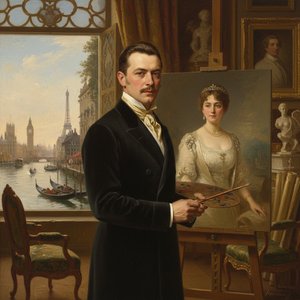
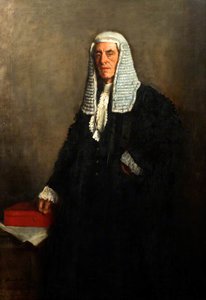
Birley’s ascent to the pinnacle of the art world was cemented through his extraordinary relationship with the British Monarchy. Securing the patronage of King George V and Queen Mary, he became the preeminent chronicler of the Edwardian and interwar periods. His style, characterized by an exquisite command of light, subtle tonal gradations, and a meticulous attention to texture, allowed him to render the regalia of royalty with breathtaking accuracy while maintaining an intimate connection to the sitter's spirit. He did not merely paint crowns and ermine; he painted the dignity and the burden of sovereignty.
Beyond the palace walls, Birley’s reach was truly global, as his talent attracted the most significant leaders of the 20th century. His portfolio serves as a visual record of history, featuring iconic likenesses of figures such as:
- Winston Churchill, capturing the resolute spirit of British leadership.
- Mahatma Gandhi, portraying the profound simplicity and strength of the Indian independence movement.
- Members of the British Royal Family, documenting the continuity of tradition through changing decades.
His ability to pivot between the opulent settings of the aristocracy and the stark, powerful presence of political revolutionaries demonstrates a versatile genius. Through his work, the textures of silk and velvet are balanced against the raw, psychological intensity of his subjects' gazes, creating a body of work that is as much about character as it is about composition.
Artistic Technique and Historical Significance
The enduring significance of Sir Oswald Birley lies in his ability to bridge the gap between traditional academic portraiture and a more modern, psychological realism. While his technique remained rooted in the classical traditions of fine detail and formal elegance, his focus on the inner life of his subjects predated much of the emotive depth seen in later portraitists. He possessed a rare ability to use light not just to define form, but to suggest mood and historical weight. Every stroke was deliberate, contributing to an atmosphere of permanence and remembrance.
As we look back upon his life and work, Birley remains more than just a painter of the elite; he was a historian of the human face. His portraits serve as windows into a vanished world, preserving the likenesses of those who shaped the modern age. Through his mastery of the medium, Sir Oswald Birley ensured that the dignity, the struggle, and the triumphs of his subjects would remain etched in the collective memory of the art world forever.
Questions & Answers
Where can I see Oswald Hornby Joseph Birley's artworks arranged by atmosphere?
Oswald Hornby Joseph Birley's works can be browsed by mood on the artist's Mood Room page, which arranges the artworks by their recorded moods.
What aliases or alternate names does Oswald Hornby Joseph Birley have?
Oswald Hornby Joseph Birley is also known as Sir Oswald Hornby Joseph Birley.
Can I visit a virtual museum of Oswald Hornby Joseph Birley's works?
A virtual visit is possible: the 3D Museum page of Oswald Hornby Joseph Birley presents the artist's works in a three-dimensional gallery.