The Dual Legacy of Oh Yong-kil: From the Pitch to the Canvas
The life of Oh Yong-kil is a rare tapestry woven from two seemingly disparate worlds: the high-stakes intensity of international athletics and the quiet, contemplative stillness of landscape painting. Born in 1944 in Uijeongbu, South Korea, his early years were defined by a physical prowess that would eventually lead him to the global stage of football. As a formidable defender for North Korea during the historic 1966 FIFA World Cup, Yong-kil experienced the raw energy, movement, and structural discipline of professional sport. This period of his life, marked by the adrenaline of competition and the keen observation required of an athlete, provided a foundational understanding of form and rhythm that would later breathe life into his artistic compositions.
Yet, beneath the surface of this sporting legend lay a burgeoning intellectual and aesthetic curiosity. His journey took him from the athletic fields of Pyongyang to the prestigious halls of Seoul National University, where he pursued a degree in German Literature. This academic immersion in language and narrative likely deepened his ability to communicate through visual metaphors. His subsequent move to Germany for postgraduate studies in economics further expanded his worldview, exposing him to the profound currents of European thought and the subtle nuances of German Expressionism. It was this intersection of Korean heritage and European intellectual tradition that would ultimately shape his unique painterly voice.
A Vision of Serenity: The Ewha Landscapes
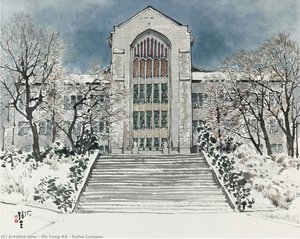
When Yong-kil transitioned from the world of economics and literature to the realm of fine art, he did not seek out grand, sweeping historical narratives; instead, he turned his gaze toward the intimate and the everyday. His body of work is most profoundly realized through his depictions of the Ewha Campus in Seoul. In these paintings, the artist transcends mere representation, transforming familiar campus architecture and seasonal shifts into vessels for emotional resonance. He captures the essence of a place—not just its physical dimensions, but its atmospheric soul.
His technique is a masterclass in restraint and subtlety. Eschewing jarring contrasts, Yong-kil utilizes muted palettes and delicate, deliberate brushstrokes to evoke a sense of profound peace. One can observe how he treats light and shadow not as dramatic tools for tension, but as soft elements that blend the boundaries between nature and man-made structures. In works such as Main Hall of Ewha Campus in Autumn, the viewer is invited into a space of deep meditation, where the changing colors of the season serve as a poignant reminder of the cyclical beauty of life.
Artistic Significance and Lasting Impression
The historical significance of Oh Yong-kil lies in his ability to bridge the gap between the physical and the spiritual. He proves that the discipline required for elite sport and the sensitivity required for fine art are not contradictory, but rather complementary facets of a single, observant life. His work stands as a testament to the power of contemplative observation, offering a sanctuary of calm in an increasingly chaotic world.
Through his paintings, Yong-kil has achieved several enduring milestones:
- Synthesis of Disciplines: Successfully merging the kinetic energy of his footballing past with the static beauty of landscape art.
- Cultural Dialogue: Creating a visual language that reflects both Korean landscapes and the influence of European Expressionist sensibilities.
- Emotional Resonance: Establishing a specialized niche in contemporary landscape painting focused on the "feeling" of a space rather than just its appearance.
Today, his works remain vital touchstones for those seeking to understand the intersection of movement and stillness, making him a singular figure in the narrative of modern Korean art.