Portrait of Nicholas Chevalier

The 21 Most Famous Nicholas Chevalier Paintings, a Gallery Selection

Updated November 2026 · ranked by our popularity score (searches, visits and orders for each work) · 25 works by Nicholas Chevalier in our catalogue

In short

Of all the originals Nicholas Chevalier left, the most famous is Hinemoa, the Maori girl (1880), in the collection of the National Gallery of Australia, Canberra. Close behind it come Race to the market, Tahiti (1880) and Self portrait (1857). Our catalog holds 25 works by Nicholas Chevalier; the gallery has kept the 21 the world admires most, each shown with its date, its museum and its story.

1828 – 1902, Saint Petersburg Realism Most works: Te Papa

Nicholas Chevalier's top 10 paintings: the gallery's choice

1
Hinemoa, the Maori girl (1880) by Nicholas Chevalier

Hinemoa, the Maori girl

1880 · Oil · National Gallery of Australia, Canberra

The oil painting titled Hinemoa, the Maori girl was executed by the Russian-born artist Nicholas Chevalier. Created about 1880, the work depicts a Maori woman named Hinemoa. The subject is a woman of the Te Arawa people. This specific figure is recognized in Māori tradition for her swim across the waters of Lake Rotorua to Mokoia island to reach Tūtānekai.

2
Race to the market, Tahiti (1880) by Nicholas Chevalier

Race to the market, Tahiti

1880 · Oil · Art Gallery of New South Wales, Sydney

In this 1880 oil painting, two outrigger canoes navigate through turquoise and cerulean waters. The composition follows a diagonal path from the lower right toward the left midground, creating a sense of movement across the sea. Figures within the vessels transport various goods, including tropical fruits and shells. The water's surface reflects the midday sun, producing bright highlights and soft shadows. In the background, vertical palm trees and jagged mountain…

3
Self portrait (1857) by Nicholas Chevalier

Self portrait

1857 · Oil On Canvas · Art Gallery of New South Wales, Sydney

This oil on canvas work is titled "Self portrait" and was executed by the artist Nicholas Chevalier. The painting, created in 1857, presents a close-up view of the artist's head and shoulders. The subject is positioned slightly off-center within the frame, looking directly toward the viewer with a piercing gaze. The composition focuses on the facial features and the textures of the subject's beard and clothing.

4
Memorandum of the Start of the Exploring Expedition (1860) by Nicholas Chevalier

Memorandum of the Start of the Exploring Expedition

1860 · Oil · Art Gallery of South Australia, Adelaide

In the vast, sun-drenched expanse of the mid-19th century landscape, Nicholas Chevalier captures more than just a moment in time; he captures the very essence of human ambition. Memorandum of the Start of the Exploring Expedition serves as a breathtaking window into an era defined by discovery and the relentless pursuit of the unknown. The painting presents a sweeping historical tableau where a group of intrepid travelers, mounted on sturdy…

5
Cook (1875) by Nicholas Chevalier

Cook

1875 · Watercolor · Te Papa, Wellington

This evocative watercolor by Nicholas Chevalier transports the viewer directly to a sun-drenched stretch of New Zealand coastline around 1875. The scene is imbued with the quiet rhythm of leisure, capturing a moment where human activity harmoniously intersects with the vast, untamed power of nature. One can almost hear the gentle lapping of waves against the sand and feel the warmth of the coastal breeze. Chevalier masterfully frames this idyllic…

6
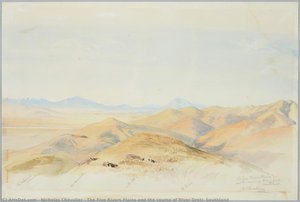
The Five Rivers Plains and the course of River Oreti, Southland (1866) by Nicholas Chevalier

The Five Rivers Plains and the course of River Oreti, Southland

1866 · Watercolor · Te Papa, Wellington

In the delicate, translucent layers of The Five Rivers Plains and the course of River Oreti, Southland, we are transported back to the year 1866, witnessing a moment of profound stillness in the New Zealand landscape. Nicholas Chevalier, a master of capturing the atmospheric nuances of the colonial frontier, presents us with a watercolor that breathes with the vitality of the natural world. The composition unfolds across the vast, grassy…

7
Noon Cannon (1780) by Nicholas Chevalier

Noon Cannon

Noon Cannon by Nicholas Chevalier presents a meticulously crafted diorama centered on a brass astronomical clock, or quadrant, and a small, antique cannon. These objects rest upon a circular marble base featuring detailed markings in Latin. The composition focuses directly on the relationship between these two instruments, emphasizing their geometric forms and the precision of their construction. The arrangement highlights the intersection of 18th-century scientific inquiry and military technology.

The Nicholas Chevalier selection continues, 11 to 21

The subjects that held Nicholas Chevalier's eye

The four subjects that come back most often in these originals, each with its finest example.

The museums that keep Nicholas Chevalier's originals

The 8 museums that hold the most of the paintings on this page.

Museum City Works by Nicholas Chevalier Paintings from this list
Te Papa, WellingtonTe Papa Wellington 8 Cook, The Five Rivers Plains and the course of River Oreti, Southland, Sketch at Maxwell
Art Gallery of New South Wales, SydneyArt Gallery of New South Wales Sydney 3 Race to the market, Tahiti, Self portrait, Cape Girão, Madeira
Royal Collection, LondonRoyal Collection London 3 The Review in Windsor Great Park in Honour of the Shah of Persia, 24 June 1873, 'Thanksgiving Day': The Procession to St Paul's Cathedral, 27 February 1872, The Marriage of Prince Alfred, Duke of Edinburgh, 23 January 1874
National Gallery of Australia, CanberraNational Gallery of Australia Canberra 1 Hinemoa, the Maori girl
Art Gallery of South Australia, AdelaideArt Gallery of South Australia Adelaide 1 Memorandum of the Start of the Exploring Expedition
National Watch - Clock Museum, ColombiaNational Watch - Clock Museum Colombia 1 Noon Cannon
National Gallery of Victoria, MelbourneNational Gallery of Victoria Melbourne 1 The Buffalo Ranges
National Museum in Kraków, KrakowNational Museum in Kraków Krakow 1 Harvest

Nicholas Chevalier decade by decade: the original that defines each

Works per decade

Pick a decade to see the original that defines it.

Collectors' questions about Nicholas Chevalier's paintings

Which work is Nicholas Chevalier most famous for?Reveal the answer

Hinemoa, the Maori girl (1880), National Gallery of Australia, Canberra. Race to the market, Tahiti (1880) and Self portrait (1857) come next.

What age was Nicholas Chevalier when Hinemoa, the Maori girl was made?Reveal the answer

52 years old: Hinemoa, the Maori girl dates from 1880, and Nicholas Chevalier was born in 1828.

What are the ten most famous Nicholas Chevalier paintings?Reveal the answer

Hinemoa, the Maori girl, Race to the market, Tahiti, Self portrait, Memorandum of the Start of the Exploring Expedition, Cook, The Five Rivers Plains and the course of River Oreti, Southland, Noon Cannon, The Buffalo Ranges, Sketch at Maxwell and Sketch of soldiers manning a redoubt. From: journal made on a visit to the disturbed District of. The ranking above gives each one's year and museum.

How many paintings did Nicholas Chevalier leave?Reveal the answer

Our catalog holds 25 works by Nicholas Chevalier, dated from 1857 to 1895.

In which museums do Nicholas Chevalier's masterpieces hang?Reveal the answer

Mostly in Te Papa (Wellington), Art Gallery of New South Wales (Sydney) and Royal Collection (London). The museum table above lists them all.

In which years did Nicholas Chevalier paint the most famous works?Reveal the answer

In 1860s: 8 of the 21 works on this page were made then, Memorandum of the Start of the Exploring Expedition among them.

What are the first and the last famous originals of Nicholas Chevalier?Reveal the answer

On this page, the earliest is Self portrait (1857) and the latest Cape Girão, Madeira (1895).

Which subjects did Nicholas Chevalier choose most often?Reveal the answer

Landscape (3), Mountains (3) and Canoe (2), across the 21 works on this page.

Which technique did Nicholas Chevalier use most?Reveal the answer

Watercolor, for 4 of the 21 works on this page.

To which art movement does Nicholas Chevalier belong?Reveal the answer

Realism, judging by the originals on this page.

Which Nicholas Chevalier works hang at the Te Papa?Reveal the answer

Cook, The Five Rivers Plains and the course of River Oreti, Southland and Sketch at Maxwell: the Te Papa, Wellington holds 8 of the works on this page.

Nicholas Chevalier: life and work

early life and career

nicholas chevalier, a russian-born artist, left an indelible mark on the art world with his works in australia and new zealand. born on may 9, 1828, in st petersburg, russia, chevalier was the son of louis chevalier, who oversaw the estates of prince de wittgenstein in russia. his mother was russian. in 1845, nicholas left russia with his father, studying painting and architecture in lausanne, switzerland, and at munich.

artistic journey

chevalier's artistic journey took him to london in 1851, where he worked as an illustrator in lithography and watercolour. his designs included a fountain erected in the royal grounds at osborne, and two of his paintings were showcased at the academy in 1852. further study in rome preceded his move to australia in late 1854.
  • mount arapiles, a painting from this period, is one of his most recognized pieces.
  • he collaborated with lady barkly on a present for the princess of wales, featuring australian life icons.
  • in 1864, his oil painting the buffalo ranges was selected by the national gallery of victoria, making it the first picture painted in australia to be included in the melbourne collection.

legacy and later life

chevalier's later life saw him commissioned by queen victoria to paint a picture of the duke of edinburgh's marriage. he made london his base, exhibiting at the academy from 1871 to 1887. though he practically gave up painting by 1895, his legacy endures.

explore more

for a deeper dive into chevalier's work, visit [https://OriginalUniqueArt.com/@/nicholas-chevalier](https://OriginalUniqueArt.com/@/nicholas-chevalier) to explore his paintings and learn more about his artistic journey. wikipedia also offers an in-depth look at his life and career: [https://en.wikipedia.org/wiki/nicholas_chevalier](https://en.wikipedia.org/wiki/nicholas_chevalier). discover the musée baron gérard (france) and its masterpieces, a must-visit destination for art lovers, showcasing works from prehistory to the 20th century: /en/art/show/art-d3cest-en/