Early Life and Artistic Beginnings
Narcisse Virgilio Díaz de la Peña’s life was a testament to resilience, his artistic journey blossoming despite the hardships that marked his early years. Born in Bordeaux in 1807 to Spanish parents, he experienced profound loss early on, becoming an orphan at the age of ten. This period of vulnerability and challenge was further compounded by a tragic accident – a reptile bite that necessitated the amputation of his leg. Yet, rather than succumbing to adversity, Díaz channeled his experiences into a fervent pursuit of art.
His initial artistic training began with copying masterpieces at the Louvre, immersing himself in the works of masters like Correggio, Prud'hon, and Watteau. These early studies laid the foundation for his technical skill and instilled within him an appreciation for classical beauty and romantic sensibility. His first paintings reflected this influence, often depicting mythological scenes and *fêtes galantes*, echoing the elegant world of 18th-century art. However, a pivotal moment arrived in 1836 when Díaz connected with the burgeoning Barbizon school, forever altering the course of his artistic development.
Embracing Nature: The Barbizon Years
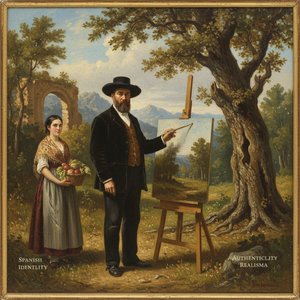
The association with the Barbizon school proved transformative for Díaz. He wholeheartedly embraced their philosophy of *en plein air* painting – venturing outdoors to capture the essence of nature directly from observation. This marked a significant departure from the studio-based traditions that had previously dominated artistic practice.
Díaz’s work during this period was profoundly influenced by his contemporaries, particularly Eugène Delacroix and Théodore Rousseau. From Delacroix, he absorbed an interest in exotic themes and vibrant color palettes, while Rousseau instilled within him a deep reverence for the French landscape. He began to focus on woodland interiors, skillfully rendering dramatic contrasts of light and shadow with heavily applied paint – a technique that would become his signature style.
His dedication and talent did not go unnoticed; Díaz exhibited regularly at the Salon, steadily gaining recognition within the Parisian art world. These exhibitions provided him with crucial exposure and helped establish his reputation as a rising star of the Barbizon school.
Maturity and Recognition
By 1851, Narcisse Díaz de la Peña had established a studio in Paris, becoming an integral part of the vibrant artistic community. This period marked a culmination of his years of dedication and experimentation. He continued to refine his distinctive style, characterized by its evocative atmosphere and masterful handling of light and texture.
His talent was formally acknowledged with numerous accolades, including three Salon gold medals and appointment as a Knight of the Legion of Honor – prestigious honors that affirmed his standing within the artistic establishment. As the 1870s progressed, Díaz’s paintings grew increasingly popular and valuable, reflecting a growing appreciation for his unique vision.
Beyond his professional achievements, Díaz enjoyed a fulfilling personal life, marrying and raising two sons, Emile and Eugene. His family provided him with stability and support as he continued to pursue his artistic passions.
Legacy of a Barbizon Master
Narcisse Virgilio Díaz de la Peña occupies a significant place in the history of 19th-century art, not only as a prominent representative of the Barbizon school but also as a pioneer of *en plein air* painting. His commitment to capturing the beauty and authenticity of nature paved the way for future generations of artists, including the Impressionists.
His influence extended beyond his immediate circle, inspiring artists to embrace a more direct and intimate relationship with the natural world. Renoir famously called him “my hero,” acknowledging Díaz’s profound impact on his own artistic development. Today, his paintings are held in esteemed collections worldwide, including The Louvre, The Metropolitan Museum of Art, and numerous other museums – a testament to his enduring legacy.
Díaz's work continues to resonate with viewers today, offering a glimpse into the soul of the French landscape and the artistic spirit of a man who overcame adversity to achieve lasting recognition. His evocative forest scenes and dramatic compositions stand as powerful reminders of the beauty and power of nature – a legacy that will continue to inspire for generations to come.
Questions & Answers
Where are Narcisse Diaz de la Peña's artworks organized by color?
Narcisse Diaz de la Peña's works can be explored by color on the artist's Spectral Index page.
How do I find all works by Narcisse Diaz de la Peña in a given medium?
Narcisse Diaz de la Peña's works can be browsed by medium on the artist's All Medium page.
What are the birth city and country of Narcisse Diaz de la Peña?
Narcisse Diaz de la Peña was born in Bordeaux, in France.