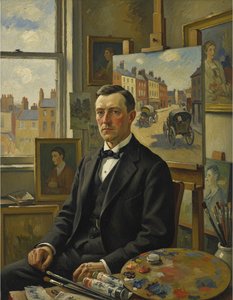
A Pioneer of the Canadian Spirit: The Life and Art of Lawren Stewart Harris
Lawren Stewart Harris, born in Brantford, Ontario, in 1885, wasn’t merely a painter; he was an architect of Canadian identity. Emerging from a privileged background – his family's wealth stemming from the Massey-Harris agricultural machinery empire – Harris possessed the financial freedom to dedicate himself wholly to artistic exploration. This independence allowed him to forge a path distinct from European traditions, becoming a pivotal figure in defining a uniquely Canadian aesthetic. From an early age, he demonstrated a keen interest in art, pursuing formal training first in Berlin and then returning to Canada with a broadened perspective, yet one that would soon be redirected towards capturing the essence of his homeland.
Harris’s artistic journey truly ignited with his involvement in the formation of the Group of Seven. This collective of artists – including J.E.H. MacDonald, Franklin Carmichael, and A.Y. Jackson – shared a revolutionary vision: to move beyond imitation of European styles and depict the raw, untamed beauty of the Canadian landscape with bold originality. Harris wasn’t simply a member; he was a catalyst, providing both financial support and intellectual leadership that propelled the group forward. He believed in a spiritual connection to the land, viewing the vast forests, rugged mountains, and icy northern expanses as subjects worthy of profound artistic reverence.
The Evolution of Style: From Impressionism to Abstraction
Harris’s style underwent a remarkable transformation throughout his career. Initially influenced by Impressionism and Post-Impressionism acquired during his European studies, his early works displayed a vibrant palette and a focus on capturing light and atmosphere. However, this approach soon gave way to something far more distinctive. Inspired by the stark beauty of Algoma and later, the dramatic landscapes of Lake Superior and the Arctic, Harris began to simplify his compositions, reducing forms to their essential geometric shapes and employing a restrained color scheme. This wasn’t merely an aesthetic choice; it was a deliberate attempt to convey the spiritual power and enduring quality of the Canadian wilderness.
The 1920s marked a period of radical experimentation for Harris. He increasingly moved towards abstraction, stripping away representational details in favor of conveying emotional and symbolic meaning through color, line, and form. Notably, he even ceased signing and dating his works, believing that the art should stand on its own merit, unburdened by the artist’s identity or historical context. This bold move underscored his commitment to a purely visual experience, inviting viewers to engage with the paintings on a deeper, more intuitive level. Later in life, Harris embraced complete abstraction, co-founding the Transcendental Painting Group in New Mexico and exploring non-objective art that sought to express universal spiritual truths.
Legacy and Impact: A Lasting Impression
Lawren Harris’s contributions to Canadian art are immeasurable. As a founding member of the Group of Seven, he played an instrumental role in establishing Canada's first internationally recognized modern art movement. His paintings not only captured the physical beauty of the landscape but also evoked a sense of national pride and identity. He helped Canadians see their own country with new eyes, recognizing its unique character and spiritual significance.
Beyond his artistic achievements, Harris was a dedicated advocate for Canadian culture. He actively promoted the work of other artists and championed the importance of art education. His influence extended beyond painting, inspiring generations of artists to explore their own creative visions and embrace the challenges of forging a distinctly Canadian voice in the global art world.
In 1969, Harris was rightfully honored as a Companion of the Order of Canada, recognizing his lifetime dedication to artistic excellence and his profound impact on the nation’s cultural landscape. His works continue to be exhibited in major museums across Canada and internationally, ensuring that his legacy endures for generations to come. To experience the power of Lawren Harris is to connect with the very soul of Canada – a land of vastness, beauty, and enduring spirit.
- Notable Works: “Above Lake Superior” (1922), “Algoma Country,” “Houses, Chestnut Street”, "Northern Lake", "Mountains, Moraine Lake".
- Further Exploration: Discover more about Lawren Harris on Wikipedia and explore the collection at The McMichael Canadian Art Collection.
Questions & Answers
Where are Lawren Stewart Harris's artworks grouped by technique?
The All Medium page groups Lawren Stewart Harris's artworks by technique.
Where are Lawren Stewart Harris's artworks grouped by keywords?
To find works by Lawren Stewart Harris on a specific theme, use the artist's By Keywords page, which groups the artworks by keyword.
Can I visit a virtual museum of Lawren Stewart Harris's works?
Lawren Stewart Harris's artworks can be seen in a 3D gallery on the artist's 3D Museum page.