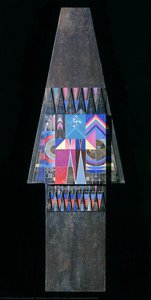
Portrait of Karl Schmid

Karl Schmid Paintings: The 23 Most Famous, Through a Gallery's Eye

Updated November 2026 · ranked by our popularity score (searches, visits and orders for each work) · 23 works by Karl Schmid in our catalogue

In short

To the gallery's eye, Karl Schmid's most famous painting is Untitled Poitn of view 1 (1986), whose original hangs in the USI Università della Svizzera italiana, Lugano. Untitled Side 1 (1989) and Untitled (1998) complete the trio every eye recognises. Of the 23 works by Karl Schmid in our catalog, the gallery presents the 23 most famous below, each original with its year, its museum and what makes it unique.

1914 – 1998, Zurich Abstract art Most works: USI Università della Svizzera italiana

The gallery's top 10 Karl Schmid paintings

1
Untitled Poitn of view 1 (1986) by Karl Schmid

Untitled Poitn of view 1

1986 · Sculpture · USI Università della Svizzera italiana, Lugano

In this 1986 work, we encounter a singular red spiral that commands the space it occupies. It rests upon a white table, a placement that creates a sharp, immediate contrast between the object and its environment. The sculpture's shape is a continuous, winding movement, a woven or shaped form that suggests a tension between the material's rigidity and the fluidity of its curve. It is a quiet study in how…

2
Untitled Side 1 (1989) by Karl Schmid

Untitled Side 1

1989 · Sculpture · USI Università della Svizzera italiana, Lugano

A weathered metal spiral dominates the composition, its form emerging from a series of interconnected, curved rods. The sculpture is defined by a heavy, rusted patina that coats the steel in shades of deep brown and burnt orange. Positioned outdoors on a stone surface, the work interacts with the natural environment, catching the direct light of a bright sun to cast sharp, rhythmic shadows across the ground. The circular movement…

3
Untitled (1998) by Karl Schmid

Untitled

1998 · Painting · USI Università della Svizzera italiana, Lugano

This vibrant abstract composition, titled Untitled, immediately draws the eye into a dazzling interplay of form and hue. It is a testament to the power of pure visual language, where color does not merely decorate but actively participates in the structure of the piece. The canvas explodes with an energetic palette—deep blues meeting fiery reds, softened by ethereal purples, punctuated by bursts of sunny yellow, delicate pinks, and grounding touches…

4
Untitled (1979) by Karl Schmid

Untitled

1979 · Painting · USI Università della Svizzera italiana, Lugano

To stand before Untitled is to encounter a vibrant conversation between structure and spontaneity. This painting, executed in 1979, does not merely hang on a wall; it activates the space around it with its sheer chromatic energy. Karl Schmid, the Swiss master whose career spanned an intriguing dialogue between art and science, presents here a composition that feels both rigorously planned and delightfully free. The eye is immediately drawn into…

5
Untitled (1959) by Karl Schmid

Untitled

1959 · Digital Illustration · USI Università della Svizzera italiana, Lugano

The darkness of the black background recedes, allowing a structured, golden lyre to emerge from the void. It is a vision of pure geometry, where intersecting lines of gold slice through the shadows to define a form that feels both ancient and modern. The subject is not a literal instrument but a rhythmic arrangement of light and precision. Every line carries a weight of intention, creating a sense of depth…

6
Spiritual Work (orig. Spirituelles Werk) (1986) by Karl Schmid

Spiritual Work (orig. Spirituelles Werk)

1986 · Acrylic · USI Università della Svizzera italiana, Lugano

The canvas holds a circular world, a dense arrangement of shapes that pulse against a dark, muted grey-blue background. Rectangles and triangles intersect in a controlled chaos, creating a layered landscape that feels both fragmented and rhythmic. Within this composition, a brilliant yellow core radiates warmth, acting as a solar center. Swirling orange flames dance around this light, moving with a deliberate, patterned energy. The edges of these forms are…

7
From Pear Tree and Patience (orig. Aus Birnbaum und Geduld) (1962) by Karl Schmid

From Pear Tree and Patience (orig. Aus Birnbaum und Geduld)

In the evocative piece From Pear Tree and Patience (orig. Aus Birnbaum und Geduld), created in 1962 by the Swiss master Karl Schmid, we are invited into a world where the boundaries between organic nature and human craftsmanship dissolve. At first glance, the viewer is met with an intricate tapestry of wooden carvings that mimic the rhythmic complexity of wallpaper or fine lace. However, upon closer inspection, the work reveals…

8
Untitled (1989) by Karl Schmid

Untitled

1989 · Acrylic On Paper · USI Università della Svizzera italiana, Lugano

To stand before this vibrant composition, an Untitled work by Karl Schmid from 1989, is to encounter a joyous explosion of pure visual energy. It is not merely a painting; it is a meticulously orchestrated dialogue between disparate shapes and brilliant hues. The surface itself, executed with acrylic paint on what appears to be paper, invites the eye into a dynamic field where structure meets spontaneity. One cannot help but…

9
Spiritual Work (orig. Spirituelles Werk) (1998) by Karl Schmid

Spiritual Work (orig. Spirituelles Werk)

1998 · Painting · USI Università della Svizzera italiana, Lugano

In the vibrant tapestry of late twentieth-century Swiss art, Karl Schmid’s Spiritual Work (orig. Spirituelles Werk) emerges as a breathtaking testament to the cosmic connection between the heavens and the earth. Created in 1998, the final year of the artist's life, this painting serves as a luminous window into a realm where energy and existence intertwine. At its heart lies a radiant sun, a brilliant yellow core that pulses with…

10
Canticle of the Sun (orig. Sonnengesang) (1979) by Karl Schmid

Canticle of the Sun (orig. Sonnengesang)

1979 · Mixed Media · USI Università della Svizzera italiana, Lugano

In the radiant masterpiece Canticle of the Sun (orig. Sonnengesang), the Swiss artist Karl Schmid invites viewers into a cosmic dance where the boundaries between the celestial and the terrestrial dissolve. Created in 1979, this evocative work serves as a profound meditation on the life-giving power of light. At its heart lies a magnificent sun, acting as a gravitational center for a swirling, intricate collage of shapes and hues. The…

Karl Schmid paintings, ranked 11 to 23

Karl Schmid's famous paintings, period by period

The subjects that held Karl Schmid's eye

The four subjects that come back most often in these originals, each with its finest example.

The museums that keep Karl Schmid's originals

The museum that holds the most of the paintings on this page.

Museum City Works by Karl Schmid Paintings from this list
USI Università della Svizzera italiana, LuganoUSI Università della Svizzera italiana Lugano 23 Untitled Poitn of view 1, Untitled Side 1, Untitled

Karl Schmid, one signature painting per decade

Works per decade

Pick a decade to see the original that defines it.

Karl Schmid's paintings: the gallery answers

Which Karl Schmid painting is the most famous of all?Reveal the answer

Untitled Poitn of view 1 (1986), USI Università della Svizzera italiana, Lugano. Untitled Side 1 (1989) and Untitled (1998) come next.

How old was Karl Schmid on completing Untitled Poitn of view 1?Reveal the answer

72 years old: Untitled Poitn of view 1 dates from 1986, and Karl Schmid was born in 1914.

Which are Karl Schmid's top 10 paintings?Reveal the answer

Untitled Poitn of view 1, Untitled Side 1, Untitled, Untitled, Untitled, Spiritual Work (orig. Spirituelles Werk), From Pear Tree and Patience (orig. Aus Birnbaum und Geduld), Untitled, Spiritual Work (orig. Spirituelles Werk) and Canticle of the Sun (orig. Sonnengesang). The ranking above gives each one's year and museum.

How many works did Karl Schmid create?Reveal the answer

Our catalog holds 23 works by Karl Schmid, dated from 1939 to 1998.

Where do Karl Schmid's most famous originals hang?Reveal the answer

Mostly in USI Università della Svizzera italiana (Lugano). The museum table above lists them all.

When did Karl Schmid create the most famous paintings?Reveal the answer

In 1980s: 10 of the 23 works on this page were made then, Untitled Poitn of view 1 among them.

Which are Karl Schmid's earliest and latest famous works?Reveal the answer

On this page, the earliest is Untitled (1939) and the latest Untitled (1998).

Which subjects did Karl Schmid return to most?Reveal the answer

Geometric shapes (7), Sun (3) and Triangles (2), across the 23 works on this page.

Which medium did Karl Schmid work in most?Reveal the answer

Painting, for 3 of the 23 works on this page.

Which movement is Karl Schmid associated with?Reveal the answer

Abstract art, judging by the originals on this page.

Which Karl Schmid originals does the USI Università della Svizzera italiana hold?Reveal the answer

Untitled Poitn of view 1, Untitled Side 1 and Untitled: the USI Università della Svizzera italiana, Lugano holds 23 of the works on this page.

Karl Schmid: the artist

A Life Forged in Resilience and Precision

The life of Karl Schmid was a profound testament to the ability of the human spirit to find beauty amidst hardship. Born in Zurich in 1914, his early years were shadowed by personal tragedy and instability; the loss of his father during the Great War and the complex mental health struggles of his mother created an environment that demanded immense resilience. Yet, it was within this crucible of adversity that Schmid developed a uniquely keen eye for the intricacies of existence. His formative training was not found in a traditional studio alone, but through the tactile, disciplined world of craftsmanship. An apprenticeship as a cabinetmaker and carpenter instilled in him a fundamental respect for material and structure—a precision that would later become the backbone of his sculptural and anatomical works.

As he matured, Schmid’s journey took him toward the intersection of art and science. His time spent in the sanatoriums of Davos, while necessitated by illness, proved to be a period of immense intellectual and creative expansion. It was here that he moved within the orbits of giants such as Oskar Kokoschka and Ernst Ludwig Kirchner. These encounters were more than mere social connections; they were profound artistic dialogues that helped shape his understanding of expressionism and the human condition. This period of shared vulnerability and creative exploration allowed Schmid to weave the raw emotion of his personal history into a sophisticated artistic language.

The Synthesis of Form, Anatomy, and Abstraction

Schmid’s oeuvre is characterized by a remarkable fluidity, moving seamlessly between the rigid demands of scientific accuracy and the liberated movements of modern abstraction. He possessed a rare ability to bridge the gap between the empirical and the spiritual. In his anatomical illustrations, one finds a meticulous dedication to the truth of the human body, where every line serves the purpose of biological clarity. However, he never allowed science to strip away the soul of his subjects; instead, he infused his studies with an artistic grace that elevated them from mere diagrams to works of profound beauty.

This duality is perhaps most evident in his transition through various stylistic movements:

  • Geometric Abstraction and Art Deco: His early explorations embraced the structured elegance of the Art Deco era, utilizing clean lines and rhythmic patterns.
  • Constructivist Principles: In works such as his 1959 piece “Untitled,” Schmid utilized gold on black to create a dynamic, musical quality, reflecting the energy of the lyre through geometric precision.
  • The Intersection of Art and Science: His later works, including the evocative “Spiritual Work” (1986), demonstrate a mastery of synthesizing disparate influences, blending the structural logic of his woodcarving roots with a deep, contemplative expressionism.

Legacy of a Versatile Visionary

Karl Schmid remains a singular figure in Swiss art history, a polymath whose contributions spanned painting, sculpture, engraving, and teaching. He did not merely exist within a single movement; rather, he acted as a conduit between the tactile world of the artisan and the intellectual world of the avant-garde. His ability to collaborate with luminaries like Hans Arp and Kokoschka speaks to his standing within the European artistic community, yet his work remains deeply personal, rooted in his own observations of life, death, and the biological wonders of the natural world.

Today, Schmid is remembered not just for the technical mastery of his woodcarvings or the precision of his engravings, but for his ability to find a unified truth in the fragmented pieces of the human experience. His legacy continues to inspire those who seek to find the harmony between the analytical mind and the creative heart, proving that art can be both a rigorous study of reality and a transcendent escape from it.