Portrait of John Henry Lorimer

The 59 Most Famous John Henry Lorimer Paintings, a Gallery Selection

Updated November 2026 · ranked by our popularity score (searches, visits and orders for each work) · 59 works by John Henry Lorimer in our catalogue

In short

Of all the originals John Henry Lorimer left, the most famous is Spring Moonlight (1896). Close behind it come Conversation Piece, Hannah and Alice Lorimer (1879) and The Flight of the Swallows (1906). Our catalog holds 59 works by John Henry Lorimer; the gallery has kept the 59 the world admires most, each shown with its date, its museum and its story.

1856 – 1936, Edinburgh Contemporary realism Most works: The National Trust For Scotland

John Henry Lorimer's top 10 paintings: the gallery's choice

1
Spring Moonlight (1896) by John Henry Lorimer

Spring Moonlight

1896 · Oil On Canvas

The room breathes with a gentle, hushed energy as a social gathering unfolds within its walls. A woman stands near a window, her long dress catching the pale glow of the moon, cradling a baby in her arms. This central figure anchors the scene, her presence a calm center amidst the subtle movement of others. Around her, people are scattered through the space—some seated in quiet conversation, others standing in…

2
Conversation Piece, Hannah and Alice Lorimer (1879) by John Henry Lorimer

Conversation Piece, Hannah and Alice Lorimer

1879 · Oil

The air in the room feels heavy with the scent of fresh blooms and the soft rustle of heavy fabric. Two women, Hannah and Alice, occupy the space with a quiet, shared purpose. Hannah stands to the left, her hand resting gently upon Alice's shoulder, a gesture that speaks of a deep, unspoken connection between sisters. They are framed by a table laden with flowers, their presence amidst the vases…

3
The Flight of the Swallows (1906) by John Henry Lorimer

The Flight of the Swallows

1906 · Oil

A family gathers within the quietude of a home, their attention drawn toward a large window. Through the glass, a group of swallows moves across the sky, marking a transition in the natural world. A woman holds a child close, while other figures—a man and two women—occupy the room, their postures reflecting a shared moment of observation. The scene is defined by the way natural light floods the interior, illuminating…

4
Lord Patrick Allan Fraser, Advocate (1877) by John Henry Lorimer

Lord Patrick Allan Fraser, Advocate

1877 · Oil

This oil painting, executed in 1877, presents a portrait of an elderly man contained within an oval-shaped frame. The subject is positioned centrally, his figure occupying the majority of the oval space. He is depicted from the upper body upwards, with his head and shoulders forming the primary focus. The man possesses a prominent, textured white beard and hair that catch the light, contrasting against the darker tones of his…

5
Antony Gibbs (1841–1907) (1879) by John Henry Lorimer

Antony Gibbs (1841–1907)

1879 · Oil On Canvas · National Trust, Bristol

In this 1879 portrait, we encounter Antony Gibbs, a man whose presence fills the frame with a quiet, settled authority. He is depicted in the prime of his life, his face framed by a full, well-groomed beard and mustache that speak to the dignity of his station. Dressed in dark, heavy clothing, he holds a rifle with a practiced ease, suggesting a life defined by the outdoors and the disciplined…

6
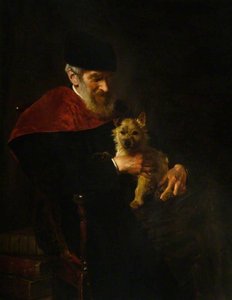
James Lorimer (1818–1890), Jurist and Political Philosopher (1890) by John Henry Lorimer

James Lorimer (1818–1890), Jurist and Political Philosopher

1890 · Oil On Canvas · Scottish National Portrait Gallery, Edinburgh

In this portrait, we find ourselves in the presence of an elderly man, seated with a stillness that suggests a lifetime of contemplation. He holds a small dog, a gesture that softens the gravity of his expression and introduces a sense of companionship into the frame. The lighting is heavily directional, casting deep shadows that define the contours of his face and the heavy folds of his clothing. This chiaroscuro…
7
Maternal Instinct (1892) by John Henry Lorimer

Maternal Instinct

1892 · Oil On Canvas · Royal Scottish Academy of Art - Architecture, Edinburgh

The composition centers on a domestic interior where three figures occupy a richly appointed room. An elderly woman sits in a chair, her form anchored within the space. A young girl kneels on the floor near her, while a younger boy sits nearby on the rug. The setting is defined by a fireplace and ornate furniture that frame the central interaction. Light enters from windows and the hearth, casting long…

The John Henry Lorimer selection continues, 11 to 59

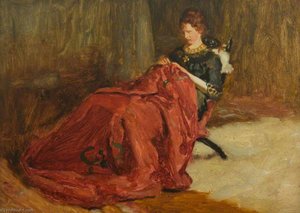
11Antony Gibbs (1841-1907) (1879) by John Henry LorimerAntony Gibbs (1841-1907)1879 · Tyntesfield 12Andrew Vans Dunlop (1805–1880) (1883) by John Henry LorimerAndrew Vans Dunlop (1805–1880)1883 13San Giovanni Crisogono Altarpiece (after Giovanni Bellini) (1880) by John Henry LorimerSan Giovanni Crisogono Altarpiece (after Giovanni Bellini)1880 · The National Trust For Scotland 14Charlotte M. Yonge (1823–1901) (1882) by John Henry LorimerCharlotte M. Yonge (1823–1901)1882 · National Trust 15Sir Thomas Sutherland (1834–1922), Chairman of P O Steamship Company (1882) by John Henry LorimerSir Thomas Sutherland (1834–1922), Chairman of P O Steamship Company1882 · Scottish National Portrait Gallery 16Hannah Lorimer Embroidering a Bedcover (1885) by John Henry LorimerHannah Lorimer Embroidering a Bedcover1885 · The National Trust For Scotland 17Charles Rampini (1840–1907) (1883) by John Henry LorimerCharles Rampini (1840–1907)1883 · Lerwick Town Hall 18John Muir (1810–1882) (1889) by John Henry LorimerJohn Muir (1810–1882)1889 19Sir Samuel George Johnson (1831–1909), Kt (1891) by John Henry LorimerSir Samuel George Johnson (1831–1909), Kt1891 · Nottingham Castle Museum And Art Gallery 20Sir Robert Stodart Lorimer (1864–1929), Architect (1886) by John Henry LorimerSir Robert Stodart Lorimer (1864–1929), Architect1886 · Scottish National Portrait Gallery 21T. W. Lorimer (1890) by John Henry LorimerT. W. Lorimer1890 · The National Trust For Scotland 22Sir Robert Stodart Lorimer (1864–1929) (1886) by John Henry LorimerSir Robert Stodart Lorimer (1864–1929)1886 · Riba Library Drawings And Archives Collections 23The Ordination of Elders in a Scottish Kirk (1891) by John Henry LorimerThe Ordination of Elders in a Scottish Kirk1891 · Scottish National Gallery 24Sir Joseph Lister (1827–1912) (1895) by John Henry LorimerSir Joseph Lister (1827–1912)1895 25Lyon Playfair (1818–1898), 1st Baron Playfair of St Andrews (1897) by John Henry LorimerLyon Playfair (1818–1898), 1st Baron Playfair of St Andrews1897 26Charles George Shaw of Ayr (1895) by John Henry LorimerCharles George Shaw of Ayr1895 · The Baird Institute 27Lord Lister (1827–1912), Professor of Surgery at the University of Glasgow (1897) by John Henry LorimerLord Lister (1827–1912), Professor of Surgery at the University of Glasgow1897 28Lady Russell Cotes (1835–1920) (1895) by John Henry LorimerLady Russell Cotes (1835–1920)1895 29Reverend Peter H. Waddell (1893) by John Henry LorimerReverend Peter H. Waddell1893 30Sir Merton Russell Cotes (1835–1921) (1895) by John Henry LorimerSir Merton Russell Cotes (1835–1921)1895 31Bishop Aeneas Chisholm (1836–1918) (1900) by John Henry LorimerBishop Aeneas Chisholm (1836–1918)1900 32Archibald Hamilton Charteris (1835–1908) by John Henry LorimerArchibald Hamilton Charteris (1835–1908) 33Alexander Lawson (1852–1921) by John Henry LorimerAlexander Lawson (1852–1921) 34Professor John Gray McKendrick (1841–1926), Professor of Physiology at the University of Glasgow (1908) by John Henry LorimerProfessor John Gray McKendrick (1841–1926), Professor of Physiology at the University of Glasgow1908 35Hush (1906) by John Henry LorimerHush1906 · Touchstones Rochdale 36The Finding of Moses (after Giovanni Battista Tiepolo) by John Henry LorimerThe Finding of Moses (after Giovanni Battista Tiepolo)The National Trust For Scotland 37Sunlight in the South Room, Kellie (1913) by John Henry LorimerSunlight in the South Room, Kellie1913 · The National Trust For Scotland 38The Long Shadows (1918) by John Henry LorimerThe Long Shadows1918 · The National Trust For Scotland 39A Beech Tree at Kellie (1881) by John Henry LorimerA Beech Tree at Kellie1881 · The National Trust For Scotland 40Walter John Francis Erskine by John Henry LorimerWalter John Francis ErskineNational Trust For Scotland 41View of Kellie Castle by John Henry LorimerView of Kellie Castle 42Le peintre des fleurs by John Henry LorimerLe peintre des fleursThe National Trust For Scotland 43A Still Life with a Vase of Flowers by John Henry LorimerA Still Life with a Vase of FlowersThe National Trust For Scotland 44Woodhenge by John Henry LorimerWoodhenge 45Reconstruction Drawing of Richborough Roman Town by John Henry LorimerReconstruction Drawing of Richborough Roman Town 46December Roses by John Henry LorimerDecember RosesThe National Trust For Scotland 47Ninian Patrick, Son of Lady and Lord Crichton Stuart by John Henry LorimerNinian Patrick, Son of Lady and Lord Crichton StuartThe National Trust For Scotland 48John Stuart Blackie (1809–1895) by John Henry LorimerJohn Stuart Blackie (1809–1895) 49A Gentleman Holding a Glove (after Titian) by John Henry LorimerA Gentleman Holding a Glove (after Titian)The National Trust For Scotland 50Reconstruction Drawing of the Gateway to Britannia by John Henry LorimerReconstruction Drawing of the Gateway to Britannia 51Striped Roses in a Ship Mug by John Henry LorimerStriped Roses in a Ship MugThe National Trust For Scotland 52Interior Iona by John Henry LorimerInterior Iona 53A Room at Twilight Kellie Castle by John Henry LorimerA Room at Twilight Kellie CastleRoyal Scottish Academy of Art - Architecture 54Sir John Scott, KCM, DCLC by John Henry LorimerSir John Scott, KCM, DCLCWigan Arts And Heritage Service 55Sundown in Spring, Kellie Castle by John Henry LorimerSundown in Spring, Kellie Castle 56Sir David Chalmers by John Henry LorimerSir David ChalmersThe National Trust For Scotland 57View through a Window by John Henry LorimerView through a WindowThe National Trust For Scotland 58Sir Robert Christison (1797–1882), Bt by John Henry LorimerSir Robert Christison (1797–1882), BtRoyal College of Physicians of Edinburgh 59The Madonna and Child with Two Musical Angels by John Henry LorimerThe Madonna and Child with Two Musical AngelsThe National Trust For Scotland

The subjects that held John Henry Lorimer's eye

The four subjects that come back most often in these originals, each with its finest example.

The museums that keep John Henry Lorimer's originals

The 8 museums that hold the most of the paintings on this page.

Museum City Works by John Henry Lorimer Paintings from this list
The National Trust For Scotland, PittenweemThe National Trust For Scotland Pittenweem 15 San Giovanni Crisogono Altarpiece (after Giovanni Bellini), Hannah Lorimer Embroidering a Bedcover, T. W. Lorimer
Scottish National Portrait Gallery, EdinburghScottish National Portrait Gallery Edinburgh 3 James Lorimer (1818–1890), Jurist and Political Philosopher, Sir Thomas Sutherland (1834–1922), Chairman of P O Steamship Company, Sir Robert Stodart Lorimer (1864–1929), Architect
National Trust, BristolNational Trust Bristol 2 Antony Gibbs (1841–1907), Charlotte M. Yonge (1823–1901)
Royal Scottish Academy of Art - Architecture, EdinburghRoyal Scottish Academy of Art - Architecture Edinburgh 2 Maternal Instinct, A Room at Twilight Kellie Castle
TyntesfieldTyntesfield 2 Charlotte M. Yonge (1823 - 1901), Antony Gibbs (1841-1907)
Lerwick Town Hall, KirkwallLerwick Town Hall Kirkwall 1 Charles Rampini (1840–1907)
Nottingham Castle Museum And Art Gallery, NottinghamNottingham Castle Museum And Art Gallery Nottingham 1 Sir Samuel George Johnson (1831–1909), Kt
Riba Library Drawings And Archives Collections, LondonRiba Library Drawings And Archives Collections London 1 Sir Robert Stodart Lorimer (1864–1929)

John Henry Lorimer decade by decade: the original that defines each

Works per decade

Pick a decade to see the original that defines it.

Collectors' questions about John Henry Lorimer's paintings

Which work is John Henry Lorimer most famous for?Reveal the answer

Spring Moonlight (1896). Conversation Piece, Hannah and Alice Lorimer (1879) and The Flight of the Swallows (1906) come next.

What age was John Henry Lorimer when Spring Moonlight was made?Reveal the answer

40 years old: Spring Moonlight dates from 1896, and John Henry Lorimer was born in 1856.

What are the ten most famous John Henry Lorimer paintings?Reveal the answer

Spring Moonlight, Conversation Piece, Hannah and Alice Lorimer, The Flight of the Swallows, Lord Patrick Allan Fraser, Advocate, Antony Gibbs (1841–1907), James Lorimer (1818–1890), Jurist and Political Philosopher, Maternal Instinct, Sir Robert Lorimer, ARA, as a Boy, James Lorimer (1818–1890) and Charlotte M. Yonge (1823 - 1901). The ranking above gives each one's year and museum.

How many paintings did John Henry Lorimer leave?Reveal the answer

Our catalog holds 59 works by John Henry Lorimer, dated from 1875 to 1918.

In which museums do John Henry Lorimer's masterpieces hang?Reveal the answer

Mostly in The National Trust For Scotland (Pittenweem), Scottish National Portrait Gallery (Edinburgh) and National Trust (Bristol). The museum table above lists them all.

In which years did John Henry Lorimer paint the most famous works?Reveal the answer

In 1890s: 13 of the 59 works on this page were made then, Spring Moonlight among them.

What are the first and the last famous originals of John Henry Lorimer?Reveal the answer

On this page, the earliest is Sir Robert Lorimer, ARA, as a Boy (1875) and the latest The Long Shadows (1918).

Which subjects did John Henry Lorimer choose most often?Reveal the answer

Victorian era (6), Portrait (4) and Portraiture (4), across the 59 works on this page.

Which technique did John Henry Lorimer use most?Reveal the answer

Oil On Canvas, for 4 of the 59 works on this page.

To which art movement does John Henry Lorimer belong?Reveal the answer

Contemporary realism, judging by the originals on this page.

Which John Henry Lorimer works hang at the The National Trust For Scotland?Reveal the answer

San Giovanni Crisogono Altarpiece (after Giovanni Bellini), Hannah Lorimer Embroidering a Bedcover and T. W. Lorimer: the The National Trust For Scotland, Pittenweem holds 15 of the works on this page.

John Henry Lorimer: life and work

The Soul of the Scottish Canvas: The Life and Legacy of John Henry Lorimer

In the golden age of late Victorian and Edwardian painting, few artists captured the quiet dignity of domesticity and the architectural grandeur of Scotland with as much grace as John Henry Lorimer. Born in Edinburgh in 1856 into a family of profound intellectual prestige, Lorimer was destined for a life shaped by both academic rigor and creative passion. As the son of James Lorimer, a distinguished professor at Edinburgh University, his early years were steeped in the scholarly atmosphere of Scotland’s capital. This foundation of discipline and observation would later become the bedrock of his artistic technique, allowing him to approach his subjects with a meticulous eye for detail and a deep respect for the historical weight of his surroundings.

Lorimer’s formal training was as much a journey through tradition as it was an exploration of modern light. Educated at the Edinburgh Academy and later at Edinburgh University, he sought refinement through the prestigious halls of the Royal Scottish Academy. Under the mentorship of masters such as Frank McTaggart and William Chalmers, Lorimer began to master the delicate balance between classical realism and the emerging influence of Impressionism. His brushwork learned to dance with light, capturing not just the physical form of a subject but the very atmosphere that enveloped it. This period of development was further enriched by his extensive travels across Europe; from the sun-drenched landscapes of Spain and Italy to the vibrant, culturally diverse vistas of Algeria, Lorimer absorbed a global visual vocabulary that he would later weave into the fabric of his Scottish scenes.

A Symbiosis of Art and Architecture

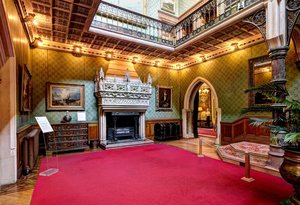
One of the most enchanting aspects of Lorimer’s career was the profound creative synergy he shared with his brother, the celebrated architect Robert Lorimer. Their relationship transcended mere familial bond, evolving into a collaborative legacy that helped define the aesthetic of their era. Nowhere is this more evident than in the magnificent restoration of Kellie Castle. While Robert worked to transform the dilapidated ruin into a triumph of architectural heritage, John was there to breathe life into its walls through his paintings. His depictions of the castle and its surrounding estates were not merely records of stone and mortar, but poetic celebrations of a revitalized Scottish identity.

This partnership allowed John Henry Lorimer to explore themes of permanence and nostalgia. Through his eyes, we see the intersection of man-made grandeur and the natural world. His ability to render the textures of ancient masonry alongside the soft, ephemeral light of a domestic interior created a sense of timelessness that remains captivating to modern viewers. This unique position—at the heart of both architectural revival and genre painting—ensured his place in the historical narrative of Scottish art.

Mastery of Portraiture and Genre Scenes

Beyond the grand landscapes and architectural studies, Lorimer was a master of the human narrative. He possessed a rare ability to capture the psychological depth of his sitters, making him a sought-after portraitist for some of the most notable figures of his time. His portraits, including those of Lyon Playfair and the pioneering surgeon Joseph Lister, are characterized by a profound sense of character and dignity. He did not merely paint faces; he painted legacies.

In his genre paintings, Lorimer turned his attention to the intimate rhythms of everyday life. These works often feature:

  • Domestic Intimacy: Scenes that evoke the warmth and quietude of the Scottish home.
  • Lyrical Realism: A technique that combines precise anatomical and structural accuracy with a soft, emotive light.
  • Cultural Documentation: Capturing the social nuances and fashions of the late 19th century.

The sheer volume of his contributions to the art world is evidenced by his frequent exhibitions at the Royal Scottish Academy and the Royal Academy in London. With over one hundred works showcased at the former, Lorimer established himself as a pillar of the Scottish art community. His death in 1936 marked the end of an era, yet his influence persists through the enduring beauty of his canvases, which continue to serve as windows into a vanished world of elegance, tradition, and profound artistic devotion.