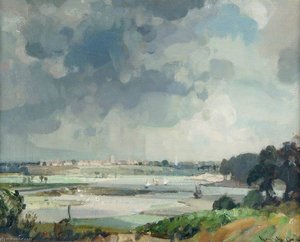
Portrait of John Arnesby Brown

The 57 Most Famous John Arnesby Brown Paintings, a Gallery Selection

Updated November 2026 · ranked by our popularity score (searches, visits and orders for each work) · 65 works by John Arnesby Brown in our catalogue

In short

Of all the originals John Arnesby Brown left, the most famous is Full Summer, Ludham, Norfolk (1902), in the collection of the Nottingham Castle Museum And Art Gallery, Nottingham. Close behind it come Dr John Brown Paton, Principal of the Nottingham Congregational Institute for 35 Years (1899) and The Riverbank (1902). Our catalog holds 65 works by John Arnesby Brown; the gallery has kept the 57 the world admires most, each shown with its date, its museum and its story.

1866 – 1955, Nottingham Impressionism Most works: Nottingham Castle Museum And Art Gallery

John Arnesby Brown's top 10 paintings: the gallery's choice

1
Full Summer, Ludham, Norfolk (1902) by John Arnesby Brown

Full Summer, Ludham, Norfolk

1902 · Oil · Nottingham Castle Museum And Art Gallery, Nottingham

A man occupies the center of a dirt road, his gaze cast backward toward a pair of cows. He holds a gun, a detail that introduces a subtle tension to the otherwise quiet pastoral scene. The landscape of Ludham unfolds around him, framed by the dense greenery of trees that line the path. Other figures appear in the periphery, one near the left edge and two others positioned further in…

2
Dr John Brown Paton, Principal of the Nottingham Congregational Institute for 35 Years (1899) by John Arnesby Brown

Dr John Brown Paton, Principal of the Nottingham Congregational Institute for 35 Years

1899 · Oil · Nottingham Castle Museum And Art Gallery, Nottingham

Dr John Brown Paton, Principal of the Nottingham Congregational Institute for 35 Years, is a portrait executed by the English painter John Arnesby Brown. The work, dating to about 1899, captures the likeness of Dr John Brown Paton, a Scottish Congregationalist minister and educator who served as the first principal of the Nottingham Congregational Institute. His tenure at the institution spanned thirty-five years, from 1863 until 1898.

3
The Riverbank (1902) by John Arnesby Brown

The Riverbank

1902 · Oil · Guildhall Art Gallery, London

The Riverbank is a work by John Arnesby Brown, painted in 1902. This piece emerged during a period when the artist was establishing his presence within the British landscape tradition. Brown, who was born in Nottingham, United Kingdom, brought a specific sensitivity to the English countryside that would define much of his career.

4
Dr Paton (1830–1911) (1899) by John Arnesby Brown

Dr Paton (1830–1911)

1899 · Oil · The Congregational Memorial Hall, Nottingham

In this 1899 portrait, we find ourselves in the presence of Dr Paton. The subject is a man of considerable presence, defined by a thick, white beard that catches the light against a deep, saturated red background. He is captured in a moment of quiet composure, dressed in a formal suit and tie, with his hands clasped together in a gesture that suggests both patience and gravity. There is a…

5
The Marshes from Burgh Castle, Norfolk (1919) by John Arnesby Brown

The Marshes from Burgh Castle, Norfolk

1919 · Oil On Canvas

In The Marshes from Burgh Castle, Norfolk, John Arnesby Brown captures a quiet moment within a rural coastal landscape. Painted about 1919, the scene unfolds across a wide vista where the earth meets the sky in a soft, hazy embrace. A weathered stone wall anchors the left side of the view, providing a solid, tactile presence against the shifting elements. Beyond this boundary, a field stretches toward a body of…

6
Haddiscoe Church, Norfolk by John Arnesby Brown

Haddiscoe Church, Norfolk

Oil

Haddiscoe Church, Norfolk is a landscape painting by John Arnesby Brown. The work focuses on a church situated atop a hill, overlooking the surrounding terrain. A road winds through the landscape, leading the eye toward the structure.

7
The Hayfield (1910) by John Arnesby Brown

The Hayfield

1910 · Oil On Canvas

The Hayfield is a work by John Arnesby Brown, painted in 1910. The artist, born in 1866 in Nottingham, United Kingdom, captured this rural scene during a period of significant development in his career. He lived until 1955, passing away in Haddiscoe, Norfolk.
The John Arnesby Brown selection continues, 11 to 57

11The Drinking Pool (1895) by John Arnesby BrownThe Drinking Pool1895 · Manchester Art Gallery 12The Drinking Pool (1895) by John Arnesby BrownThe Drinking Pool1895 13Homeward (1896) by John Arnesby BrownHomeward1896 · Harris Museum - Art Gallery 14The Pier (1905) by John Arnesby BrownThe Pier1905 · Ferens Art Gallery 15The Bridge (1904) by John Arnesby BrownThe Bridge1904 · Walker Art Gallery 16Hay Cutting on the Norfolk Marshes by John Arnesby BrownHay Cutting on the Norfolk Marshes 17The Coming Day by John Arnesby BrownThe Coming Day 18Calves by John Arnesby BrownCalves 19Silver Morning (1910) by John Arnesby BrownSilver Morning1910 20Fading Day (1910) by John Arnesby BrownFading Day1910 · Harris Museum - Art Gallery 21Sheepfold (1908) by John Arnesby BrownSheepfold1908 22A Norfolk Landscape (1912) by John Arnesby BrownA Norfolk Landscape1912 23Sir Edward Henry Fraser (1913) by John Arnesby BrownSir Edward Henry Fraser1913 24In June (1917) by John Arnesby BrownIn June1917 25A Summer Day (1912) by John Arnesby BrownA Summer Day1912 26The Raincloud (1915) by John Arnesby BrownThe Raincloud1915 27The Line of the Plough (1919) by John Arnesby BrownThe Line of the Plough1919 28The Smug and Silver Trent (1924) by John Arnesby BrownThe Smug and Silver Trent1924 29Spring (1925) by John Arnesby BrownSpring1925 30The Watch Tower (1923) by John Arnesby BrownThe Watch Tower1923 · Laing Art Gallery 31Nottingham Castle The Centre of Medieval England (London, Midland and Scottish Railway poster artwork) (1924) by John Arnesby BrownNottingham Castle The Centre of Medieval England (London, Midland and Scottish Railway poster artwork)1924 32The Cloud (September) (1930) by John Arnesby BrownThe Cloud (September)1930 33Sketch for 'The Estuary, Gathering Clouds' (1931) by John Arnesby BrownSketch for 'The Estuary, Gathering Clouds'1931 34View of Norwich from the Bungay Road, Norfolk (1935) by John Arnesby BrownView of Norwich from the Bungay Road, Norfolk1935 35A Fellside Cumberland Village (1939) by John Arnesby BrownA Fellside Cumberland Village1939 · Touchstones Rochdale 36Panoramic View of Nottingham by John Arnesby BrownPanoramic View of Nottingham 37Herald of Night by John Arnesby BrownHerald of Night 38May Morning, Nottingham by John Arnesby BrownMay Morning, Nottingham 39Wymondham Abbey, Norfolk by John Arnesby BrownWymondham Abbey, Norfolk 40Seascape with Yacht by John Arnesby BrownSeascape with Yacht 41The Dutch Windmill by John Arnesby BrownThe Dutch Windmill 42Cattle in a Field by John Arnesby BrownCattle in a Field 43Blythsburgh (Beccles across the Marshes) by John Arnesby BrownBlythsburgh (Beccles across the Marshes) 44A Norfolk Landscape with Potato Pickers by John Arnesby BrownA Norfolk Landscape with Potato PickersThe National Trust For Scotland 45The Yacht Race by John Arnesby BrownThe Yacht RaceFitzwilliam College 46Morston Church, Norfolk by John Arnesby BrownMorston Church, Norfolk 47The Old Silk Mill, Derby by John Arnesby BrownThe Old Silk Mill, Derby 48Haystacks, Evening by John Arnesby BrownHaystacks, Evening 49Landscape with Church by John Arnesby BrownLandscape with Church 50Suffolk River by John Arnesby BrownSuffolk RiverBristol Museum - Art Gallery 51Landscape by John Arnesby BrownLandscape 52The White Bull by John Arnesby BrownThe White Bull 53Study for 'The Two Piers' by John Arnesby BrownStudy for 'The Two Piers'Nottingham Castle Museum And Art Gallery 54Autumn Morning by John Arnesby BrownAutumn MorningRoyal Albert Memorial Museum 55Spring by John Arnesby BrownSpring 56Alderman William Lambert by John Arnesby BrownAlderman William LambertNottingham Castle Museum And Art Gallery 57Near Nottingham by John Arnesby BrownNear NottinghamNottingham Castle Museum And Art Gallery

The subjects that held John Arnesby Brown's eye

The four subjects that come back most often in these originals, each with its finest example.

The museums that keep John Arnesby Brown's originals

The 8 museums that hold the most of the paintings on this page.

Museum City Works by John Arnesby Brown Paintings from this list
Nottingham Castle Museum And Art Gallery, NottinghamNottingham Castle Museum And Art Gallery Nottingham 7 Full Summer, Ludham, Norfolk, Dr John Brown Paton, Principal of the Nottingham Congregational Institute for 35 Years, Haymaking
Harris Museum - Art Gallery, PrestonHarris Museum - Art Gallery Preston 2 Homeward, Fading Day
Guildhall Art Gallery, LondonGuildhall Art Gallery London 1 The Riverbank
The Congregational Memorial Hall, NottinghamThe Congregational Memorial Hall Nottingham 1 Dr Paton (1830–1911)
Norfolk Museums, NorwichNorfolk Museums Norwich 1 Myra Plater, Sister of the Artist
Manchester Art Gallery, ManchesterManchester Art Gallery Manchester 1 The Drinking Pool
Ferens Art Gallery, HullFerens Art Gallery Hull 1 The Pier
Walker Art Gallery, LiverpoolWalker Art Gallery Liverpool 1 The Bridge

John Arnesby Brown decade by decade: the original that defines each

Works per decade

Pick a decade to see the original that defines it.

Collectors' questions about John Arnesby Brown's paintings

Which work is John Arnesby Brown most famous for?Reveal the answer

Full Summer, Ludham, Norfolk (1902), Nottingham Castle Museum And Art Gallery, Nottingham. Dr John Brown Paton, Principal of the Nottingham Congregational Institute for 35 Years (1899) and The Riverbank (1902) come next.

What age was John Arnesby Brown when Full Summer, Ludham, Norfolk was made?Reveal the answer

36 years old: Full Summer, Ludham, Norfolk dates from 1902, and John Arnesby Brown was born in 1866.

What are the ten most famous John Arnesby Brown paintings?Reveal the answer

Full Summer, Ludham, Norfolk, Dr John Brown Paton, Principal of the Nottingham Congregational Institute for 35 Years, The Riverbank, Dr Paton (1830–1911), The Marshes from Burgh Castle, Norfolk, Haddiscoe Church, Norfolk, The Hayfield, Haymaking, Myra Plater, Sister of the Artist and Poppy Field (verso). The ranking above gives each one's year and museum.

How many paintings did John Arnesby Brown leave?Reveal the answer

Our catalog holds 65 works by John Arnesby Brown, dated from 1890 to 1939.

In which museums do John Arnesby Brown's masterpieces hang?Reveal the answer

Mostly in Nottingham Castle Museum And Art Gallery (Nottingham), Harris Museum - Art Gallery (Preston) and Guildhall Art Gallery (London). The museum table above lists them all.

In which years did John Arnesby Brown paint the most famous works?Reveal the answer

In 1910s: 10 of the 57 works on this page were made then, The Marshes from Burgh Castle, Norfolk among them.

What are the first and the last famous originals of John Arnesby Brown?Reveal the answer

On this page, the earliest is Haymaking (1890) and the latest A Fellside Cumberland Village (1939).

Which subjects did John Arnesby Brown choose most often?Reveal the answer

Rural landscape (5), British countryside (5) and Man (4), across the 57 works on this page.

Which technique did John Arnesby Brown use most?Reveal the answer

Oil, for 5 of the 57 works on this page.

To which art movement does John Arnesby Brown belong?Reveal the answer

Impressionism, judging by the originals on this page.

Which John Arnesby Brown works hang at the Nottingham Castle Museum And Art Gallery?Reveal the answer

Full Summer, Ludham, Norfolk, Dr John Brown Paton, Principal of the Nottingham Congregational Institute for 35 Years and Haymaking: the Nottingham Castle Museum And Art Gallery, Nottingham holds 7 of the works on this page.

John Arnesby Brown: life and work

A Life of Light and Landscape

Sir John Alfred Arnesby Brown was a figure of remarkable duality, a man who navigated the physical vigor of professional sport and the delicate, atmospheric nuances of fine art with equal distinction. Born in Nottingham, his early years were marked by a pursuit of athletic excellence; he was an English footballer who famously played for Notts County in the Football League. Yet, it was through the lens of the landscape painter that he would secure his enduring legacy as one of the leading British landscape artists of the 20th century. His journey from the competitive pitches of the late 19th century to the prestigious halls of the Royal Academy is a testament to a profound devotion to the natural world.

His artistic education was rigorous and transformative, beginning with lessons under a local tutor in Nottingham before he moved to the renowned Bushey School of Art in Hertfordshire. There, studying under Hubert von Herkomer, Brown began to cultivate a technique that would become his hallmark. His work was deeply influenced by the plein air ideal and the evocative traditions of the Barbizon School and French Impressionists. This influence manifested in his ability to capture the fleeting qualities of light and atmosphere, turning the English countryside into a stage for luminous, emotive storytelling.

The Pastoral Vision

Brown’s oeuvre is most celebrated for its impressionistic depictions of pastoral landscapes, where the quiet majesty of the countryside is often punctuated by the presence of cattle. He possessed a unique ability to render the textures of the earth and the shifting moods of the sky, creating scenes that felt both timeless and intensely immediate. While his heart often resided in the tranquil meadows of Norfolk—specifically around Haddiscoe, where he eventually settled—his vision was not limited to a single geography. His work frequently captured the serene beauty of the marshes and the rhythmic life of rural England.

As his career matured, Brown’s interests underwent a fascinating evolution. While he remained a master of the pastoral, after 1905, he began to direct his observant eye toward the industrial landscape. He found a new kind of beauty in the structural complexities of rail yards and brickworks around Kings Lynn, proving that his sensitivity to light and form could transcend the idyllic and embrace the burgeoning modernity of his era. This expansion of subject matter demonstrated a profound artistic maturity and an unwavering commitment to documenting the changing face of the British landscape.

Legacy and Recognition

The significance of Sir John Alfred Arnesby Brown extends far beyond the canvas, reaching into the very fabric of British cultural history. His dedication to his craft was recognized with the highest honors, culminating in his knighthood in 1938 for his services to the nation's art. This accolade served as a formal acknowledgment of a career that had successfully bridged the gap between traditional landscape values and the evolving sensibilities of modern impressionism.

His life was also intertwined with the artistic community through his marriage to Mia Edwards, a talented Welsh painter noted for her portraits of children. Together, they shared a life steeped in creativity, moving between the artist colonies of St Ives, Cornwall, and the seasonal beauty of Norfolk. Today, the works of Arnesby Brown continue to resonate within prestigious UK public collections, serving as enduring windows into a vanished era of pastoral peace and atmospheric wonder.