

1


Updated November 2026 · ranked by our popularity score (searches, visits and orders for each work) · 2 works by Jacopo Ripanda in our catalogue
In short
To the gallery's eye, Jacopo Ripanda's most famous painting is Naval Combat, whose original hangs in the Capitoline Museums, Rome. Of the 2 works by Jacopo Ripanda in our catalog, the gallery presents the 2 most famous below, each original with its year, its museum and what makes it unique.

A Singular Vision: Jacopo Ripanda’s “Neptune and Amphitrite” The fresco "Neptune and Amphitrite," executed by Jacopo Ripanda in 1505, stands as a testament to the artist's extraordinary dedication to capturing the spirit of antiquity—a pursuit that transcended mere representation and fundamentally reshaped artistic perception. Situated within the Palazzo dei Conservatori in Rome, this monumental work delves into the mythology surrounding Poseidon and his consort Amphitrite, offering viewers an immersive experience…
The 2 museums that hold the most of the paintings on this page.
| Museum | City | Works by Jacopo Ripanda | Paintings from this list |
|---|---|---|---|
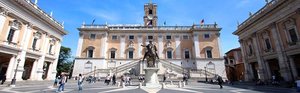 Capitoline Museums |
Rome | 1 | Naval Combat |
 Palazzo dei Conservatori |
Rome | 1 | Neptune and Amphitrite |
Every dated original by Jacopo Ripanda on this page was made in 1505: here they are, the most famous first.
Pick a year to see its originals.
A Singular Vision: Jacopo Ripanda’s “Neptune and Amphitrite” The fresco "Neptune and Amphitrite," executed by Jacopo Ripanda in 1505, stands as a testament to the artist's extraordinary dedication to capturing the spirit of antiquity—a pursuit that transcended mere representation and fundamentally reshaped artistic perception. Situated within the Palazzo dei Conservatori in Rome, this monumental work delves into the mythology surrounding Poseidon and his consort Amphitrite, offering viewers an immersive experience…
Naval Combat.
Our catalog holds 2 works by Jacopo Ripanda.
Mostly in Capitoline Museums (Rome) and Palazzo dei Conservatori (Rome). The museum table above lists them all.
Jacopo Ripanda lived a life that felt deeply connected to the stones and shadows of ancient Rome. Though he was born in Bologna, his heart belonged to the ruins of the imperial past. Very little is known about his early years or the specific moments that shaped his youth, but he emerged from the artistic circles of his home city, learning under masters like Ercole Grandi and Lorenzo Costa. These teachers provided him with a foundation in the Emilian tradition, yet Ripanda sought something more than the devotional subjects common to his peers. He looked toward the weathered marble and the silent monuments left behind by a lost era.
His time in Rome during the reign of Pope Alexander VI changed everything. It was here that he began to look at the city not just as a resident, but as an observer seeking truth in detail. He became famous for a peculiar and clever invention: a viewing device consisting of a sighting tube and a plumb bob. This simple tool allowed him to see the far-off carvings on Trajan’s Column with a clarity that others could not achieve. By using this apparatus, he could resolve distant friezes and capture the minute details of the stone. This method brought a new level of accuracy to his drawings and sparked much conversation among the scholars of his day.
The patronage of the papacy provided Ripanda with the opportunity to leave his mark on the very walls of Rome. Under Alexander VI, he was entrusted with painting four rooms in the Palazzo dei Conservatori on the Capitoline Hill. These rooms were intended to tell stories from classical history. The Sala di Annibale and the Sala della Lupa remain as the most visible parts of this work. In these spaces, his style merged the soft influences of his Bolognese training with a new, rigorous focus on Roman antiquity. He used light and shadow to give form to his figures, much like the architectural precision he practiced when studying the city's monuments.
His work was not limited to the halls of power. In 1505, he painted frescoes in the Palazzo Doria-Pamphili that depicted the lives of Julius Caesar and Trajan. These works used a technique called chiaroscuro to create depth and presence. While some of his later projects, including commissions for the Vatican, were halted when Pope Julius II took office, his influence continued through others. His detailed drawings of Roman designs were eventually published as engravings by Girolamo Muziano in 1576, long after Ripanda himself had passed away.
The legacy of this painter is found in the way he bridged the gap between scientific observation and artistic expression. He did not merely paint what he imagined; he painted what he could prove to be true through measurement and sight. His approach left a mark on later artists like Baldassare Peruzzi and Michelangelo, who would also grapple with the challenge of depicting monumental architecture with accuracy. Even as his personal biography remains largely hidden by time, the precision of his gaze remains visible in the history of Roman art.