Museums on this site: Gallerie dell'Accademia di Venezia
Color intensity: balanced
Jacobello Alberegno (1367 - 1396): Venetian Visionary of Apocalypse
Jacobello Alberegno remains an enigmatic figure in the annals of Venetian art, shrouded in obscurity despite his undeniable contribution to the artistic landscape of the late fourteenth century. Precise biographical details are scarce, primarily reliant on a single document referencing his death – July 14th, 1397 – and bolstered by the discovery of a solitary signed masterpiece: the tempera on panel triptych depicting the Crucifixion with Saints Ambrose and Jerome housed in the Gallerie dell’Accademia di Venezia. This poignant testament to Alberegno's artistic legacy underscores the challenge posed by reconstructing his life story from fragmentary evidence.
Early Life & Training: Little is known about Alberegno’s formative years, fueling speculation regarding his origins and artistic influences. Scholars posit connections to Byzantine traditions propagated by Paolo Veneziano and Giusto de Menabuoi, recognizing Alberegno's embrace of Venetian stylistic innovations alongside a steadfast adherence to established iconography.
The Crucifixion Triptych: This pivotal work—the cornerstone of Alberegno’s oeuvre—offers invaluable insight into his artistic sensibilities. Executed around 1360-65, the triptych exemplifies Giotto's influence through its compositional choices and meticulous attention to detail, mirroring the stylistic trends prevalent in Padua during Alberegno’s time.
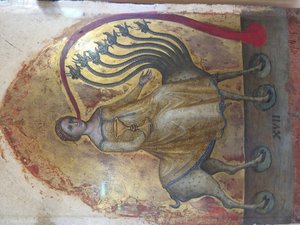
The Polyptych of the Apocalypse: Arguably Alberegno’s most celebrated achievement—though tragically incomplete—the Polyptych of the Apocalypse stands as a testament to his ambition and artistic prowess. Initially venerated in San Giovanni Evangelista di Torcello, this monumental complex comprised five panels depicting episodes from Revelation, reflecting Giusto de Menabuoi's stylistic vision for Padua’s Baptistery.
Influence & Legacy: Alberegno’s impact extended beyond his immediate contemporaries, shaping Venetian artistic discourse and establishing precedents for subsequent generations of painters. His embrace of Byzantine iconography alongside Venetian innovation cemented his position as a pivotal figure in the burgeoning Renaissance movement, marking a decisive break from medieval conventions.
Notable Works & Artistic Style
Jacobello Alberegno’s artistic style is characterized by a harmonious blend of Byzantine tradition and Venetian innovation—a stylistic duality that distinguishes him from his peers. His meticulous attention to detail, evident in the Crucifixion Triptych and the Polyptych of the Apocalypse, reflects Giotto's influence through its compositional choices and masterful rendering of textures. The artist skillfully employed tempera on panel, incorporating gold leaf to heighten visual impact and imbue his paintings with spiritual resonance—techniques consistent with Venetian artistic practices during Alberegno’s lifetime.
The Crucifixion Triptych: This masterpiece exemplifies Giotto's influence through its compositional choices and meticulous attention to detail, mirroring the stylistic trends prevalent in Padua during Alberegno’s time.
Jacobello Alberegno emerged during a period of profound cultural transformation in Venice, witnessing the gradual adoption of Byzantine artistic ideals alongside the burgeoning influence of Giotto—a pivotal moment marking a decisive break from medieval conventions. His unwavering commitment to Venetian stylistic traditions—coupled with his embrace of Byzantine iconography—established him as a cornerstone of the Venetian Renaissance, shaping artistic discourse and bequeathing enduring legacies to subsequent generations of painters. Alberegno’s contribution solidified Venice's position as a vanguard of European artistic innovation, securing his place in art history as a visionary artist who bridged the gap between medieval piety and humanist inquiry.
By the OriginalUniqueArt.com Editorial Team
Quiz
There is only one correct answer for each question.
Question 1:
Q1: Where was Jacobello Alberegno born?
Question 2:
Q2: What is Alberegno known for creating?
Question 3:
Q3: Which Saint’s image appears on the side panels of Alberegno’s Polyptych of the Apocalypse?
Explore the life & art of Pietro Perugino, a pivotal Renaissance master and Raphael’s influential teacher. Discover his serene compositions, Sistine Chapel frescoes, and lasting legacy with OriginalUniqueArt.