Portrait of Ivan Albright

Ivan Albright Paintings: The 39 Most Famous, Through a Gallery's Eye

Updated November 2026 · ranked by our popularity score (searches, visits and orders for each work) · 39 works by Ivan Albright in our catalogue

In short

To the gallery's eye, Ivan Albright's most famous painting is That Which I Should Have Done I Did Not Do (The Door) (1941), whose original hangs in the Art Institute of Chicago, Chicago. I Walk To and Fro Through Civilization (1926) and Dorian Gray (1945) complete the trio every eye recognises. Of the 39 works by Ivan Albright in our catalog, the gallery presents the 39 most famous below, each original with its year, its museum and what makes it unique.

1897 – 1983, Harvey Magic realism Most works: Art Institute of Chicago

The gallery's top 10 Ivan Albright paintings

1
That Which I Should Have Done I Did Not Do (The Door) (1941) by Ivan Albright

That Which I Should Have Done I Did Not Do (The Door)

1941 · Oil On Canvas · Art Institute of Chicago, Chicago

In the annals of American art, few works possess the haunting, visceral power of Ivan Albright's magnum opus, That Which I Should Have Done I Did Not Do (The Door). Created during a decade-long labor of intense devotion between 1931 and 1941, this oil on canvas is far more than a mere depiction of an object; it is a profound meditation on the weight of human choice and the inevitable…

2
I Walk To and Fro Through Civilization (1926) by Ivan Albright

I Walk To and Fro Through Civilization

1926 · Oil On Canvas · Art Institute of Chicago, Chicago

The oil on canvas painting titled I Walk To and Fro Through Civilization, also known by the full title I Walk To and Fro through Civilization and I Talk as I Walk (Follow Me, the Monk), was executed by the American artist Ivan Albright. The work was created about 1926–1927. This piece is a detailed study of a single figure positioned within a shadowed, narrow space.

3
Dorian Gray (1945) by Ivan Albright

Dorian Gray

1945 · Silk · Art Institute of Chicago, Chicago

Ivan Albright executed Dorian Gray in 1944. The work was produced specifically for the 1945 movie adaptation of the 1891 novel. Through this commission, the artist sought to capture the essence of the original literary narrative. The resulting image provides a visual translation of the themes found within the text.

4
A Face from Georgia (1972) by Ivan Albright

A Face from Georgia

1972 · Oil On Canvas · Art Institute of Chicago, Chicago

A tight, centered close-up captures an elderly man, presenting a landscape of physical decay. The skin is a complex map of fine, web-like wrinkles and deep furrows that suggest a lifetime of hardship. Earthy, somber tones of ochre and brown dominate the composition, creating a heavy, sculptural quality. This darkness is interrupted by the saturated blue of his clothing and a sharp, red collar, which draws the eye toward the…

Ivan Albright paintings, ranked 11 to 39

The subjects that held Ivan Albright's eye

The four subjects that come back most often in these originals, each with its finest example.

The museums that keep Ivan Albright's originals

The 2 museums that hold the most of the paintings on this page.

Museum City Works by Ivan Albright Paintings from this list
Art Institute of Chicago, ChicagoArt Institute of Chicago Chicago 20 That Which I Should Have Done I Did Not Do (The Door), I Walk To and Fro Through Civilization, Dorian Gray
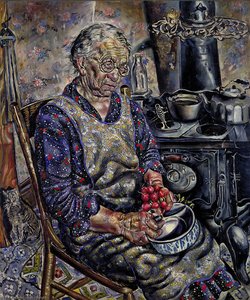
Smithsonian American Art Museum, Washington, D.C.Smithsonian American Art Museum Washington, D.C. 1 The Farmer's kitchen

Ivan Albright, one signature painting per decade

Works per decade

Pick a decade to see the original that defines it.

Ivan Albright's paintings: the gallery answers

Which Ivan Albright painting is the most famous of all?Reveal the answer

That Which I Should Have Done I Did Not Do (The Door) (1941), Art Institute of Chicago, Chicago. I Walk To and Fro Through Civilization (1926) and Dorian Gray (1945) come next.

How old was Ivan Albright on completing That Which I Should Have Done I Did Not Do (The Door)?Reveal the answer

44 years old: That Which I Should Have Done I Did Not Do (The Door) dates from 1941, and Ivan Albright was born in 1897.

Which are Ivan Albright's top 10 paintings?Reveal the answer

That Which I Should Have Done I Did Not Do (The Door), I Walk To and Fro Through Civilization, Dorian Gray, A Face from Georgia, There Were No Flowers Tonight, The Temptation of St. Anthony, Self-Portrait, I Drew A Picture in the Sand and the Water Washed It Away, The Lineman and Three Love Birds. The ranking above gives each one's year and museum.

How many works did Ivan Albright create?Reveal the answer

Our catalog holds 39 works by Ivan Albright, dated from 1926 to 1982.

Where do Ivan Albright's most famous originals hang?Reveal the answer

Mostly in Art Institute of Chicago (Chicago) and Smithsonian American Art Museum (Washington, D.C.). The museum table above lists them all.

When did Ivan Albright create the most famous paintings?Reveal the answer

In 1920s: 9 of the 39 works on this page were made then, I Walk To and Fro Through Civilization among them.

Which are Ivan Albright's earliest and latest famous works?Reveal the answer

On this page, the earliest is I Walk To and Fro Through Civilization (1926) and the latest Self-Portrait (1982).

Which subjects did Ivan Albright return to most?Reveal the answer

Man (3), Portraits (3) and Chair (3), across the 39 works on this page.

Which medium did Ivan Albright work in most?Reveal the answer

Oil On Canvas, for 5 of the 39 works on this page.

Which movement is Ivan Albright associated with?Reveal the answer

Magic realism, judging by the originals on this page.

Which Ivan Albright originals does the Art Institute of Chicago hold?Reveal the answer

That Which I Should Have Done I Did Not Do (The Door), I Walk To and Fro Through Civilization and Dorian Gray: the Art Institute of Chicago, Chicago holds 20 of the works on this page.

Ivan Albright: the artist

The Architect of Decay: The Life and Vision of Ivan Albright

Ivan Le Lorraine Albright (1897–1983) stands as a singular figure in American art history—a magician of realism whose canvases captured not just what was seen but the insidious creep of time and the unsettling beauty of disintegration. Born near Chicago to Adam Emory Albright, a landscape painter descended from gunsmiths, Albright’s artistic journey began alongside his identical twin brother, Malvin. While they both studied at the Art Institute of Chicago, their paths diverged into different dimensions of form; where Malvin sought the tactile weight of sculpture, Ivan pursued the ethereal and often harrowing depths of painting. This early immersion in the fine arts instilled in him a profound respect for craftsmanship and a precision that would later define his obsessive, microscopic approach to the canvas.

Albright's formative years were shaped by a deep fascination with European masters such as El Greco and Rembrandt, artists who possessed the ability to wrestle with themes of spirituality, mortality, and the dramatic interplay of light. However, he swiftly forged a distinctive style that moved beyond mere imitation. His technique became synonymous with an unparalleled dedication to meticulous detail and a masterful manipulation of color. Though he briefly explored architecture during his studies at the University of Illinois Urbana-Champaign, he ultimately abandoned commercial ambitions for the solitary, painstaking solace of art, driven by a need to document the textures of existence that others might overlook.

Shadows of War and the Aesthetics of Mortality

A pivotal moment in Albright's psychological and artistic development arrived during World War I. Serving as a medical illustrator in Nantes, France, he was tasked with producing images that were often unsettling in their clinical accuracy. This experience served as a grim precursor to his later preoccupations with morbidity and the fragility of life. The visceral reality of human vulnerability and the inescapable presence of death became foundational themes in his oeuvre. His work began to transcend simple representation, moving into the realm of Magic Realism, where the hyper-realistic depiction of objects served to heighten a sense of profound unease and existential dread.

As his career progressed, Albright’s fascination with the passage of time manifested in works that explored the concept of "the beautiful grotesque." He did not merely paint decay; he celebrated its intricate complexity. His canvases often feature:

  • The Texture of Time: A focus on the crumbling, the weathered, and the eroded surfaces of both objects and skin.
  • Chiaroscuro Mastery: The use of dramatic light and shadow to create depth and a sense of psychological tension.
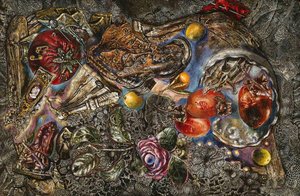
  • Symbolic Still Lifes: Arrangements of objects that, while seemingly mundane, carry heavy connotations of mortality and the fleeting nature of life.

A Legacy Written in Detail

Throughout his long career, Albright achieved significant recognition for his ability to blend realism with a surreal, almost hallucinatory intensity. His notable works, such as The Farmer's Kitchen (1934), demonstrate a poignant depiction of Depression-era life through a lens that is both haunting and hyper-detailed. Similarly, his explorations in pieces like That Which I Should Have Done I Did Not Do (The Door) showcase his ability to use physical thresholds as metaphors for psychological states. His self-portraits remain some of his most enduring contributions, serving as intense character studies that reveal the artist's own preoccupation with the human condition.

The historical significance of Ivan Albright lies in his refusal to look away from the uncomfortable truths of biological and material decline. In an era where many artists sought abstraction or pure decorative beauty, Albright leaned into the microscopic scrutiny of the ephemeral. He remains a master of the unsettling beautiful, leaving behind a legacy that challenges viewers to find meaning within the very processes of dissolution. His work continues to resonate with anyone moved by the profound, haunting intersection of memory, time, and the inevitable transformation of all living things.