

1


Updated November 2026 · ranked by our popularity score (searches, visits and orders for each work) · 4 works by Henri Lebert in our catalogue
In short
To the gallery's eye, Henri Lebert's most famous painting is At the Wormsa (1828), whose original hangs in the Musée d'Unterlinden, Colmar. Landscape with the Castles of Girsberg and Saint-Ulrich (1830) and View of Haut-Landsbourg (1833) complete the trio every eye recognises. Of the 4 works by Henri Lebert in our catalog, the gallery presents the 4 most famous below, each original with its year, its museum and what makes it unique.
The museum that holds the most of the paintings on this page.
| Museum | City | Works by Henri Lebert | Paintings from this list |
|---|---|---|---|
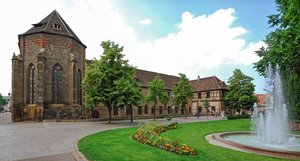 Musée d'Unterlinden |
Colmar | 4 | At the Wormsa, Landscape with the Castles of Girsberg and Saint-Ulrich, View of Haut-Landsbourg |
Some ten years, from 1828 to 1838, were enough for Henri Lebert: the gallery walks through them year by year, one famous original after another.
Pick a year to see its originals.
At the Wormsa (1828), Musée d'Unterlinden, Colmar. Landscape with the Castles of Girsberg and Saint-Ulrich (1830) and View of Haut-Landsbourg (1833) come next.
34 years old: At the Wormsa dates from 1828, and Henri Lebert was born in 1794.
Our catalog holds 4 works by Henri Lebert, dated from 1828 to 1838.
Mostly in Musée d'Unterlinden (Colmar). The museum table above lists them all.
On this page, the earliest is At the Wormsa (1828) and the latest Unterlinden Convent (1838).
At the Wormsa, Landscape with the Castles of Girsberg and Saint-Ulrich and View of Haut-Landsbourg: the Musée d'Unterlinden, Colmar holds 4 of the works on this page.
Henri Lebert enters the historical record in 1794. Born in Thann, within the Haut-Rhin department of France, his early years are rooted in the Alsatian landscape. The path for this future Alsatian painter and draughtsman begins not in a formal academy, but within the industrial rhythm of the Munster region. Here, the focus is on precision and pattern rather than the sweeping vistas that would later define his output.
The training takes place at the Hartmann fabric printing factory in Munster. It is a practical, technical education. As a student of textile design, Lebert masters the intricate requirements of floral motifs and industrial patterns. This period of apprenticeship establishes the foundational discipline of his hand. He learns to translate botanical forms into repeatable, structured designs for the manufacturing of textiles. This technical grounding in Munster provides the essential skills that bridge the gap between decorative craft and fine art.
The industrial rhythm of Munster defines Lebert's early professional life. He works within the Soehnée l’aîné et Cie manufacture, a firm that would eventually become Ets Hartmann. His hands are occupied with the creation of floral motifs intended for fabric printing. This period is defined by the precision required for textile design, translating botanical forms into patterns for cotton and other materials.
A shift occurs as he moves toward Colmar, the cultural center of the region. The focus of his practice undergoes a transformation. He moves away from the repetitive demands of the printing factory to pursue oil painting. This evolution begins with the study of flowers, but his gaze soon shifts toward the wider landscape. He transitions from a creator of decorative motifs to a designer of landscapes, capturing the topography of the Vosges.
Lebert operates within the visual language of the Romantic period. His approach shifts between the precision required for industrial design and the expressive freedom of landscape painting. He moves from the controlled application of color in floral motifs to the atmospheric depth of oil on canvas. This transition marks a departure from the rigid requirements of textile manufacturing toward a more personal, observational mode of art.
The influence of German Romanticism dictates much of his compositional logic. He finds his primary subjects in the rugged terrain of the Vosges, focusing on the interplay between nature and the decaying structures of the past. His sepia wash drawings capture these scenes with a specific, tonal gravity, often centering on the ruined castles that dot the regional landscape. These works rely on the subtle gradations of black chalk, watercolor, and gouache to build form and shadow.
His technical repertoire is diverse, spanning several mediums that allow for different levels of detail and texture. He utilizes oil on canvas for larger, more permanent compositions, while his use of black chalk and sepia washes provides a more immediate, sketch-like quality to his studies of the natural world. This versatility allows him to navigate between the decorative demands of fabric design and the more somber, atmospheric requirements of landscape and still life.
The landscape of the Vosges mountains provides the primary stage for his most significant compositions. Between 1830 and 1840, his brush captures the scenic castles of Girsberg and Saint-Ulrich. These works focus on the rugged topography and the historical silhouettes of the region. In 1828, he produced Chasse dans les Vosges, an oil on canvas that shifts the focus toward the movement of the hunt within the natural terrain.
Botanical precision defines much of his detailed output. A pair of works titled Fructillis imperialis; et Iris, dated 1828, utilizes a combination of black chalk, watercolor, and gouache to render floral forms. This technical approach allows for a layered depth in his depictions of nature. His interest in architectural history is equally evident in his 1838 oil painting of the Couvent des Unterlinden, which documents the medieval structure in Colmar.


