A Florentine Brush in Georgian England
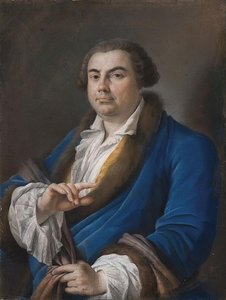
Giovanni Battista Cipriani, sometimes recorded as Giuseppe Cipriani, arrived in England in 1755, a moment that would indelibly shape the course of British decorative arts. Born in Florence in 1727 to a family originating from Pistoia, his early artistic formation was steeped in the traditions of the Italian Baroque. He first studied under Ignatius Hugford, a Florentine artist with strong English ties, and later refined his skills with Anton Domenico Gabbiani. These foundational years instilled within him a mastery of technique and an appreciation for dramatic composition that would characterize much of his work. Even before setting foot on British soil, Cipriani had begun to establish a reputation in Italy, completing commissions such as *St Tesauro* and *St Peter Igneo* for the Abbey of San Michele in Pelago, Pistoia, alongside contributions to ecclesiastical decorations in Florence. These early projects demonstrated a burgeoning talent that hinted at the significant role he would soon play on an international stage. His journey towards England was facilitated by connections forged in Rome between 1750 and 1753, notably with architect Sir William Chambers and sculptor Joseph Wilton – relationships that proved instrumental in opening doors to patronage and opportunity across the Channel.
Patronage and Flourishing Decorative Schemes
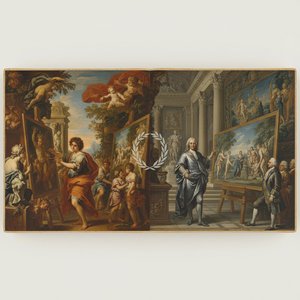
Upon his arrival in England, Cipriani swiftly integrated into the vibrant artistic milieu of Georgian society. He quickly garnered the support of influential figures like Lord Tilney and the Duke of Richmond, securing commissions that allowed him to showcase his versatility and skill. His talents were immediately put to use on ambitious decorative projects, including a magnificent ceiling at the Albany, designed by William Chambers for Lord Holland, and contributions to the evolving grandeur of Buckingham House. A particularly noteworthy commission involved creating an entire room adorned with poetical subjects at Standlynch in Wiltshire – a testament to his ability to translate literary themes into visually stunning compositions. However, it was his involvement with Somerset House, another landmark project spearheaded by Chambers, that truly cemented Cipriani’s position as a leading decorative artist of the era. He meticulously prepared designs for the interior of the north block, including rooms that would house the Royal Academy from 1750 onwards – spaces now integral to the Courtauld Gallery. Within Somerset House, his allegorical panels representing Allegory, Fable, Nature, and History, alongside delicate monochrome decorations in the joint ante-room of the Royal and Antiquarian Societies, demonstrated a refined sensibility and an ability to imbue architectural spaces with intellectual depth. Joseph Baretti’s guide through the Royal Academy further highlighted Cipriani's contributions, noting his designs for carvings – masks and grotesque groups – that adorned various fronts of the building.
A Founding Father of British Art
Cipriani’s artistic standing was formally recognized in 1768 when he became a founding member of the Royal Academy, a testament to his influence within the burgeoning English art world. This prestigious appointment underscored his commitment to fostering artistic excellence and establishing a national identity for British art. He further distinguished himself by designing the Academy’s diploma – an intricate and symbolic representation of artistic ideals – which was expertly engraved by his long-time friend and collaborator, Francesco Bartolozzi. In recognition of this significant service, Cipriani was presented with a silver cup by his fellow Academicians in 1769, a gesture that spoke volumes about the esteem in which he was held. Beyond his administrative contributions, Cipriani continued to produce designs for prints, often rendered in delicate pen and ink or vibrant color washes, which Bartolozzi would then translate into exquisite engravings. He also ventured into engraving himself, creating works based on masterpieces by Benvenuto Cellini – *The Death of Cleopatra* – and Anton Domenico Gabbiani – *The Descent of the Holy Ghost*. His portraiture skills were further showcased through engravings for Thomas Hollis’s memoirs in 1780. Cipriani's talents extended to grand ceremonial commissions, including designs for allegorical elements on both the Gold State Coach and the Lord Mayor's Gold Coach, built in 1762 and 1757 respectively, adding a touch of artistic splendor to these iconic symbols of British power. He also undertook restoration work at Windsor Castle, carefully preserving Verrio’s paintings, and meticulously restored Rubens’ magnificent ceiling in the Banqueting House at Whitehall.
Style, Legacy, and Enduring Influence
Cipriani's artistic style represented a compelling synthesis of Italian Baroque influences and the emerging Neoclassical aesthetics that were gaining prominence in England during the mid-18th century. His designs for furniture, particularly those featuring graceful nymphs, playful amorini, and intricately detailed medallion subjects incorporated into Pergolesi’s ornamental bands, became immensely fashionable. These designs were often brought to life through exquisite marquetry or painted onto wood by skilled artisans, contributing significantly to the popularity of satinwood furniture – a hallmark of Georgian elegance. While he occasionally designed handles for drawers and doors, Cipriani's primary impact lay in the realm of decorative painting and design. His legacy rests on his substantial contributions to English interior decoration and his role as a crucial bridge between Italian artistic traditions and the evolving tastes of Georgian England. He passed away in Hammersmith, West London, in 1785, and was laid to rest at Dovehouse Green, Chelsea, where Francesco Bartolozzi erected a poignant monument in his memory. Cipriani’s influence extended beyond his own creations; he nurtured the talents of several promising artists, including John Alexander Gresse, Charles Grignion the Younger, and Mauritius Lowe, ensuring that his artistic vision would continue to inspire future generations. His work remains a testament to the power of cross-cultural exchange and the enduring beauty of classical ideals.
Key Contributions & Lasting Impression
Here's a summary of Cipriani’s significant achievements:
- Pioneered Neoclassical style in England: He was instrumental in introducing and popularizing this aesthetic.
- Significant decorative schemes at Somerset House & Buckingham Palace: His work graced some of Britain's most iconic buildings.
- Royal Academy Role: Founding member, designer of the Academy’s diploma, and a key figure in its early development.
- Collaborations: Frequent collaborations with William Chambers, Joseph Wilton, and Francesco Bartolozzi enriched his artistic output.
- Artistic Style: Blended Baroque drama with Neoclassical refinement, influencing furniture design & interior decoration.
Cipriani’s impact resonates through the elegant interiors of Georgian England. He wasn't merely an artist; he was a cultural ambassador, skillfully weaving Italian artistry into the fabric of British aesthetic identity.
His legacy is one of refined beauty, intellectual depth, and enduring influence.