Geoffrey Scowcroft Fletcher: A Londoner’s Eye
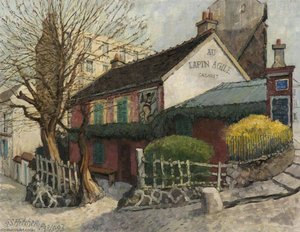
Geoffrey Scowcroft Fletcher (1923-2004) wasn't a grand, sweeping painter of historical epics or monumental landscapes. Instead, he carved his legacy from the quiet corners of London – the gaslit alleys, the crumbling terraces, the forgotten details that whispered stories of a city in constant flux. Born in Bolton, Lancashire, into a family with strong artistic leanings, Fletcher’s early life instilled a keen observational eye and a deep appreciation for the everyday. This foundation would prove crucial to his distinctive style, which blended romantic realism with an almost melancholic sensitivity towards urban decay and the passage of time.
His formal training at the Slade School of Art in London provided a solid technical base, but it was his subsequent scholarship to the British School at Rome that truly ignited his artistic vision. Immersed in the classical beauty of Italy, Fletcher began to develop a more nuanced approach to capturing light and atmosphere – an element he would later bring back to his beloved London.
The Chronicle of a City
Fletcher’s most celebrated work, *The London Nobody Knows* (1962), cemented his reputation as a unique chronicler of the capital. This meticulously researched book, accompanied by stunning drawings and insightful commentary, ventured beyond the iconic landmarks to explore the hidden pockets of London – the forgotten corners where life unfolded in quiet dignity. It wasn’t merely a record of architectural details; it was an elegy for a disappearing world, a poignant reminder of the city's layered history and its vulnerability to change. The book’s success led to a 1967 documentary film adaptation, directed by Norman Cohen and narrated by James Mason, further amplifying Fletcher’s voice and perspective.
Following *The London Nobody Knows*, Fletcher continued to document the city through his work for *The Daily Telegraph*, contributing drawings and text to their “London Day By Day” column. This sustained engagement with the urban landscape allowed him to develop a deep understanding of its rhythms, its inhabitants, and its ever-shifting character. His writing style mirrored his visual approach – intimate, observant, and imbued with a quiet melancholy.
A Painter’s Palette: Style and Technique
Fletcher's artistic style defies easy categorization. He wasn’t rigidly committed to any single movement, instead drawing upon elements of romantic realism and impressionism to create a uniquely personal visual language. His paintings are characterized by meticulous detail – the texture of stone in works like ‘Arnside Tower,’ the play of light on water in ‘Thames Barges off Southend’ – yet they never feel overly precise or academic. There's a looseness, an almost painterly spontaneity that imbues his work with life and energy.
He employed oil paints with skill, layering colors to create depth and atmosphere, often using subtle gradations of tone to evoke mood and emotion. His drawings, frequently executed in charcoal or pen and ink, shared the same meticulous attention to detail and a similar sensitivity to light and shadow. His subjects – from crumbling warehouses to bustling market stalls – were rendered with an almost photographic realism, yet always imbued with a sense of warmth and humanity.
Beyond London: Landscapes and Echoes
While inextricably linked with London in the public imagination, Fletcher’s artistic scope extended far beyond the capital. He possessed an innate ability to capture the essence of place, whether it was the rugged beauty of Cumbria, as exemplified in his evocative painting ‘Arnside Tower,’ or the serene coastal scenes of Essex. ‘Thames Barges off Southend’ beautifully illustrates this talent – a masterful Impressionistic rendering of weathered piers and moody skies, capturing not just the visual appearance of the scene but also its atmosphere and emotional resonance.
Even in works like ‘Llandudno, Punch & Judy,’ a vibrant depiction of a seaside amusement scene, there is a sense of nostalgia, a subtle acknowledgement of the fleeting nature of joy and entertainment. Fletcher’s landscapes weren't idealized depictions; they were honest portrayals of rural England, often featuring crumbling structures or scenes touched by time, reflecting his enduring fascination with history and decay.
Legacy and Influence
Geoffrey Scowcroft Fletcher remains a significant figure in British art, largely due to his unique perspective on London. His work offers a valuable glimpse into the city’s past, its present, and its potential future. His meticulous attention to detail, combined with his sensitive portrayal of urban life, has earned him a devoted following among collectors and art enthusiasts alike. Fletcher's legacy lies not in grand pronouncements or revolutionary techniques, but in his quiet, observant eye – an eye that captured the soul of London and continues to resonate with viewers today.