A Life Shrouded in Mystery: Unveiling Geertgen tot Sint Jans
The name Geertgen tot Sint Jans resonates softly within the annals of Early Netherlandish painting, a whisper of brilliance from an artist whose life remains frustratingly obscure. Flourishing in Haarlem during the latter half of the 15th century—roughly between 1460 and 1490—Geertgen’s existence is pieced together primarily through the writings of Karel van Mander, a Dutch art historian writing over a century after his death. Van Mander suggests a connection to the Knights Hospitaller of Saint John in Haarlem, lending the artist his distinctive surname, meaning “little Gerard of Saint John.” Whether he was a lay brother within the order or simply affiliated with them remains uncertain, yet this association profoundly shaped his artistic output. The scant documentary evidence surrounding Geertgen’s life contributes to an aura of mystique, allowing us to focus intently on the remarkable quality and spiritual depth of his surviving works. It is believed that he may have been a student of Albert van Ouwater, a pivotal figure in the development of painting within Haarlem, though concrete proof remains elusive.The Fragmentary Legacy: Surviving Masterpieces
Tragically, much of Geertgen’s oeuvre has been lost to time and circumstance. The tumultuous history of Haarlem, particularly the siege of 1573 during the Eighty Years' War, resulted in the destruction of numerous artworks, including a significant portion of his production. What remains offers tantalizing glimpses into an exceptional talent. The most celebrated surviving pieces are fragments of a large triptych originally created for the altar of the Knights of Saint John. These panels—The Legend of Saint John the Baptist and The Lamentation of Christ—now reside in Vienna’s Kunsthistorisches Museum, their separation from the original structure a poignant reminder of art's vulnerability to historical forces. The Lamentation, particularly, is renowned for its serene emotionality and innovative landscape, foreshadowing developments that would characterize Dutch painting in the centuries to come. Other attributed works include John the Baptist in the Wilderness, a contemplative depiction of spiritual isolation, and Man of Sorrows, a powerfully moving portrayal of Christ’s suffering. Each surviving panel is a testament to Geertgen's mastery of oil painting techniques, his delicate handling of light, and his ability to imbue religious scenes with profound psychological resonance.Innovation in Landscape and Spirituality
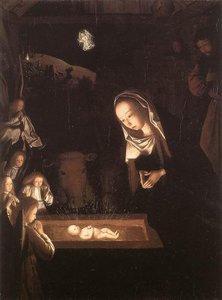
Geertgen tot Sint Jans distinguished himself through several key artistic innovations. He possessed an exceptional sensitivity to landscape, integrating it seamlessly into the narrative structure of his paintings. Unlike many of his contemporaries who used landscapes merely as backdrops, Geertgen’s settings are imbued with symbolic meaning and contribute significantly to the overall emotional impact of the work. His landscapes aren't simply realistic depictions; they evoke a sense of spiritual tranquility and reflect the inner state of the figures within them. Furthermore, Geertgen demonstrated a remarkable ability to convey emotion through subtle gestures and facial expressions. His figures are not grand or theatrical but possess an intimate humanity that draws the viewer into their world of faith and sorrow. The use of chiaroscuro—the dramatic interplay of light and shadow—is also notable, enhancing the emotional intensity of his scenes and creating a sense of depth and realism. This technique is particularly evident in The Nativity at Night, where darkness envelops the scene, punctuated by the radiant glow emanating from the infant Christ.A Lasting Influence: Geertgen’s Place in Art History
Despite the limited number of securely attributed works, Geertgen tot Sint Jans occupies a significant position within the history of Early Netherlandish art. His influence can be detected in the work of later Dutch masters, particularly those associated with the Haarlem school. His innovative approach to landscape and his sensitive portrayal of human emotion paved the way for developments that would define Dutch painting in the 17th century. The impact of The Lamentation, as evidenced by Jacob Matham’s engraving and accompanying poetry, demonstrates the profound effect Geertgen's work had on his contemporaries. While overshadowed by more prolific artists like Jan van Eyck or Rogier van der Weyden during his lifetime, modern scholarship has increasingly recognized Geertgen’s unique contributions to the Northern Renaissance. He represents a crucial link between the International Gothic style and the burgeoning realism of the 16th century, embodying a delicate balance between spiritual devotion and artistic innovation. His legacy endures not only through his surviving masterpieces but also through the enduring mystery that surrounds his life—a testament to the power of art to transcend the limitations of historical knowledge.Rediscovering a Master
- Early Netherlandish Painting: Geertgen’s work is firmly rooted in the traditions of Early Netherlandish painting, characterized by meticulous detail, realistic depictions, and a focus on religious themes.
- Haarlem School: He played a key role in establishing the Haarlem school of painting, influencing subsequent generations of artists working in the region.
- Spiritual Depth: His paintings are notable for their profound spiritual depth and emotional resonance, inviting viewers to contemplate themes of faith, suffering, and redemption.
- Landscape Innovation: Geertgen’s innovative use of landscape as an integral part of the narrative structure set him apart from many of his contemporaries.
Questions & Answers
How popular are Geertgen tot Sint Jans's artworks?
A Stats page exists for Geertgen tot Sint Jans, presenting statistics about the artist's artworks on this website.
Can I browse Geertgen tot Sint Jans's works by color palette?
Geertgen tot Sint Jans's works can be browsed by color palette on the artist's By Palettes page.
What aliases or alternate names does Geertgen tot Sint Jans have?
Geertgen tot Sint Jans appears under the alternate names Geertgen van Haarlem, Gerrit van Haarlem, Gerrit Gerritsz, Gheertgen, Geerrit.