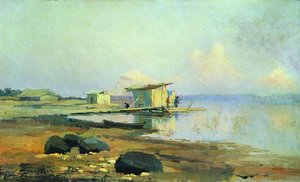
Portrait of Fyodor Vasilyev

The 100 Most Famous Fyodor Vasilyev Paintings, a Gallery Selection

Updated November 2026 · ranked by our popularity score (searches, visits and orders for each work) · 108 works by Fyodor Vasilyev in our catalogue

In short

Of all the originals Fyodor Vasilyev left, the most famous is Summer Hot Day (1869). Close behind it come River in Krasnoye Selo (1870) and Morning in a Village (1869). Our catalog holds 108 works by Fyodor Vasilyev; the gallery has kept the 100 the world admires most, each shown with its date, its museum and its story.

1850 – 1873, Gatchina Realism Most works: Tretyakov Gallery

Fyodor Vasilyev's top 10 paintings: the gallery's choice

1
Summer Hot Day (1869) by Fyodor Vasilyev

Summer Hot Day

1869 · Oil On Canvas

The canvas presents a horizontal view of a rural landscape under a clear sky. A large tree occupies the center of the frame, its verticality anchoring the composition against the sloping ground and distant hills. A winding path begins in the foreground and recedes into the background, creating a sense of depth through atmospheric perspective. Near this path, a solitary figure sits, positioned slightly off-center. The scene is rendered with…

2
River in Krasnoye Selo (1870) by Fyodor Vasilyev

River in Krasnoye Selo

1870 · Oil

In this 1870 work, we find ourselves standing on the banks of a river near Krasnoye Selo. The scene is one of profound stillness, where the natural world and human presence exist in a delicate, unforced harmony. Two figures occupy the river bank, their presence adding a sense of scale and intimacy to the landscape. One individual holds an umbrella, a small but significant detail that suggests a moment of…

3
Morning in a Village (1869) by Fyodor Vasilyev

Morning in a Village

1869 · Oil

In this 1869 oil painting, a village scene unfolds through a realistic lens. The foreground is occupied by a woman positioned next to two horses. One horse stands to her left, while the second is situated further back in the composition. The woman's posture suggests she is tending to or leading the animals. Several animals populate the immediate environment, including three dogs located at the center, the right edge, and…

4
Peasants Hut (1863) by Fyodor Vasilyev

Peasants Hut

1863 · Charcoal

In this 1863 work titled Peasants Hut, the artist Fyodor Vasilyev turns his attention to the quietude of the Russian countryside. The piece focuses on a traditional barn, an element that functions as a symbol of agricultural heritage and the simplicity of rural life. It is a scene that captures a specific moment of stillness within a landscape that feels deeply rooted in the earth.

5
The Trunk of an Old Oak (1869) by Fyodor Vasilyev

The Trunk of an Old Oak

1869 · Pencil

In "The Trunk of an Old Oak" by Fyodor Vasilyev, a massive oak trunk dominates the frame. The composition is vertically oriented, pulling the eye upward to emphasize the sheer height of the tree. Branches reach out and climb toward the top of the image, carving irregular shapes against the space. At the base of this wooden giant, a smaller figure appears, engaged in quiet activity near the roots. This…

6
After a Rain. Country Road (1869) by Fyodor Vasilyev

After a Rain. Country Road

1869 · Oil On Canvas

In this work, titled After a Rain. Country Road, Fyodor Vasilyev presents a quiet moment of transition within the Russian countryside. Painted in 1869, the scene captures the immediate aftermath of rainfall, focusing on the subtle shifts in the landscape once the storm has passed. It is a study of a simple rural setting, where the dampness of the earth and the heavy atmosphere of the sky define the mood…

7
Bank of the Volga after the Storm (1871) by Fyodor Vasilyev

Bank of the Volga after the Storm

1871 · Oil On Canvas

The painting Bank of the Volga after the Storm by Fyodor Vasilyev captures a specific moment of stillness. Created in 1871, the work presents a realistic depiction of a river landscape. The Volga River stretches toward a wide horizon, meeting a sandy shore under a heavy, overcast sky. It is a scene of quietude following a period of turbulence.

8
Peasant Family in a Boat (1870) by Fyodor Vasilyev

Peasant Family in a Boat

1870 · Oil On Canvas

There is a profound stillness in this 1870 oil on canvas, a moment captured where the rhythm of labor meets the calm of the natural world. A peasant family occupies a small boat, drifting across a surface of water that reflects a soft, diffused light. A man rows with steady intent, while a woman and child sit within the vessel, their presence part of the landscape rather than an imposition…

9
Horses at the Watering (1869) by Fyodor Vasilyev

Horses at the Watering

1869 · Watercolor

In Horses at the Watering by Fyodor Vasilyev, the world is weighted toward the heavens. The composition is dominated by a vast sky where heavy clouds claim the majority of the frame. A low horizon line pushes the earth downward, granting the atmosphere an expansive, overwhelming presence. This arrangement forces the eye to look upward, past the immediate landscape and into the shifting light of the clouds.

10
On the Bank of the Volga (1870) by Fyodor Vasilyev

On the Bank of the Volga

1870 · Oil On Canvas

On the Bank of the Volga is a landscape painted by Fyodor Vasilyev in 1870. The scene captures a quiet moment along the river's edge, where the water meets the shore in a soft, hazy light. It focuses on the intersection of natural beauty and the quiet rhythms of everyday life.

The Fyodor Vasilyev selection continues, 11 to 100

11Evening (1869) by Fyodor VasilyevEvening1869 12Dugout (1870) by Fyodor VasilyevDugout1870 13After a Heavy Rain (1870) by Fyodor VasilyevAfter a Heavy Rain1870 14At the River. Windy Day (1869) by Fyodor VasilyevAt the River. Windy Day1869 15Near Krasnoye Selo (1868) by Fyodor VasilyevNear Krasnoye Selo1868 16Logs by the Road (1869) by Fyodor VasilyevLogs by the Road1869 17Landscape. Pargolovo (1868) by Fyodor VasilyevLandscape. Pargolovo1868 18Near a Watering Place (1868) by Fyodor VasilyevNear a Watering Place1868 19Before a Thunderstorm (1868) by Fyodor VasilyevBefore a Thunderstorm1868 20Barges near the Bank (1870) by Fyodor VasilyevBarges near the Bank1870 21Peasants with a Boat on a Sandy Beach (1868) by Fyodor VasilyevPeasants with a Boat on a Sandy Beach1868 22After a Rain (1869) by Fyodor VasilyevAfter a Rain1869 23Crimean Landscape (1873) by Fyodor VasilyevCrimean Landscape1873 24Abandoned Mill (1873) by Fyodor VasilyevAbandoned Mill1873 25Mountains of the Crimea in Autumn by Fyodor VasilyevMountains of the Crimea in Autumn 26Autumn (1869) by Fyodor VasilyevAutumn1869 27Barns (1870) by Fyodor VasilyevBarns1870 28The Shore. Cloudy Day (1869) by Fyodor VasilyevThe Shore. Cloudy Day1869 29On the Island Valaam (1869) by Fyodor VasilyevOn the Island Valaam1869 30On the Neva (1871) by Fyodor VasilyevOn the Neva1871 31The Barn (1868) by Fyodor VasilyevThe Barn1868 32Cumulus (1871) by Fyodor VasilyevCumulus1871 33On the River. Calm (1867) by Fyodor VasilyevOn the River. Calm1867 34Winter (1871) by Fyodor VasilyevWinter1871 35At the Sink (1871) by Fyodor VasilyevAt the Sink1871 36The Evening before the Storm (1869) by Fyodor VasilyevThe Evening before the Storm1869 37Rye (1870) by Fyodor VasilyevRye1870 38Trees. Study (1870) by Fyodor VasilyevTrees. Study1870 39Birch Grove in the Evening (1869) by Fyodor VasilyevBirch Grove in the Evening1869 40In the Vicinity of St. Petersburg (1868) by Fyodor VasilyevIn the Vicinity of St. Petersburg1868 41Peasant's Courtyard (1869) by Fyodor VasilyevPeasant's Courtyard1869 42Evening (1871) by Fyodor VasilyevEvening1871 43Dawn in St. Petersburg (1870) by Fyodor VasilyevDawn in St. Petersburg1870 44Village (1869) by Fyodor VasilyevVillage1869 45Landscape with a Rock and Stream (1867) by Fyodor VasilyevLandscape with a Rock and Stream1867 46Road through a Birchwood (1869) by Fyodor VasilyevRoad through a Birchwood1869 47Bridge over a Brook (1870) by Fyodor VasilyevBridge over a Brook1870 48On Valaam. Rocks (1867) by Fyodor VasilyevOn Valaam. Rocks1867 49Clouds. The Village of Krestinskoye (1867) by Fyodor VasilyevClouds. The Village of Krestinskoye1867 50Near a Church. Valaam (1867) by Fyodor VasilyevNear a Church. Valaam1867 51Forest Road (1869) by Fyodor VasilyevForest Road1869 52Hot Summer Day (1869) by Fyodor VasilyevHot Summer Day1869 53Before a Thunderstorm (1869) by Fyodor VasilyevBefore a Thunderstorm1869 54Volga Lagoon (1870) by Fyodor VasilyevVolga Lagoon1870 55The Crowns of the Trees (1867) by Fyodor VasilyevThe Crowns of the Trees1867 56After a Rain (Spring in St. Petersburg) (1867) by Fyodor VasilyevAfter a Rain (Spring in St. Petersburg)1867 57The Sea with Ships (1873) by Fyodor VasilyevThe Sea with Ships1873 58Surf Waves (1873) by Fyodor VasilyevSurf Waves1873 59Self-Portrait (1873) by Fyodor VasilyevSelf-Portrait1873 60Morning (1873) by Fyodor VasilyevMorning1873 61Dawn (1873) by Fyodor VasilyevDawn1873 62Abandoned Mill 2 (1873) by Fyodor VasilyevAbandoned Mill 21873 63On the Beach (1873) by Fyodor VasilyevOn the Beach1873 64Mountains in the Clouds (1873) by Fyodor VasilyevMountains in the Clouds1873 65Crimea. Yalta (1873) by Fyodor VasilyevCrimea. Yalta1873 66Landscape. Crimea (1873) by Fyodor VasilyevLandscape. Crimea1873 67Pine Grove in the Swamp (1873) by Fyodor VasilyevPine Grove in the Swamp1873 68Mountains in the Crimea in Winter (1873) by Fyodor VasilyevMountains in the Crimea in Winter1873 69Evening in the Crimea (1873) by Fyodor VasilyevEvening in the Crimea1873 70Autumn Forest (1873) by Fyodor VasilyevAutumn Forest1873 71Wet Meadow (1872) by Fyodor VasilyevWet Meadow1872 72Wet Meadow 1. Study (1872) by Fyodor VasilyevWet Meadow 1. Study1872 73In the Mountain of the Crimea. Brook (1873) by Fyodor VasilyevIn the Mountain of the Crimea. Brook1873 74In the Crimea. After a Rain (1873) by Fyodor VasilyevIn the Crimea. After a Rain1873 75Abandoned Mill 1 (1873) by Fyodor VasilyevAbandoned Mill 11873 76Eriklik the Fountain (Crimea) (1872) by Fyodor VasilyevEriklik the Fountain (Crimea)1872 77Swamp in a Forest. Mist (1873) by Fyodor VasilyevSwamp in a Forest. Mist1873 78Sailboats. Study by Fyodor VasilyevSailboats. Study 79Landscape with Clouds by Fyodor VasilyevLandscape with Clouds 80Clouds over Hills. Study by Fyodor VasilyevClouds over Hills. Study 81Early Morning by Fyodor VasilyevEarly Morning 82The Thaw by Fyodor VasilyevThe ThawThe State Russian Museum 83Sunset by Fyodor VasilyevSunsetNational Gallery of Armenia 84Clouds by Fyodor VasilyevClouds 85Apiary by Fyodor VasilyevApiary 86Peasant's House by Fyodor VasilyevPeasant's House 87Village by Fyodor VasilyevVillage 88Lombardy Poplars on the Bank of a Lake. Evening by Fyodor VasilyevLombardy Poplars on the Bank of a Lake. Evening 89Tide by Fyodor VasilyevTide 90Rapid Stream by Fyodor VasilyevRapid Stream 91Brook in a Forest by Fyodor VasilyevBrook in a Forest 92Bay by Fyodor VasilyevBay 93Oaks by Fyodor VasilyevOaks 94Water Mill on a Mountain River. Crimea by Fyodor VasilyevWater Mill on a Mountain River. Crimea 95Cypresses in the Crimea by Fyodor VasilyevCypresses in the Crimea 96In an Oak Grove by Fyodor VasilyevIn an Oak Grove 97Trees by Fyodor VasilyevTrees 98Tide near the Shore of the Crimea by Fyodor VasilyevTide near the Shore of the Crimea 99In the Mountains of the Crimea (1873) by Fyodor VasilyevIn the Mountains of the Crimea1873 · Tretyakov Gallery 100Wet Meadow (1872) by Fyodor VasilyevWet Meadow1872 · Tretyakov Gallery

Fyodor Vasilyev's famous paintings, period by period

The subjects that held Fyodor Vasilyev's eye

The four subjects that come back most often in these originals, each with its finest example.

The museums that keep Fyodor Vasilyev's originals

The 3 museums that hold the most of the paintings on this page.

Museum City Works by Fyodor Vasilyev Paintings from this list
Tretyakov Gallery, MoscowTretyakov Gallery Moscow 8 In the Mountains of the Crimea, Wet Meadow
The State Russian Museum, St. PetersburgThe State Russian Museum St. Petersburg 3 The Thaw
National Gallery of Armenia, YerevanNational Gallery of Armenia Yerevan 1 Sunset

Fyodor Vasilyev year by year: the originals that define each

Barely a decade, 1863 to 1873, gave the world every dated Fyodor Vasilyev original in this selection: here it is, year by year.

Works per year

Pick a year to see its originals.

Collectors' questions about Fyodor Vasilyev's paintings

Which work is Fyodor Vasilyev most famous for?Reveal the answer

Summer Hot Day (1869). River in Krasnoye Selo (1870) and Morning in a Village (1869) come next.

What age was Fyodor Vasilyev when Summer Hot Day was made?Reveal the answer

19 years old: Summer Hot Day dates from 1869, and Fyodor Vasilyev was born in 1850.

What are the ten most famous Fyodor Vasilyev paintings?Reveal the answer

Summer Hot Day, River in Krasnoye Selo, Morning in a Village, Peasants Hut, The Trunk of an Old Oak, After a Rain. Country Road, Bank of the Volga after the Storm, Peasant Family in a Boat, Horses at the Watering and On the Bank of the Volga. The ranking above gives each one's year and museum.

How many paintings did Fyodor Vasilyev leave?Reveal the answer

Our catalog holds 108 works by Fyodor Vasilyev, dated from 1863 to 1873.

In which museums do Fyodor Vasilyev's masterpieces hang?Reveal the answer

Mostly in Tretyakov Gallery (Moscow), The State Russian Museum (St. Petersburg) and National Gallery of Armenia (Yerevan). The museum table above lists them all.

In which years did Fyodor Vasilyev paint the most famous works?Reveal the answer

In 1873: 21 of the 100 works on this page were made then, Crimean Landscape among them.

What are the first and the last famous originals of Fyodor Vasilyev?Reveal the answer

On this page, the earliest is Peasants Hut (1863) and the latest Crimean Landscape (1873).

Which subjects did Fyodor Vasilyev choose most often?Reveal the answer

Forests (22), Sky (18) and Russian landscape (13), across the 100 works on this page.

Which technique did Fyodor Vasilyev use most?Reveal the answer

Oil On Canvas, for 19 of the 100 works on this page.

To which art movement does Fyodor Vasilyev belong?Reveal the answer

Realism, judging by the originals on this page.

Which Fyodor Vasilyev works hang at the Tretyakov Gallery?Reveal the answer

In the Mountains of the Crimea and Wet Meadow: the Tretyakov Gallery, Moscow holds 2 of the works on this page.

Fyodor Vasilyev: life and work

Fyodor Vasilyev: A Russian Soul Captured in Light and Shadow

Fyodor Alexandrovich Vasilyev (1850-1873) stands as a pivotal, yet tragically short-lived, figure in the development of Russian landscape painting. His brief career, spanning just two decades, nonetheless produced a body of work that profoundly influenced a generation of artists and established him as a pioneer of the lyrical landscape style – a movement characterized by its atmospheric depth, emotional resonance, and intimate portrayal of the Russian countryside and Crimean mountains. Born in Gatchina, near St. Petersburg, Vasilyev’s life was marked by hardship and early responsibility, experiences that undoubtedly shaped his artistic vision.

His origins were humble; he was born to a low-level government official, Alexander Vasilyevich Vasilyev, and Olga Emelyanova Polyntseva. The marriage of his parents occurred four years after his birth, leading to him being considered an illegitimate child from the outset. This early circumstance instilled in him a sense of self-reliance and resilience that would later manifest in his art. From the age of twelve, he was forced to earn his living through various manual labor jobs – as a mailman, scribe, and assistant restoring paintings – a stark contrast to the privileged artistic circles he would eventually encounter.

Vasilyev’s formal artistic education began in 1863 when he enrolled in evening classes at the School of Painting within the Society for Promotion of Artists. This institution provided him with a foundational understanding of technique and art history, but it was his encounters with established painters that truly ignited his creative spirit. Notably, he befriended Ivan Shishkin, one of Russia’s most celebrated landscape artists, who recognized Vasilyev's exceptional talent and took on the role of mentor. Shishkin’s influence is readily apparent in Vasilyev’s early works, particularly those created during their collaborative period on the island of Valaam in 1867. This experience exposed him to the grandeur and spiritual depth of the Russian wilderness.

Shishkin's mentorship extended beyond technical instruction; he introduced Vasilyev to a network of influential figures within the St. Petersburg art world, including Ivan Kramskoi, Ilya Repin, Pavel Tretyakov, and Pavel Stroganov – patrons who would later champion his work. These connections proved invaluable, providing him with access to exhibitions, commissions, and critical acclaim. However, Vasilyev’s rise was not without its challenges. His talent attracted the attention of Shishkin's rivals, leading to a period of intense competition and accusations of artistic manipulation within the art community.

The Barbizon Influence and Vasilyev’s Unique Style

Vasilyev’s early paintings demonstrate a clear debt to the Barbizon school of French landscape painting. Artists associated with this movement – such as Théodore Rousseau and Jean-François Millet – prioritized capturing the essence of nature, often depicting scenes of rural life with a focus on atmospheric effects and subtle color variations. Vasilyev initially adopted many of their techniques, employing loose brushwork and prioritizing mood over precise detail. However, he quickly transcended mere imitation, developing his own distinctive style that blended Barbizon influences with a uniquely Russian sensibility.

Unlike the French Barbizon painters who often sought to represent idealized landscapes, Vasilyev’s work was deeply rooted in the realities of the Russian countryside and the Crimean mountains. He captured not just the visual appearance of these locations but also their emotional resonance – the quiet solitude of a forest path, the melancholy beauty of a rain-swept field, the dramatic grandeur of the mountain peaks. His paintings are imbued with a sense of nostalgia and longing, reflecting his own personal experiences and the spirit of the Russian people.

Key works from this period, such as *After a Thunderstorm* (1868) and *Near a Watering Place* (1868), showcase Vasilyev’s ability to evoke atmosphere through color and light. His use of muted tones, subtle gradations of shade, and dynamic brushwork creates a sense of depth and movement that draws the viewer into the scene. He was particularly adept at capturing the effects of weather – rain, fog, and mist – transforming ordinary landscapes into realms of ethereal beauty.
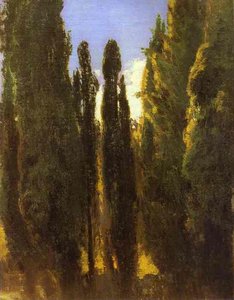
Collaborations and Artistic Circles

Vasilyev’s artistic journey was intertwined with several significant collaborations and interactions within the vibrant St. Petersburg art scene. His association with Ivan Shishkin proved to be particularly formative, providing him with invaluable guidance and exposure. However, Vasilyev also engaged in a productive working relationship with Ilya Repin during their Volga River expedition in 1870, resulting in the evocative painting *Volga View. Barges*. This experience broadened his artistic horizons and exposed him to new subjects and techniques.

Furthermore, Vasilyev became a member of the Peredvizhniki (Wanderers), a group of realist artists who sought to depict the lives and struggles of ordinary Russians. While he was initially hesitant to fully embrace this movement’s political agenda, he recognized its value as a platform for promoting his work and engaging with a wider audience. His membership in the Peredvizhniki brought him into contact with other prominent artists such as Repin, Kramskoi, and Viktor Mazurin.

A Tragic End and Lasting Legacy

Despite his burgeoning success, Vasilyev’s life was tragically cut short at the age of 23. Diagnosed with tuberculosis, he sought refuge in the Crimean mountains, hoping to find respite from his illness. However, his health continued to deteriorate, and he ultimately succumbed to the disease in Yalta in October 1873.

His untimely death left a void in the Russian art world, but Vasilyev’s legacy endures through his remarkable body of work. His paintings are celebrated for their atmospheric depth, emotional resonance, and intimate portrayal of the Russian landscape. He is widely regarded as one of the pioneers of the lyrical landscape style, and his influence can be seen in the works of later generations of Russian artists, including Isaac Levitan and Valentin Serov. Vasilyev’s brief but brilliant career serves as a testament to the power of artistic vision and the enduring beauty of the natural world.

Key Works

  • After a Thunderstorm (1868): Demonstrates early Barbizon influence, capturing dramatic weather effects.
  • Near a Watering Place (1868): Exhibits skillful use of light and shadow to create atmospheric depth.
  • After a Rain (1869): A prime example of Vasilyev’s ability to evoke mood through color and brushwork.
  • Volga View. Barges (1870): Collaboration with Ilya Repin, showcasing the artist's versatility.
  • Thaw (1871): A pivotal work that brought Vasilyev widespread recognition.
  • Wet Meadow (1872): Considered his masterpiece, reflecting a mature style and profound connection to the Russian landscape.

Fyodor Vasilyev’s life was tragically brief, but his artistic legacy continues to inspire and captivate viewers today. His paintings offer a poignant glimpse into the soul of Russia – its beauty, its melancholy, and its enduring spirit.