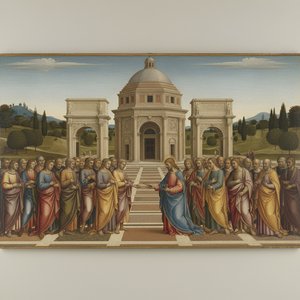
The Architect of the Paduan School
In the sun-drenched, intellectually vibrant landscape of the Italian Renaissance, where the names of titans like Da Vinci and Michelangelo often cast long shadows, there exists a more enigmatic figure whose influence was woven into the very fabric of the Paduan school. Francesco Squarcione remains a phantom of art history, a man whose personal oeuvre is remarkably sparse, yet whose intellectual footprint is monumental. Born in Padua around 1397, Squarcione’s journey into the annals of greatness did not begin with a palette and brush, but rather with the meticulous discipline of the needle and thread. His original vocation as a tailor provided him with a unique, exacting eye for detail—a precision that would later define his approach to visual composition and the training of the next generation of masters.
Squarcione’s transition from craftsman to creator began in earnest around 1426, when he executed an altarpiece for the Olivetan monastery at Venda. This early foray into sacred art marked the beginning of a career that would eventually see him established as a pivotal figure in Northern Italian art. While his own signed works are rare—notably limited to the Madonna and Child now housed in Berlin and the Lazara Altarpiece in Padua—his true legacy was forged not on canvas, but through the curation of antiquity. Driven by an insatiable passion for the remnants of Roman civilization, Squarcione traveled extensively throughout Italy and perhaps even into Greece, acting more as an archaeologist of beauty than a mere painter. He amassed a staggering collection of ancient sculptures, reliefs, and vases, transforming his workshop into a living museum where the fragments of the past could breathe life into the art of the present.
A Crucible of Genius
The true magnitude of Squarcione’s achievement is found in the extraordinary lineage of artists who emerged from his tutelage. By 1431, he had established a thriving school in Padua that functioned as a crucible for Renaissance innovation. His workshop was a place where the rigid, formal traditions of the Middle Ages were melted down and recast in the light of classical realism. He did not merely teach technique; he taught a way of seeing. By inviting students to study his vast collection of antique fragments, he bridged the gap between medieval tradition and the burgeoning humanist movement. His pedagogical method was deeply rooted in the study of Roman sculpture, instilling a sense of structural permanence and anatomical rigor in those who studied under him.
The list of luminaries who passed through his doors is a testament to his profound impact on the trajectory of Western art:
- Andrea Mantegna: Perhaps his most famous pupil, with whom Squarcione shared a complex relationship marked by both mentorship and legal disputes.
- Cosimo Tura: A key figure in the development of the Paduan style.
- Carlo Crivelli: Whose later works would demonstrate the enduring influence of the school's meticulous approach.
- Marco Zoppo: Who absorbed the foundational training of realism and careful observation of nature.
Through these students, Squarcione’s obsession with classical antiquity and his emphasis on sculptural form were disseminated across Italy, shaping the aesthetic language of the Renaissance. He provided the intellectual and material foundation upon which the Paduan school was built, ensuring that even as his own hand faded from the historical record, his vision would continue to resonate through the brushstrokes of the masters who followed him.