A Voice of Clay and Resistance
In the heart of Mato Grosso do Sul, Brazil, where the ancestral echoes of the Terena people meet the complexities of contemporary life, the art of Etnia Terena emerges as a profound dialogue between memory and matter. Born in Cuiabá, her identity is inextricably linked to the resilience of her community—a people who have navigated centuries of displacement and assimilation attempts with an unwavering spirit. Her artistic practice is not merely an aesthetic pursuit but a scholarly and soulful reclamation of indigenous narratives. With a background rooted in advanced education, including a doctorate focused on the symbolic power of the Emin Dance, she approaches her medium with the precision of a researcher and the passion of a guardian of culture.
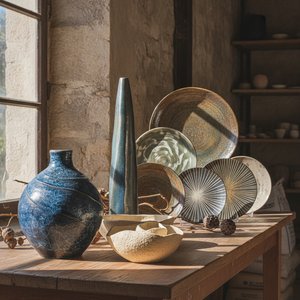
The work of Etnia Terena serves as a bridge between the ancient and the modern. Her ceramic sculptures, often characterized by earthy tones and intricate, rhythmic designs, draw direct inspiration from the traditional folk pottery of her ancestors. These pieces are more than objects; they are vessels of storytelling. When one observes her Pratos, jarra collections, there is a palpable sense of the natural world—the soil, the heat, and the organic textures that define the Brazilian landscape. Through the manipulation of clay, she breathes life into themes of survival and identity, ensuring that the ancestral knowledge of the Terena people remains visible in an increasingly globalized world.
The Intersection of Art and Activism
Beyond the kiln, Terena’s influence extends into the very fabric of social and cultural preservation. Her career is marked by a multidisciplinary approach where art intersects with education, communication, and community empowerment. She has been a pivotal figure in fostering collaborative spaces for young indigenous creators, utilizing theatrical productions to amplify voices that are often marginalized by mainstream Brazilian society. This commitment to communal growth is further evidenced by her leadership in sustainable economic initiatives, such as the development of bio-jewelry projects, which marry traditional ecological wisdom with modern economic viability.
Her intellectual contributions are equally significant, particularly her efforts to safeguard the linguistic heritage of her people through digitization projects. By treating language and art as two sides of the same coin—both being essential tools for cultural continuity—she has positioned herself as a vital curator of indigenous aesthetics. Her work explores the concept of non-ephemerality, a principle where art acts as a permanent record of a people's existence against the tides of colonial erasure. Whether through her role as an exhibition curator or her academic pursuits, she continues to challenge the boundaries of how indigenous art is perceived in global exhibition spaces.
Legacy and Cultural Significance
The historical significance of Etnia Terena lies in her ability to transform the act of creation into an act of resistance. Her sculptures do not just sit in galleries; they demand recognition for a culture that has fought to remain whole. Through her mastery of ceramic form, she achieves several critical milestones:
- Preservation of Symbolism: Reinterpreting traditional motifs and ritualistic elements within a contemporary sculptural context.
- Cultural Advocacy: Utilizing the visibility of fine art to advocate for indigenous rights and the protection of ancestral territories.
- Educational Innovation: Bridging the gap between academic research and grassroots community development through projects like Lab Gente.
- Aesthetic Sovereignty: Establishing a distinct visual language that asserts the presence of Terena identity within the broader landscape of South American contemporary art.
As her practice continues to evolve, Etnia Terena remains a singular force in the art world—a creator whose hands are stained with the earth of her homeland and whose vision is fixed firmly on the horizon of cultural survival. Her work stands as a testament to the fact that even in the face of profound change, the stories etched in clay can endure, providing a permanent sanctuary for the soul of a people.