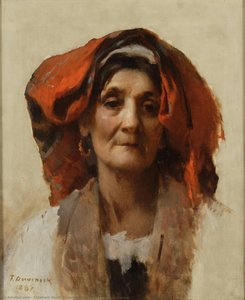
Portrait of Elizabeth Boott

The 20 Most Famous Elizabeth Boott Paintings, Each One of a Kind

Updated November 2026 · ranked by our popularity score (searches, visits and orders for each work) · 20 works by Elizabeth Boott in our catalogue

In short

Woman and Children (1878) is the Elizabeth Boott painting that draws the most eyes; the original belongs to the Cincinnati Art Museum, Cincinnati. After it, the eye goes to The shawm player and his son (1876) and Narcissus on the Campagna (1872). Among the 20 works of Elizabeth Boott in our catalog, these 20 are the most famous, each a unique original presented with its year, its museum and the reason it endures.

1846 – 1888, Boston Most works: Brooklyn Museum

Top 10 paintings by Elizabeth Boott, through the gallery's eye

1
Woman and Children (1878) by Elizabeth Boott

Woman and Children

1878 · Oil On Canvas · Cincinnati Art Museum, Cincinnati

A woman sits anchored against a wall of rough, pale stone. She is the center of a small, triangular world, holding two children close to her form. The light enters from the upper left, washing over the soft curves of their limbs and the heavy folds of their clothing. Her garment is a deep, saturated blue that cuts through the warmth of the background. Around her, the palette remains grounded…

2
The shawm player and his son (1876) by Elizabeth Boott

The shawm player and his son

1876 · Watercolor · Metropolitan Museum of Art, New York

In "The shawm player and his son" by Elizabeth Boott, a musical moment unfolds with an intimate, spontaneous energy. The composition centers on a tall man positioned on the left, his breath filling the shawm to produce a melody that seems to hang in the air. To his right, a cluster of five children gathers closely, their bodies oriented toward the sound. This arrangement creates a sense of community and…

Elizabeth Boott's famous paintings, numbers 11 to 20

The subjects that held Elizabeth Boott's eye

The four subjects that come back most often in these originals, each with its finest example.

The museums that keep Elizabeth Boott's originals

The 5 museums that hold the most of the paintings on this page.

Museum City Works by Elizabeth Boott Paintings from this list
Brooklyn Museum, BrooklynBrooklyn Museum Brooklyn 4 Rhododendrons, Rhododendrons, Autumn Foliage
Cincinnati Art Museum, CincinnatiCincinnati Art Museum Cincinnati 2 Woman and Children, Apple Tree Branches
Smithsonian American Art Museum, Washington, D.C.Smithsonian American Art Museum Washington, D.C. 2 Sharon Springs, Richmond
Metropolitan Museum of Art, New YorkMetropolitan Museum of Art New York 1 The shawm player and his son
Museum of Fine Arts, BostonMuseum of Fine Arts Boston 1 Narcissus on the Campagna

Elizabeth Boott across the years: the unique originals of each

A long career of 17 years, 1872 to 1888: Elizabeth Boott's most famous originals, shown year by year.

Works per year

Pick a year to see its originals.

Elizabeth Boott's paintings: questions for the gallery

What is the single most famous work of Elizabeth Boott?Reveal the answer

Woman and Children (1878), Cincinnati Art Museum, Cincinnati. The shawm player and his son (1876) and Narcissus on the Campagna (1872) come next.

At what age did Elizabeth Boott create Woman and Children?Reveal the answer

32 years old: Woman and Children dates from 1878, and Elizabeth Boott was born in 1846.

Which ten paintings by Elizabeth Boott are the most famous?Reveal the answer

Woman and Children, The shawm player and his son, Narcissus on the Campagna, Lady Bloodgood, (painting), Apple Tree Branches, Rhododendrons, Rhododendrons, Autumn Foliage, Apple Blossoms and Sharon Springs. The ranking above gives each one's year and museum.

How many works by Elizabeth Boott are known?Reveal the answer

Our catalog holds 20 works by Elizabeth Boott, dated from 1872 to 1888.

Where can the most famous Elizabeth Boott originals be seen?Reveal the answer

Mostly in Brooklyn Museum (Brooklyn), Cincinnati Art Museum (Cincinnati) and Smithsonian American Art Museum (Washington, D.C.). The museum table above lists them all.

During which period did Elizabeth Boott create the best-known paintings?Reveal the answer

In 1882: 5 of the 20 works on this page were made then, Rhododendrons among them.

Which famous Elizabeth Boott painting is the earliest, and which the latest?Reveal the answer

On this page, the earliest is Narcissus on the Campagna (1872) and the latest Girl in Grey Shawl, (painting) (1888).

What Elizabeth Boott originals can I see at the Brooklyn Museum?Reveal the answer

Rhododendrons, Rhododendrons and Autumn Foliage: the Brooklyn Museum, Brooklyn holds 4 of the works on this page.

Elizabeth Boott: a portrait of the artist

A Life Painted in Light and Shadow

The life of Elizabeth Boott Duveneck, often affectionately known as Lizzie, reads like a sweeping narrative from a Jamesian novel, filled with cosmopolitan elegance and profound romantic devotion. Born in Boston, Massachusetts, she was raised within a world of high culture, the daughter of the accomplished composer Francis Boott. Her early years were shaped by a privileged upbringing that spanned continents, moving from the refined atmosphere of her father's home to the sun-drenched landscapes of Italy. This international existence provided her with a unique, multifaceted perspective, allowing her to absorb the artistic currents flowing through Europe and America alike.

Her journey into the realm of fine art was marked by a rigorous pursuit of mastery. She sought instruction from some of the most influential figures of her era, beginning with the William Morris Hunt class for women in Boston, where she embraced modern French aesthetic principles. Her education continued under the guidance of Thomas Couture outside Paris and later through a transformative summer of study in Munich under her future husband, Frank Duveneck. These mentors helped shape her ability to work across various media, including watercolor, pencil, pen, and ink, as she developed a particular facility for capturing the delicate nuances of still lifes, landscapes, and portraits.

Artistic Mastery and the Impressionist Spirit

As an American Impressionist, Elizabeth Boott Duveneck possessed a remarkable ability to translate the atmosphere of her surroundings onto the canvas. Her work often reflected the beauty of the Italian landscapes she inhabited, most notably during her time at the Villa Castellani in Bellosguardo. One of her most celebrated achievements, Villa Castellani Bellosquardo, stands as a stunning testament to her skill in capturing Italian beauty through an Impressionist lens. Her technique was characterized by a sensitive touch, whether she was rendering the quiet stillness of a still life or the sweeping vistas of a landscape.

Her professional trajectory was marked by significant milestones that established her reputation within the American art community. She achieved notable success through various exhibitions, including:

  • A joint exhibition with Annie Dixwell in Boston at J. Eastman Chase's Gallery.
  • Submissions to the American Watercolor Society and the Boston Art Club.
  • Showcases at the National Academy of Design and the Philadelphia Society of Artists.
  • Exhibitions at the Boston Museum of Fine Arts.
  • A prestigious showing at the Paris Salon in 1886.

A Legacy of Love and Loss

Beyond her technical prowess, Elizabeth's life was defined by a legendary romance that defied social expectations. Her marriage to Frank Duveneck in Paris in 1886 was a subject of great speculation, as it united a woman of high Bostonian social standing with a painter perceived by some as a bohemian outsider. Despite the disapproval of her father and the concerns of friends like the novelist Henry James, the couple shared a deep and devoted bond. They lived together at the Villa Castellini, creating a vibrant artistic hub that attracted students and intellectuals alike.

Tragically, the brilliance of her life was extinguished far too soon. Her death in Paris from pneumonia left a void in both the art world and the heart of her husband. The impact of her passing was so profound that Frank Duveneck, devastated by the loss, created a highly expressive funerary monument for her at the Cimitero degli Allori in Florence. Today, Elizabeth Boott Duveneck is remembered not only as a talented painter of landscapes and portraits but as a woman whose life and art were inextricably linked to the beauty and the tragedies of the world she so exquisitely captured.