Portrait of Eduardo Chillida

The 10 Most Famous Eduardo Chillida Paintings, Each One of a Kind

Updated November 2026 · ranked by our popularity score (searches, visits and orders for each work) · 10 works by Eduardo Chillida in our catalogue

In short

Embrace XI (1996) is the Eduardo Chillida painting that draws the most eyes; the original belongs to the Guggenheim Museum Bilbao, Bilbao. After it, the eye goes to Temblor n.° 3 o Hierros del temblor III and Untitled (1993). Among the 10 works of Eduardo Chillida in our catalog, these 10 are the most famous, each a unique original presented with its year, its museum and the reason it endures.

1924 – 2002, San Sebastián Most works: Guggenheim Museum Bilbao

Top 10 paintings by Eduardo Chillida, through the gallery's eye

1
Embrace XI (1996) by Eduardo Chillida

Embrace XI

1996 · Metalwork · Guggenheim Museum Bilbao, Bilbao

In the realm of modern sculpture, few works command the space with as much visceral intensity as Eduardo Chillida’s Embrace XI. Created in 1996, this monumental steel structure is far more than a mere arrangement of metal; it is a captured moment of elemental struggle. The piece exists in a state of beautiful paradox, presenting itself as both vertical and curved, simultaneously rigid and fluid. To witness Embrace XI is…

2
Temblor n.° 3 o Hierros del temblor III by Eduardo Chillida

Temblor n.° 3 o Hierros del temblor III

Dark metal reaches into a void of absolute black. In 1957, Eduardo Chillida forged Temblor n.° 3 o Hierros del temblor III, a work that captures a sudden, jagged movement frozen in bronze. The sculpture is a collision of sharp angles and irregular shapes, jutting out into the surrounding space like shards of a broken machine. It possesses a heavy, industrial strength, yet the way the pieces overlap creates a…

4
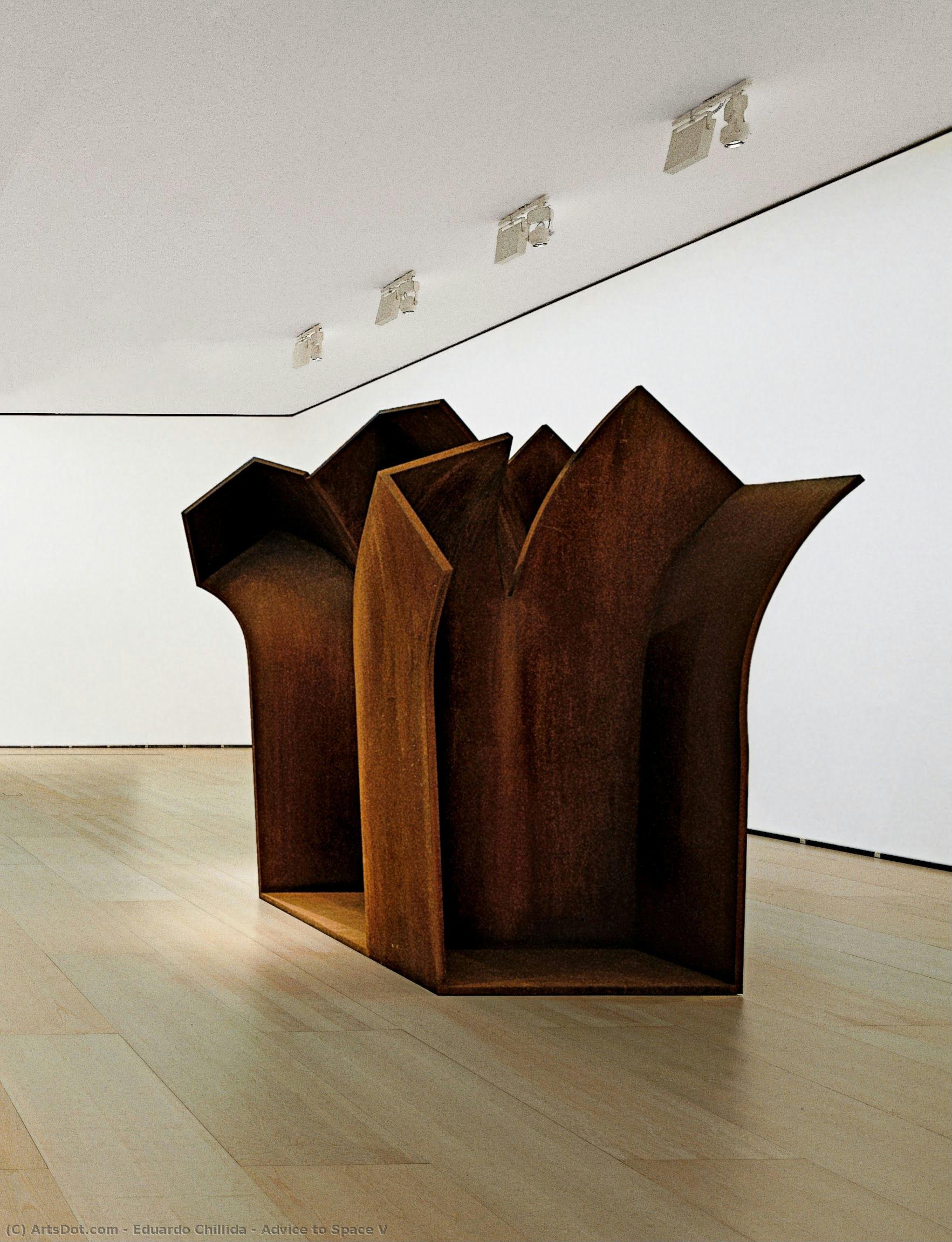
Advice to Space V (1993) by Eduardo Chillida

Advice to Space V

1993 · Guggenheim Museum Bilbao, Bilbao

Advice to Space V (Consejo al espacio V, 1993) was originally designed to sit before the Neue Pinakothek in Munich when the first studies for the project were created in 1987. (Ten years later the artist composed Looking for Light II [Buscando la luz II] for the nearby Pinakothek der Moderne.) This piece, constructed from enormous sheets of steel, combines an organic quality with a lightness that is unique to…

10
Praise of Fire (Elogio del fuego) by Eduardo Chillida

Praise of Fire (Elogio del fuego)

Eduardo Chillida fa seguire agli studi classici quelli di architettura a Madrid, interrotti per trasferirsi a Parigi nella ricerca di un ambiente culturale più aperto rispetto alla Spagna franchista: qui, suggestionato dalla plastica greca arcaica del Louvre, può finalmente dedicarsi all’arte e, dal 1947, alla scultura. Dopo le prime opere imperniate sulla resa della figura umana, si cimenta nell’astrazione in gesso e terracotta, debitrice di una certa linea di ricerca…

The subjects that held Eduardo Chillida's eye

The four subjects that come back most often in these originals, each with its finest example.

The museums that keep Eduardo Chillida's originals

The 7 museums that hold the most of the paintings on this page.

Museum City Works by Eduardo Chillida Paintings from this list
Guggenheim Museum Bilbao, BilbaoGuggenheim Museum Bilbao Bilbao 2 Embrace XI, Advice to Space V
Ca' Pesaro - International Gallery of Modern Art, VeniceCa' Pesaro - International Gallery of Modern Art Venice 1 Temblor n.° 3 o Hierros del temblor III
UPF Art Track, BarcelonaUPF Art Track Barcelona 1 Untitled
Reina Sofía School of Music, ΜαδρίδοReina Sofía School of Music Μαδρίδο 1 Untitled
Bechtler Museum of Modern Art, CharlotteBechtler Museum of Modern Art Charlotte 1 Leku I
Spanish Railways Foundation, MadridSpanish Railways Foundation Madrid 1 Logo of the Visitor Centre of Leitzaran
Galleria Civica di Arte Moderna e Contemporanea Torino, TurinGalleria Civica di Arte Moderna e Contemporanea Torino Turin 1 Praise of Fire (Elogio del fuego)

Eduardo Chillida across the years: the unique originals of each

Eduardo Chillida's dated originals shown here fit into about ten years, 1993 to 2000: the eye follows them year by year.

Works per year

Pick a year to see its originals.

Eduardo Chillida's paintings: questions for the gallery

What is the single most famous work of Eduardo Chillida?Reveal the answer

Embrace XI (1996), Guggenheim Museum Bilbao, Bilbao. Temblor n.° 3 o Hierros del temblor III and Untitled (1993) come next.

At what age did Eduardo Chillida create Embrace XI?Reveal the answer

72 years old: Embrace XI dates from 1996, and Eduardo Chillida was born in 1924.

Which ten paintings by Eduardo Chillida are the most famous?Reveal the answer

Embrace XI, Temblor n.° 3 o Hierros del temblor III, Untitled, Advice to Space V, Untitled, Untitled, Gravitation, Leku I, Logo of the Visitor Centre of Leitzaran and Praise of Fire (Elogio del fuego). The ranking above gives each one's year and museum.

How many works by Eduardo Chillida are known?Reveal the answer

Our catalog holds 10 works by Eduardo Chillida, dated from 1993 to 2000.

Where can the most famous Eduardo Chillida originals be seen?Reveal the answer

Mostly in Guggenheim Museum Bilbao (Bilbao), Ca' Pesaro - International Gallery of Modern Art (Venice) and UPF Art Track (Barcelona). The museum table above lists them all.

During which period did Eduardo Chillida create the best-known paintings?Reveal the answer

In 1993: 2 of the 10 works on this page were made then, Untitled among them.

Which famous Eduardo Chillida painting is the earliest, and which the latest?Reveal the answer

On this page, the earliest is Untitled (1993) and the latest Untitled (2000).

What Eduardo Chillida originals can I see at the Guggenheim Museum Bilbao?Reveal the answer

Embrace XI and Advice to Space V: the Guggenheim Museum Bilbao, Bilbao holds 2 of the works on this page.

Eduardo Chillida: a portrait of the artist

The Monumental Spirit of Eduardo Chillida

To speak of Eduardo Chillida is to speak of the very landscape of modern sculpture—a force of nature rendered in metal, stone, and wood. Born in San Sebastián on January 10, 1924, this Spanish Basque master was destined for a life marked by profound physical struggle and equally profound artistic triumph. Though his early path saw him pursuing architecture at the University of Madrid, it was the raw, undeniable call of art that ultimately redirected his destiny. His formative years were steeped in the cultural atmosphere of the Basque Country, an environment that would forever inform the deep resonance of his work.

His initial forays into sculpture began in Paris, a period where he wrestled with plaster and clay, absorbing influences from the great traditions housed within institutions like the Louvre. Yet, it was upon returning to the nurturing embrace of the Basque Country that Chillida’s artistic voice found its definitive timbre. The physical setbacks of his promising football career served perhaps as an unexpected crucible, channeling a restless energy into his creative pursuits.

Forging Form: Materials and Technique

Chillida's technical evolution is as compelling as the forms he created. Initially drawn to the delicate possibilities of plaster, he soon found his true medium in forged iron. Working alongside local blacksmiths, he mastered the art of transforming raw metal into structures that seemed both impossibly heavy and ethereally light. This mastery was not merely about joining materials; it was about coaxing them into a dialogue with space itself. His exploration expanded to include wood, notably when he began his seminal series, Anvil of Dreams, where wooden bases served as launching pads for metal forms that seemed to erupt in rhythmic, explosive curves.

The material choices were never arbitrary. Whether it was the cold strength of iron or the subtle luminescence of alabaster, Chillida treated each substance with a deep respect, allowing its inherent qualities—its weight, its patina, its resistance—to become integral parts of the sculpture's narrative. He sought not just to depict the human form, often focusing on torsos and busts, but to capture the very essence of existence struggling against constraint.

The Dialogue with Space: Abstract Realism

Despite his monumental scale and highly abstract compositions, Chillida himself resisted easy categorization. He preferred to be known as a "realist sculptor," suggesting that his abstraction was not an escape from reality, but rather a deeper excavation of it. His work is fundamentally concerned with the relationship between matter and void—the space around the sculpture is as vital, if not more so, than the material itself. This preoccupation led him to create public works that did not merely occupy space, but actively engaged with it, forcing the viewer into a physical conversation with the artwork.

His pieces often evoke primal energies and deep human introspection. They feel monumental because they are; they speak of endurance, of history, and of the enduring spirit of humanity rooted deeply in its cultural soil. The very act of viewing a Chillida piece becomes an immersive experience, one where the viewer must navigate the interplay between solid mass and infinite emptiness.

A Legacy Etched in Iron

Eduardo Chillida’s career stands as a towering achievement in 20th-century art. His body of work is a testament to relentless inquiry—an investigation into what it means to be human, contained within the boundaries of physical form and boundless spirit. From his early explorations to his later, massive public installations, he left behind a legacy that continues to challenge perceptions of weight, grace, and permanence. He did not just create sculptures; he forged dialogues between man, material, and the eternal space surrounding us.