Portrait of E. Irving Couse

E. Irving Couse Paintings: The 100 Most Famous, Through a Gallery's Eye

Updated November 2026 · ranked by our popularity score (searches, visits and orders for each work) · 152 works by E. Irving Couse in our catalogue

In short

To the gallery's eye, E. Irving Couse's most famous painting is Taos Indian and Pottery (1920). The Harvest Song (1920) and Indian Brave Recording General MacKenzie's Fight with the Cheyenes (1902) complete the trio every eye recognises. Of the 152 works by E. Irving Couse in our catalog, the gallery presents the 100 most famous below, each original with its year, its museum and what makes it unique.

1866 – 1936, Saginaw Most works: Reading Public Museum

The gallery's top 10 E. Irving Couse paintings

1
Taos Indian and Pottery (1920) by E. Irving Couse

Taos Indian and Pottery

1920 · Oil On Canvas

In 1920, E. Irving Couse captures a quiet moment of stillness in Taos Indian and Pottery. The scene unfolds within the intimate confines of an indoor space, perhaps a humble room or a traditional hut. A deep red wall provides a warm backdrop to the central figure, grounding the composition in a sense of place and purpose.

2
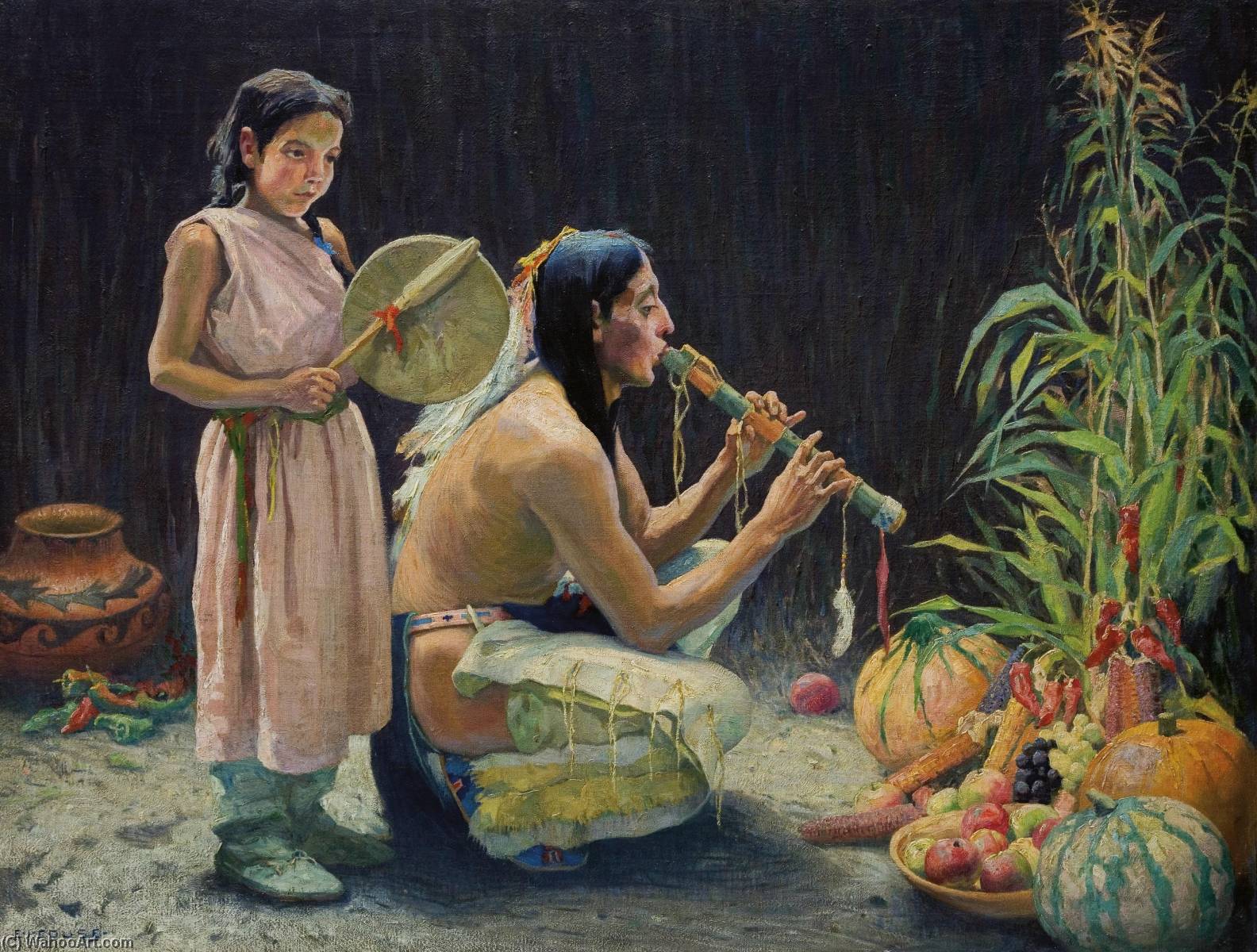
The Harvest Song (1920) by E. Irving Couse

The Harvest Song

1920 · Oil On Canvas

The air feels heavy with the scent of ripening produce in The Harvest Song, a work painted by E. Irving Couse in 1920. Within this sun-drenched field, a man sits amidst an abundance of nature, his breath steady as he plays a flute. Beside him, a woman holds a drum, her presence completing a rhythmic duet that seems to echo through the surrounding crops. They exist in a moment of…

3
Indian Brave Recording General MacKenzie's Fight with the Cheyenes (1902) by E. Irving Couse

Indian Brave Recording General MacKenzie's Fight with the Cheyenes

1902 · Oil

In "Indian Brave Recording General MacKenzie's Fight with the Cheyenes" by E. Irving Couse, a quiet moment of creation unfolds. Two Native American men lean into their task, focused entirely on the act of painting a mural. They work upon a large, stretched animal hide, perhaps deer or buffalo, which serves as the canvas for their story. This central activity anchors the entire scene, drawing the eye directly to the…

4
The Water Course (1910) by E. Irving Couse

The Water Course

1910 · Oil · Reading Public Museum, Reading

In The Water Course, E. Irving Couse presents a quiet moment of interaction with the natural world. Painted around 1910, the work focuses on two Native American figures positioned within a rugged, sunlit landscape. They are situated near a flowing stream, their presence integrated into the terrain rather than imposed upon it. The scene captures a sense of tranquility, focusing on the subtle connection between the individuals and the land…

5
The Sculptor (1914) by E. Irving Couse

The Sculptor

1914 · Oil On Canvas

The Sculptor is an oil painting by E. Irving Couse, executed in 1914. The work focuses on a Native American man engaged in the act of creating petroglyphs or drawings upon a textured surface. The subject is positioned in a central-right profile, kneeling as he works against a shallow, textured background suggesting a rock face or cave wall.

6
The Cooling Stream (1912) by E. Irving Couse

The Cooling Stream

1912 · Oil On Canvas

The air feels heavy and still under a blanket of overcast clouds. Near the edge of a flowing river, a group of indigenous figures gathers, their presence deeply woven into the natural landscape. There is a quiet, somber energy in the way they move, a sense of ritual or perhaps a shared moment of mourning that settles over the scene. The water of the stream ripples softly, catching subtle highlights…

7
The Mountain Stream (1914) by E. Irving Couse

The Mountain Stream

1914 · Oil On Canvas

In The Mountain Stream, E. Irving Couse positions a solitary Indigenous man in the foreground, seated along a riverbank. The figure is the central focus, rendered with a posture and gaze that suggest deep introspection. This quietude is framed by a landscape of flowing water and dense foliage, creating a scene centered on contemplation and a profound connection with the natural world.

9
Indian Hunter (1925) by E. Irving Couse

Indian Hunter

1925 · Oil · Reading Public Museum, Reading

In this 1925 oil painting, a Native American hunter moves through a sun-dappled grove of birch or aspen trees. The composition is oriented vertically, drawing the eye to the profile of the figure on the left as he moves toward the right. There is a stillness here, a sense of quiet tension as the subject navigates the forest floor. Light filters through the canopy in patches of pale yellow, creating…

10
The Blanket Mender (1934) by E. Irving Couse

The Blanket Mender

1934 · Oil · The Owings Gallery, Santa Fe

The Blanket Mender is an oil painting by E. Irving Couse. Created about 1934, this work captures a quiet moment of focused labor. The subject is a Native American figure, depicted in a state of stillness as they attend to a textile. There is a profound sense of patience in the way the figure engages with the fabric, a task requiring steady hands and a calm mind.

E. Irving Couse paintings, ranked 11 to 100

11Flute Player (1931) by E. Irving CouseFlute Player1931 · Private collection 12Untitled (AQU5U9) (1899) by E. Irving CouseUntitled (AQU5U9)1899 13Indian Weaver (1914) by E. Irving CouseIndian Weaver1914 · American Museum of Western Art 14Untitled (AQU5U3) (1927) by E. Irving CouseUntitled (AQU5U3)1927 · El Paso Museum of Art 15Ambush (1897) by E. Irving CouseAmbush1897 · Briscoe Western Art Museum 16The Pictographs (1919) by E. Irving CouseThe Pictographs1919 17The Captive (1891) by E. Irving CouseThe Captive1891 18The Card Player (1897) by E. Irving CouseThe Card Player1897 19Klikitat Indian with Pony (1898) by E. Irving CouseKlikitat Indian with Pony1898 20Indian Seated by a Campfire (1898) by E. Irving CouseIndian Seated by a Campfire1898 21An Indian Hunter (1897) by E. Irving CouseAn Indian Hunter1897 22The Peace Pipe (1901) by E. Irving CouseThe Peace Pipe1901 · Metropolitan Museum of Art 23Indian Drinking (1903) by E. Irving CouseIndian Drinking1903 24Moki Snake Sance (1904) by E. Irving CouseMoki Snake Sance1904 · American Museum of Western Art 25Walpi Pueblo (1903) by E. Irving CouseWalpi Pueblo1903 · Smithsonian American Art Museum 26The Forest Pool by E. Irving CouseThe Forest PoolThe Owings Gallery 27Quail Hunters by E. Irving CouseQuail Hunters 28Sacred Waters by E. Irving CouseSacred WatersIndianapolis Museum of Art 29Woman in a White Dress by E. Irving CouseWoman in a White Dress 30The Speaker by E. Irving CouseThe Speaker 31Indian Portrait by E. Irving CouseIndian Portrait 32Evening Solitude by E. Irving CouseEvening Solitude 33Western Sunlight by E. Irving CouseWestern Sunlight 34Medicine Man by E. Irving CouseMedicine Man 35Hunting Cranes by E. Irving CouseHunting Cranes 36Klickitat Brave by E. Irving CouseKlickitat Brave 37The Sculptor by E. Irving CouseThe Sculptor 38Ute Waterbottle by E. Irving CouseUte Waterbottle 39Young Kibbey Whitman Couse by E. Irving CouseYoung Kibbey Whitman Couse 40The Thinker by E. Irving CouseThe Thinker 41The Setting Sun by E. Irving CouseThe Setting Sun 42John Concha, Taos Pueblo by E. Irving CouseJohn Concha, Taos Pueblo 43Resting by E. Irving CouseResting 44Moonlight Meditation by E. Irving CouseMoonlight Meditation 45The Master Workman by E. Irving CouseThe Master Workman 46The Evening Meal by E. Irving CouseThe Evening Meal 47Indian By A Stream by E. Irving CouseIndian By A Stream 48The Lovers by E. Irving CouseThe LoversBrigham Young University Museum of Art 49Lamb by E. Irving CouseLamb 50Young Hunter by a Stream by E. Irving CouseYoung Hunter by a Stream 51Portrait Of Kibbey Whitman Couse by E. Irving CousePortrait Of Kibbey Whitman Couse 52Flute Player, Rio Lucero, Taos, NM by E. Irving CouseFlute Player, Rio Lucero, Taos, NM 53The Arrow Maker by E. Irving CouseThe Arrow Maker 54Indians in Moonlight by E. Irving CouseIndians in Moonlight 55The Tom Tom Lesson by E. Irving CouseThe Tom Tom Lesson 56The Lesson by E. Irving CouseThe Lesson 57Lovers (Indian Love Song) by E. Irving CouseLovers (Indian Love Song) 58The Peace Pipe by E. Irving CouseThe Peace Pipe 59Putting on the War Shoes by E. Irving CousePutting on the War Shoes 60Indian Painter by E. Irving CouseIndian Painter 61The Drink by E. Irving CouseThe Drink 62Serenade by E. Irving CouseSerenade 63The Pottery Maker by E. Irving CouseThe Pottery Maker 64Indian by the Fire by E. Irving CouseIndian by the Fire 65Return of the War Party (1910) by E. Irving CouseReturn of the War Party1910 66The Beaded Tobacco Bag by E. Irving CouseThe Beaded Tobacco Bag 67By the Fire by E. Irving CouseBy the Fire 68Beaded Bag by E. Irving CouseBeaded Bag 69Evening Reverie (1911) by E. Irving CouseEvening Reverie1911 70The Love Call (1908) by E. Irving CouseThe Love Call1908 71The Pottery Decorator by E. Irving CouseThe Pottery Decorator 72New Rug (1917) by E. Irving CouseNew Rug1917 73Making Pottery (1912) by E. Irving CouseMaking Pottery1912 74Lone Hunter (1915) by E. Irving CouseLone Hunter1915 75The Sentinel (1912) by E. Irving CouseThe Sentinel1912 76The Successful Hunter (1913) by E. Irving CouseThe Successful Hunter1913 77Indian Girl in a Blanket (1921) by E. Irving CouseIndian Girl in a Blanket1921 78Crow Tent (1918) by E. Irving CouseCrow Tent1918 79The Evening Meal (1918) by E. Irving CouseThe Evening Meal1918 80The Magic Flute (also known as Flute Player at the Spring) (1918) by E. Irving CouseThe Magic Flute (also known as Flute Player at the Spring)1918 81The Flute Ceremony (1922) by E. Irving CouseThe Flute Ceremony1922 82Untitled (AQU5UF) (1921) by E. Irving CouseUntitled (AQU5UF)1921 · El Paso Museum of Art 83Indian Summer (1924) by E. Irving CouseIndian Summer1924 84Moonlight on the Hondo (1928) by E. Irving CouseMoonlight on the Hondo1928 85Hunting the Turkey in the Aspens (1926) by E. Irving CouseHunting the Turkey in the Aspens1926 86Flute Song, Moonlight (1927) by E. Irving CouseFlute Song, Moonlight1927 87Sheep At Sundown by E. Irving CouseSheep At Sundown 88Pottery Vendor (1916) by E. Irving CousePottery Vendor1916 · Philbrook Museum of Art 89The Chief by E. Irving CouseThe Chief 90Chief David Shoppenegons (1911) by E. Irving CouseChief David Shoppenegons1911 · Detroit Institute of Arts 91The Lesson (1902) by E. Irving CouseThe Lesson1902 92Indian Painter by E. Irving CouseIndian PainterMinneapolis Institute of Art 93Hidden House by E. Irving CouseHidden House 94Moving In Clouds by E. Irving CouseMoving In Clouds 95Purple Shore by E. Irving CousePurple Shore 96Boat Alone by E. Irving CouseBoat Alone 97Trees In Snow by E. Irving CouseTrees In Snow 98Lillies by E. Irving CouseLillies 99At The Spring (Sheep In Field) by E. Irving CouseAt The Spring (Sheep In Field) 100Taos Canyon Creek by E. Irving CouseTaos Canyon Creek

The subjects that held E. Irving Couse's eye

The four subjects that come back most often in these originals, each with its finest example.

The museums that keep E. Irving Couse's originals

The 8 museums that hold the most of the paintings on this page.

Museum City Works by E. Irving Couse Paintings from this list
Reading Public Museum, ReadingReading Public Museum Reading 2 The Water Course, Indian Hunter
The Owings Gallery Santa Fe 2 The Blanket Mender, The Forest Pool
American Museum of Western Art, ColoradoAmerican Museum of Western Art Colorado 2 Indian Weaver, Moki Snake Sance
El Paso Museum of Art, El PasoEl Paso Museum of Art El Paso 2 Untitled (AQU5U3), Untitled (AQU5UF)
Smithsonian American Art Museum, Washington, D.C.Smithsonian American Art Museum Washington, D.C. 2 Walpi Pueblo
Cincinnati Art Museum, CincinnatiCincinnati Art Museum Cincinnati 1 Indian Drinking from a Lake
Private collection, AkronPrivate collection Akron 1 Flute Player
Briscoe Western Art Museum, San AntonioBriscoe Western Art Museum San Antonio 1 Ambush

E. Irving Couse, one signature painting per decade

Works per decade

Pick a decade to see the original that defines it.

E. Irving Couse's paintings: the gallery answers

Which E. Irving Couse painting is the most famous of all?Reveal the answer

Taos Indian and Pottery (1920). The Harvest Song (1920) and Indian Brave Recording General MacKenzie's Fight with the Cheyenes (1902) come next.

How old was E. Irving Couse on completing Taos Indian and Pottery?Reveal the answer

54 years old: Taos Indian and Pottery dates from 1920, and E. Irving Couse was born in 1866.

Which are E. Irving Couse's top 10 paintings?Reveal the answer

Taos Indian and Pottery, The Harvest Song, Indian Brave Recording General MacKenzie's Fight with the Cheyenes, The Water Course, The Sculptor, The Cooling Stream, The Mountain Stream, Indian Drinking from a Lake, Indian Hunter and The Blanket Mender. The ranking above gives each one's year and museum.

How many works did E. Irving Couse create?Reveal the answer

Our catalog holds 152 works by E. Irving Couse, dated from 1891 to 1934.

Where do E. Irving Couse's most famous originals hang?Reveal the answer

Mostly in Reading Public Museum (Reading), The Owings Gallery (Santa Fe) and American Museum of Western Art (Colorado). The museum table above lists them all.

When did E. Irving Couse create the most famous paintings?Reveal the answer

In 1910s: 18 of the 100 works on this page were made then, The Water Course among them.

Which are E. Irving Couse's earliest and latest famous works?Reveal the answer

On this page, the earliest is The Captive (1891) and the latest The Blanket Mender (1934).

Which subjects did E. Irving Couse return to most?Reveal the answer

Native american (14), Native american culture (13) and Southwestern landscape (10), across the 100 works on this page.

Which medium did E. Irving Couse work in most?Reveal the answer

Oil On Canvas, for 10 of the 100 works on this page.

Which E. Irving Couse originals does the Reading Public Museum hold?Reveal the answer

The Water Course and Indian Hunter: the Reading Public Museum, Reading holds 2 of the works on this page.

E. Irving Couse: the artist

A Bridge Between Worlds: The Life and Art of Eanger Irving Couse

Eanger Irving Couse, born in 1866 amidst the burgeoning industrial landscape of Saginaw, Michigan, was an artist destined to become a pivotal figure in American art. His story isn’t simply one of artistic development; it's a compelling narrative of cultural connection, bridging the rigorous traditions of European academic painting with a profound and respectful portrayal of Native American life and the captivating landscapes of the Southwest. From his earliest years, Couse displayed an innate curiosity about the Chippewa tribes inhabiting the lands near his childhood home—an attraction that blossomed into a lifelong dedication to depicting their existence with sensitivity and dignity. This wasn’t mere observation; it was the seed of a deep empathy that would fundamentally shape his artistic journey. He left traditional schooling at sixteen, driven by an unwavering commitment to art, initially studying at the Art Institute of Chicago and then the National Academy of Design in New York City before embarking on a decade-long sojourn in Paris.

From Parisian Salons to the Allure of Taos

Paris proved transformative. Studying under William-Adolphe Bouguereau at the École des Beaux-Arts and Académie Julian instilled within Couse a mastery of classical techniques—precise draftsmanship, nuanced modeling, and a refined sense of composition. He honed his skills capturing the light and atmosphere of the Normandy coast, yet even amidst these European influences, the pull towards the American West remained strong. A visit to his father-in-law’s ranch in Oregon sparked an interest in Native American subjects, culminating in *The Captive*, exhibited at the Paris Salon in 1892. This significant early work, depicting a scene from the Whitman Massacre and modeled by his wife Virginia and a local Klikitat Indian, demonstrated both his technical prowess and burgeoning thematic concerns. Returning to the United States, Couse balanced studio work in New York with increasingly frequent trips westward, eventually leading him to Taos, New Mexico, in 1902. This marked a turning point; he was captivated by the unique light, landscape, and culture of the region, establishing a summer residence that would evolve into his permanent home. He wasn’t merely visiting; he was immersing himself, seeking to understand and represent a way of life far removed from the bustling cities of the East Coast.

The Soul of Taos: A Defining Artistic Vision

Taos became more than just a location for Couse—it was an immersion into a culture. He dedicated himself to studying and painting the lives of the Taos Indians, not as exoticized figures but as individuals possessing inherent dignity and grace. Unlike some contemporaries who focused on dramatic narratives or romanticized portrayals, Couse sought to capture quiet moments of daily life—scenes of contemplation, craftsmanship, and familial connection. His style evolved into a distinctive blend of academic precision and an evocative use of light and color, creating paintings that were both technically accomplished and emotionally resonant. He favored warm, earthy tones, often depicting his subjects bathed in the soft glow of firelight or the golden hues of the setting sun. He frequently employed two primary models, Ben Lujan and Jerry Mirable, allowing him to portray a sense of continuity and intimacy within his work. This dedication led to his becoming a founding member and first president of the Taos Society of Artists in 1915, solidifying Taos’s reputation as an important artistic center. His paintings weren't simply representations; they were interpretations imbued with respect and understanding—a testament to his commitment to portraying Native American life authentically.

Recognition, Legacy, and Enduring Influence

Couse’s talent didn’t go unnoticed. He received numerous awards throughout his career, including the Altman Prize from the National Academy of Design, the Isidor Prize from the Salmagundi Club, and the Lippincott Prize from the Pennsylvania Academy of Fine Arts. Notably, he secured commissions from the Santa Fe Railway between 1914 and 1936 to create paintings used in their advertising campaigns—a testament to his ability to capture the allure of the Southwest for a wider audience. *Elk-foot of the Taos Tribe* is widely considered his masterwork, eventually purchased for the United States national art collection, cementing his place within the canon of American art. Beyond these accolades, Couse’s lasting legacy lies in his contribution to shaping perceptions of Native American life and establishing a unique artistic identity for the Taos Society. He offered a perspective that diverged from more stereotypical representations prevalent at the time, emphasizing peaceful coexistence and the inherent beauty of Pueblo culture. His work stands as a powerful reminder of the importance of cultural sensitivity and respectful representation in art. The preservation of his home and studio—now the Eanger Irving Couse House and Studio–Joseph Henry Sharp Studios, listed on the National Register of Historic Places—ensures that future generations can connect with his artistic vision and appreciate his profound impact on American art history.

Key Characteristics of His Work

  • Academic Precision: Couse’s foundation in European academic training is evident in the meticulous detail and realistic rendering of his figures and landscapes.
  • Evocative Use of Light: He masterfully employed light and shadow to create atmosphere and emotional depth, often depicting scenes bathed in warm, golden tones.
  • Respectful Representation: Couse’s portrayals of Native Americans were characterized by dignity and sensitivity, avoiding stereotypical or romanticized depictions.
  • Focus on Daily Life: He preferred to capture quiet moments of everyday existence rather than dramatic narratives, offering a glimpse into the routines and traditions of Pueblo culture.
  • Limited Palette: Couse favored a warm, earthy palette that reflected the colors of the Southwestern landscape and created a sense of harmony and tranquility.
Eanger Irving Couse’s art continues to resonate today not only for its technical brilliance but also for its enduring message of cultural understanding and respect. He remains a significant figure in American art history, a testament to the power of art to bridge divides and illuminate the human spirit.