Portrait of Cindy Sherman

The 34 Most Famous Cindy Sherman Paintings, Each One of a Kind

Updated November 2026 · ranked by our popularity score (searches, visits and orders for each work) · 34 works by Cindy Sherman in our catalogue

In short

Untitled Film Still #30 (1979) is the Cindy Sherman painting that draws the most eyes; the original belongs to the The Feminist Institute, New York City. After it, the eye goes to Untitled #153 (1985) and Untitled #582 (2016). Among the 34 works of Cindy Sherman in our catalog, these 34 are the most famous, each a unique original presented with its year, its museum and the reason it endures.
born 1954, Glen Ridge Contemporary art Most works: The Feminist Institute

Top 10 paintings by Cindy Sherman, through the gallery's eye

1
Untitled Film Still #30 (1979) by Cindy Sherman

Untitled Film Still #30

1979 · Acrylic On Canvas · The Feminist Institute, New York City

Cindy Sherman's "Untitled Film Still #30," created in 1979, stands as a cornerstone of conceptual photography and performance art—a piece that transcends mere visual representation to delve into the complexities of identity formation. More than just capturing an image; Sherman meticulously constructs a scenario designed to dismantle conventional notions of femininity and cinematic tropes, prompting viewers to confront their own perceptions of gender roles.

2
Untitled #153 (1985) by Cindy Sherman

Untitled #153

1985 · Black and White Photography · The Feminist Institute, New York City

To stand before an image like Untitled #153 is not merely to observe a photograph; it is to participate in a profound act of looking. Cindy Sherman, the master cartographer of the self, invites us into a liminal space—a place suspended between reality and performance. This black and white capture from 1985 presents a figure reclining upon the earth within what appears to be a dense, wooded clearing. The composition…

3
Untitled #582 (2016) by Cindy Sherman

Untitled #582

2016 · Black and White Photography · The Feminist Institute, New York City

In the evocative monochrome of Untitled #582, we encounter a moment frozen in time that transcends simple photography to become a profound psychological study. Created in 2016 by the legendary Cindy Sherman, this work serves as a masterful window into the artist's lifelong exploration of the constructed self. The image presents a woman seated with an air of regal detachment, her figure framed by the organic textures of a tree…

4
Untitled #264 (1992) by Cindy Sherman

Untitled #264

1992 · Painting · The Feminist Institute, New York City

A woman lies on her back, her form partially revealed from the waist down. A crown rests upon her head, while a mask obscures her facial features. This 1992 work utilizes the artist's own body to explore the boundaries of identity and the performance of the self.

5
Untitled #224 (1990) by Cindy Sherman

Untitled #224

1990 · Black and White Photography · The Feminist Institute, New York City

The camera captures a moment frozen in monochrome, where a woman sits amidst an abundance of fruit that feels both heavy and unsettling. A crown of leaves rests upon her head, its organic edges pressing against her brow as she holds clusters of grapes with a grip that seems more burdened than celebratory. Around her, the table is scattered with more dark, ripe bunches, their textures rendered in sharp, silvered…

6
Untitled #400 (2000) by Cindy Sherman

Untitled #400

2000 · Black and White Photography · The Feminist Institute, New York City

To stand before an image by Cindy Sherman is not merely to observe a photograph; it is to participate in a sophisticated, often unsettling, interrogation of selfhood. In Untitled #400, the viewer is confronted with a carefully curated tableau—a moment suspended between reality and performance. The black and white medium itself lends an immediate air of timeless drama, stripping away the distraction of vibrant color to focus intensely on posture,…

7
Untitled Film Still #16 (1978) by Cindy Sherman

Untitled Film Still #16

1978 · Acrylic On Canvas · Nelson-Atkins Museum of Art, Kansas City

Cindy Sherman's “Untitled Film Still #16” isn’t merely a photograph; it’s an invitation to interrogate the very nature of representation and performance. Executed in 1978, this iconic image captures a solitary woman seated in an ornate armchair against a textured white brick wall—a seemingly simple composition that belies its profound conceptual undercurrents.

8
Untitled (A) (1975) by Cindy Sherman

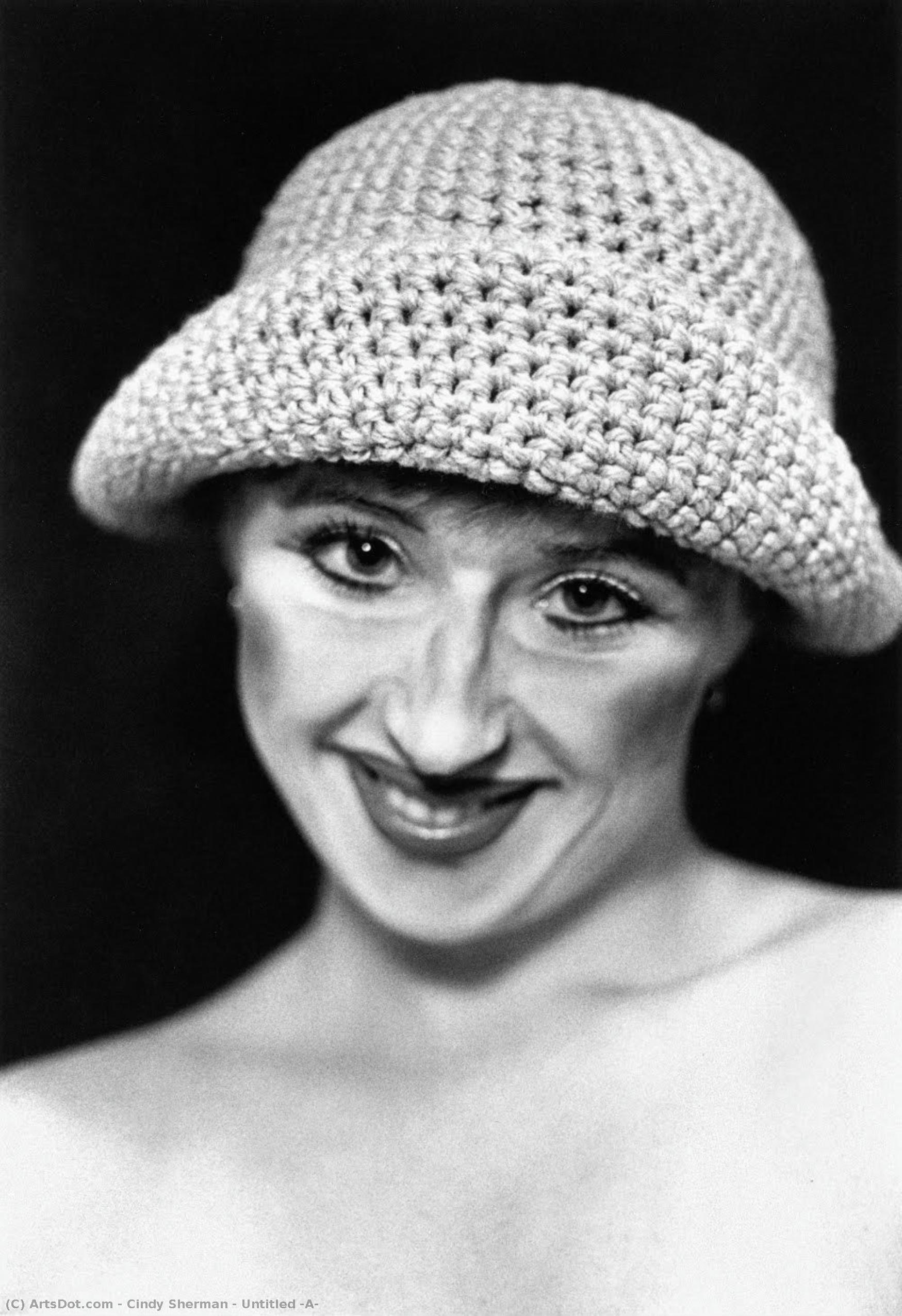
Untitled (A)

1975 · Digital Photography · The Feminist Institute, New York City

Captured in 1975, Cindy Sherman’s “Untitled (A)” is more than just a portrait; it’s an exploration of identity, performance, and the subtle power of suggestion. This black and white photograph, measuring 40 x 27 cm, offers a glimpse into a pivotal moment in Sherman's artistic development, predating her globally recognized "Untitled Film Stills" series but foreshadowing its thematic concerns. The image presents a woman—Sherman herself—with an expression that dances between…

9
Untitled (B) (1975) by Cindy Sherman

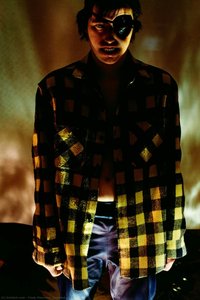
Untitled (B)

1975 · Digital Photography · The Feminist Institute, New York City

Within the stark confines of black and white photography lies a world of constructed identities, meticulously crafted personas brought to life by the singular vision of Cindy Sherman. Her work, particularly pieces like “Untitled (B),” isn’t about capturing a definitive self; it’s an exploration of how we perceive ourselves and others through the lens of media, societal expectations, and performance. Created in 1975, this photograph stands as a pivotal moment…

10
Untitled Film Still #48 (1979) by Cindy Sherman

Untitled Film Still #48

1979 · Black and White Photography · The Feminist Institute, New York City

is a black and white photograph by the American artist Cindy Sherman. Created about 1979, this work belongs to a series of photographic captures that mimic the aesthetic of mid-century cinema. The image exists as a frozen moment, a single frame pulled from a narrative that never truly occurred.

Cindy Sherman's famous paintings, numbers 11 to 34

Cindy Sherman's famous paintings, period by period

The subjects that held Cindy Sherman's eye

The four subjects that come back most often in these originals, each with its finest example.

The museums that keep Cindy Sherman's originals

The 5 museums that hold the most of the paintings on this page.

Museum City Works by Cindy Sherman Paintings from this list
The Feminist Institute, New York CityThe Feminist Institute New York City 21 Untitled Film Still #30, Untitled #153, Untitled #582
Nelson-Atkins Museum of Art, Kansas CityNelson-Atkins Museum of Art Kansas City 1 Untitled Film Still #16
Elgiz Museum of Contemporary Art, İstanbulElgiz Museum of Contemporary Art İstanbul 1 Untitled #184
Allen Memorial Art Museum, OberlinAllen Memorial Art Museum Oberlin 1 Untitled Film Still #53
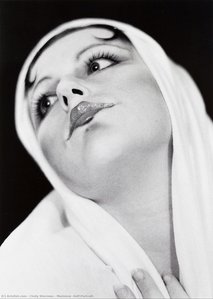
SCAD Museum of Art, SavannahSCAD Museum of Art Savannah 1 Madonna (Self-Portrait)

Cindy Sherman across the decades: one unique original for each

Works per decade

Pick a decade to see the original that defines it.

Cindy Sherman's paintings: questions for the gallery

What is the single most famous work of Cindy Sherman?Reveal the answer

Untitled Film Still #30 (1979), The Feminist Institute, New York City. Untitled #153 (1985) and Untitled #582 (2016) come next.

At what age did Cindy Sherman create Untitled Film Still #30?Reveal the answer

25 years old: Untitled Film Still #30 dates from 1979, and Cindy Sherman was born in 1954.

Which ten paintings by Cindy Sherman are the most famous?Reveal the answer

Untitled Film Still #30, Untitled #153, Untitled #582, Untitled #264, Untitled #224, Untitled #400, Untitled Film Still #16, Untitled (A), Untitled (B) and Untitled Film Still #48. The ranking above gives each one's year and museum.

How many works by Cindy Sherman are known?Reveal the answer

Our catalog holds 34 works by Cindy Sherman, dated from 1975 to 2016.

Where can the most famous Cindy Sherman originals be seen?Reveal the answer

Mostly in The Feminist Institute (New York City), Nelson-Atkins Museum of Art (Kansas City) and Elgiz Museum of Contemporary Art (İstanbul). The museum table above lists them all.

During which period did Cindy Sherman create the best-known paintings?Reveal the answer

In 1970s: 9 of the 34 works on this page were made then, Untitled Film Still #30 among them.

Which famous Cindy Sherman painting is the earliest, and which the latest?Reveal the answer

On this page, the earliest is Untitled (A) (1975) and the latest Untitled #582 (2016).

What subjects did Cindy Sherman favour?Reveal the answer

Black and white (12), Identity (10) and Portrait (9), across the 34 works on this page.

What materials did Cindy Sherman paint with most?Reveal the answer

Black and White Photography, for 11 of the 34 works on this page.

Which movement does the work of Cindy Sherman belong to?Reveal the answer

Contemporary art, judging by the originals on this page.

What Cindy Sherman originals can I see at the The Feminist Institute?Reveal the answer

Untitled Film Still #30, Untitled #153 and Untitled #582: the The Feminist Institute, New York City holds 21 of the works on this page.

Cindy Sherman: a portrait of the artist

A Deconstruction of Identity: The World of Cindy Sherman

Born in Glen Ridge, New Jersey, in 1954, Cynthia Morris Sherman emerged as a pivotal figure in late 20th and early 21st-century art, not through traditional portraiture, but through its deliberate dismantling. More commonly known as Cindy Sherman, she didn’t seek to capture likeness; instead, she sought to expose the constructed nature of identity itself – how it is formed by media, societal expectations, and the very act of being looked at. Her work isn't about *who* someone is, but rather *how* we perceive them, and the roles we assign based on superficial cues. Growing up in a relatively strict household with an engineer father and a mother who worked with children facing learning difficulties, Sherman’s early life provided a quiet backdrop for a mind that would later become intensely focused on observation and performance. This formative period instilled within her a keen awareness of social dynamics and the subtle pressures of conformity – themes that would permeate her artistic practice.

From Painting to Photographic Performance

Sherman’s artistic journey began with painting at Buffalo State University in 1972, but she quickly grew frustrated by what she perceived as the limitations of the medium. It wasn't enough to simply *represent* reality; she wanted to dissect it, to expose its underlying mechanisms. Photography offered her a new language – one that allowed for direct engagement with representation and the manipulation of image. This shift marked a turning point, leading to her groundbreaking series, Bus Riders (1976), where she began experimenting with disguises and characterizations, observing and embodying everyday people on public transportation. However, it was the Untitled Film Stills (1977-1980) that catapulted her to international recognition. This seminal series of 70 black-and-white photographs presented Sherman herself as archetypal female characters lifted directly from the visual vocabulary of B-movies and television. These weren’t recreations, but rather evocations – carefully constructed scenarios that hinted at narratives without ever fully revealing them. Each image felt simultaneously familiar and unsettling, prompting viewers to question their own assumptions about gender roles and cinematic tropes. The series wasn't simply *about* these characters; it was a commentary on the very act of representation, exposing how images shape our understanding of identity.

Exploring Archetypes and Societal Roles

Throughout the 1980s and beyond, Sherman continued to explore the themes of constructed identity and societal expectations through diverse series. Her Centerfolds & Fashion Series directly confronted the objectification of women in media, recreating images reminiscent of magazine spreads with a critical eye. Fairy Tales and Disasters (mid-to-late 1980s) saw her move into more fantastical and grotesque territory, utilizing prosthetics and elaborate makeup to create unsettling imagery that challenged conventional notions of beauty and narrative. The History Portraits (early 1990s) were particularly striking – recreations of historical paintings with subtle but significant alterations, questioning the authenticity and power dynamics inherent in traditional portraiture. She wasn’t simply copying these works; she was interrogating them, exposing their constructed nature and challenging the very notion of artistic “masterpieces.” Later work continued this exploration, often incorporating large-format color photography and digital manipulation to further blur the lines between reality and illusion.

Influences and Lasting Legacy

Sherman’s work is deeply rooted in Conceptual Art, prioritizing ideas over traditional artistic skills. She draws heavily from Feminist Theory, engaging with critiques of representation and the male gaze, particularly as articulated by Laura Mulvey in her influential essay “Visual Pleasure and Narrative Cinema.” Mulvey’s concept of "to-be-looked-at-ness" – the objectification of women within cinematic structures – became a central concern in Sherman's work. While pinpointing direct influences is difficult, one can also see echoes of Surrealism in her exploration of the subconscious and the unsettling juxtaposition of images. Her impact on contemporary art has been profound. She’s considered a key figure in the “Pictures Generation,” a group of artists who explored the impact of mass media on culture. Recognition came with prestigious awards like the MacArthur Fellowship (1995), and her photographs are now held by major museums worldwide, including MoMA and the Nelson-Atkins Museum of Art. Cindy Sherman’s innovative approach to self-portraiture has not only redefined the genre but also continues to provoke critical dialogue about identity, representation, and the pervasive power of images in shaping our perceptions of ourselves and the world around us. Her work remains remarkably relevant today, prompting ongoing discussions about authenticity, performance, and the ever-evolving nature of selfhood in a media-saturated society.