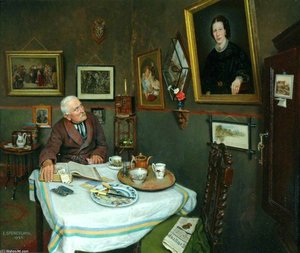
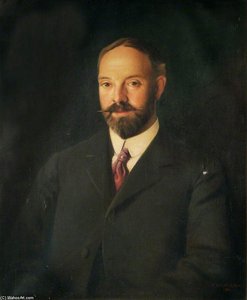
Charles Spencelayh: A Master of Hyperrealist Domesticity
Charles Spencelayh (1865-1958) was a highly regarded British genre and portrait painter, born on October 27, 1865, in Rochester, Kent. His artistic journey began at the National Art Training School in South Kensington. While initially exhibiting his work in Paris, Spencelayh achieved significant recognition within Great Britain, becoming celebrated for his meticulous depictions of everyday life and intimate portraits.
Early Life & Artistic Development
Spencelayh's career spanned several decades, with over 70 paintings exhibited at the Royal Academy between 1892 and 1958. A pivotal moment arrived in 1939 when his work "Why War" earned him the title of 'Painting of the Year,' solidifying his position as a leading figure in British art. His early training instilled a strong foundation in classical techniques, which he later adapted to create his signature hyperrealistic style. He was influenced by the meticulous detail found in 17th-century Dutch genre painting, particularly artists like Pieter de Hooch and Jan Steen, though Spencelayh’s work is distinctly Victorian in its sensibility.
Key Works & Artistic Style
Spencelayh's paintings are characterized by their extraordinary attention to detail, capturing the nuances of light, texture, and expression with remarkable precision. His subjects frequently revolved around domestic scenes, portraying moments of quiet contemplation or gentle amusement. Notable works include:
- The Laughing Parson (1935): Demonstrates his ability to capture a moment of jovial interaction.
- His Daily Ration (1946): A poignant depiction of everyday life, showcasing his observational skills.
- Exploration (1931): An impressive still life example highlighting his mastery of form and composition.
- Apples (1951): Showcases his command of color and light in a seemingly simple subject.
- Mrs Spencelayh: A stunning portrait exemplifying his skill in capturing character and dignity.
- The Lacemaker: A testament to his hyperrealistic technique, filled with intricate detail.
Spencelayh’s style is often described as hyperrealist, though he avoided the overtly photographic quality sometimes associated with that term. Instead, his paintings possess a timeless quality, imbued with a sense of warmth and nostalgia.
Legacy & Royal Patronage
Charles Spencelayh enjoyed considerable popularity during his lifetime, notably becoming a favorite artist of Queen Mary, who avidly collected his works. In 1924, he was commissioned to paint a miniature portrait of King George V for the Queen’s Doll Museum. His masterpiece, "The Old Dealer," achieved significant recognition when it sold at Sotheby's for over £345,000 in 2009, demonstrating the enduring value and appeal of his art. His meticulous approach to capturing everyday life resonated with audiences seeking a sense of stability and beauty amidst societal changes.
Further Exploration & Related Artists
A retrospective exhibition celebrating his life and art was held at the Guildhall Museum, Rochester, from January 31 to June 21, 2015.