Portrait of Charles Meryon

The 10 Most Famous Charles Meryon Paintings, Each One of a Kind

Updated November 2026 · ranked by our popularity score (searches, visits and orders for each work) · 11 works by Charles Meryon in our catalogue

In short

The Petit Pont (1850) is the Charles Meryon painting that draws the most eyes; the original belongs to the Bibliothèque nationale de France, Paris. After it, the eye goes to Le Stryge (1853) and Le Petit Pont (1850). Among the 11 works of Charles Meryon in our catalog, these 10 are the most famous, each a unique original presented with its year, its museum and the reason it endures.

1821 – 1868, Paris Realism Most works: Metropolitan Museum of Art

Top 10 paintings by Charles Meryon, through the gallery's eye

1
The Petit Pont (1850) by Charles Meryon

The Petit Pont

1850 · Etching · Bibliothèque nationale de France, Paris

The Petit Pont is an etching by the French artist Charles Meryon. Created about 1850, this print captures a specific slice of the Parisian landscape. The work emerged from the artist's focused study of the city's architecture, rendered through the precise application of ink on paper.

2
Le Stryge (1853) by Charles Meryon

Le Stryge

1853 · Etching · Harvard Art Museums, Cambridge

Le Stryge, also known as The Vampire, is a print created by the artist Charles Meryon in 1853. This work belongs to a period of the artist's career characterized by his focus on the city of Paris. Meryon was born in Paris, France, in 1821 and remained active in the medium of etching throughout his life until his death in 1868.

3
Le Petit Pont (1850) by Charles Meryon

Le Petit Pont

1850 · Etching

In 1850, Charles Meryon captured a specific slice of the Parisian urban landscape. His etching, Le Petit Pont, focuses on the bridge itself and the silhouette of Notre Dame Cathedral rising in the background. The scene documents the architecture of 19th-century Paris, freezing a moment in time through the precise rendering of stone and structure. A horse and a few figures move through the cityscape, grounding the heavy masonry in…

4
It Rocks but Does Not Sink (1854) by Charles Meryon

It Rocks but Does Not Sink

1854 · Etching · Metropolitan Museum of Art, New York

This evocative depiction, titled "It Rocks but Does Not Sink," plunges the viewer into the heart of maritime peril. The scene is dominated by a magnificent vessel battling through waters rendered with dramatic ferocity. One can almost feel the spray against the rigging and hear the groan of the timbers under duress. It is more than just a depiction of a storm; it is a profound meditation on human resilience,…

5
St. Étienne-du-Mont (1852) by Charles Meryon

St. Étienne-du-Mont

1852 · Etching · Charles Allis Art Museum, Milwaukee

St. Étienne-du-Mont, Paris, from Eaux-fortes sur Paris (Etchings of Paris) is an etching by Charles Meryon. Created in 1852, this work captures a specific slice of the Parisian cityscape. It belongs to the movements of Romanticism and Realist etching during the 19th Century.

6
St. Etienne-du-Mont, Paris, from Eaux-fortes sur Paris (Etchings of Paris) (1852) by Charles Meryon

St. Etienne-du-Mont, Paris, from Eaux-fortes sur Paris (Etchings of Paris)

1852 · Etching · Toledo Museum of Art, Toledo

Charles Meryon's "St. Etienne-du-Mont, Paris, from Eaux-fortes sur Paris" is more than a depiction of a Parisian street; it’s a haunting meditation on the city’s soul, rendered with an almost palpable sense of melancholy and gothic grandeur. Executed in 1852 as part of his seminal series, *Eaux-fortes sur Paris*, this work captures a pivotal moment in the artist's career – a transition from naval exploration to a deeply personal and…

7
Etchings of Paris; Title page to the suite (1852) by Charles Meryon

Etchings of Paris; Title page to the suite

1852 · Etching · Metropolitan Museum of Art, New York

Charles Meryon's "Etchings of Paris," specifically the title page to his celebrated suite, is more than just a depiction of a Parisian street; it’s a meticulously crafted window into the artist’s uniquely melancholic and intensely atmospheric vision of the city. Created in 1852, during a period of rapid industrialization and social upheaval in France, this work captures a fleeting moment of urban twilight – a scene both familiar and subtly…

9
The Morgue, Paris (1854) by Charles Meryon

The Morgue, Paris

1854 · Te Papa, Wellington

French printmaker Charles Meryon (1821-68) was the illegitimate son of a British doctor and a French dancer. He entered the French Naval Academy at Brest in 1837 and travelled widely with his parents. Meryon took drawing lessons in 1840 from Vincent Courdouan (1810–93), from whom he learned elegant precision of line. He served as midshipman on the corvette Le Rhin during its mission to the French possessions in Oceania (1842–6).…

10
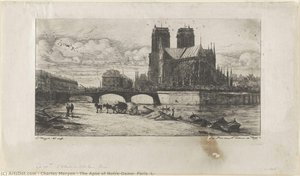
The Apse of Notre-Dame, Paris (L (1854) by Charles Meryon

The Apse of Notre-Dame, Paris (L

1854 · Te Papa, Wellington

The French printmaker Charles Meryon (1821-68) was the illegitimate son of a British doctor and a French dancer. He entered the French Naval Academy at Brest in 1837 and travelled widely with his parents. Meryon took drawing lessons in 1840 from Vincent Courdouan (1810–93), from whom he learned elegant precision of line. He served as midshipman on the corvette Le Rhin during its mission to the French possessions and settlements…

The subjects that held Charles Meryon's eye

The four subjects that come back most often in these originals, each with its finest example.

The museums that keep Charles Meryon's originals

The 6 museums that hold the most of the paintings on this page.

Museum City Works by Charles Meryon Paintings from this list
Metropolitan Museum of Art, New YorkMetropolitan Museum of Art New York 2 It Rocks but Does Not Sink, Etchings of Paris; Title page to the suite
Te Papa, WellingtonTe Papa Wellington 2 The Morgue, Paris, The Apse of Notre-Dame, Paris (L
Bibliothèque nationale de France, ParisBibliothèque nationale de France Paris 1 The Petit Pont
Harvard Art Museums, CambridgeHarvard Art Museums Cambridge 1 Le Stryge
Charles Allis Art Museum, MilwaukeeCharles Allis Art Museum Milwaukee 1 St. Étienne-du-Mont
Toledo Museum of Art, ToledoToledo Museum of Art Toledo 1 St. Etienne-du-Mont, Paris, from Eaux-fortes sur Paris (Etchings of Paris)

Charles Meryon across the years: the unique originals of each

Between 1850 and 1854, 5 years in all, Charles Meryon made every dated original shown here: a short span, followed year by year.

Works per year

Pick a year to see its originals.

Charles Meryon's paintings: questions for the gallery

What is the single most famous work of Charles Meryon?Reveal the answer

The Petit Pont (1850), Bibliothèque nationale de France, Paris. Le Stryge (1853) and Le Petit Pont (1850) come next.

At what age did Charles Meryon create The Petit Pont?Reveal the answer

29 years old: The Petit Pont dates from 1850, and Charles Meryon was born in 1821.

Which ten paintings by Charles Meryon are the most famous?Reveal the answer

The Petit Pont, Le Stryge, Le Petit Pont, It Rocks but Does Not Sink, St. Étienne-du-Mont, St. Etienne-du-Mont, Paris, from Eaux-fortes sur Paris (Etchings of Paris), Etchings of Paris; Title page to the suite, La Loi Solaire, The Morgue, Paris and The Apse of Notre-Dame, Paris (L. The ranking above gives each one's year and museum.

How many works by Charles Meryon are known?Reveal the answer

Our catalog holds 11 works by Charles Meryon, dated from 1850 to 1854.

Where can the most famous Charles Meryon originals be seen?Reveal the answer

Mostly in Metropolitan Museum of Art (New York), Te Papa (Wellington) and Bibliothèque nationale de France (Paris). The museum table above lists them all.

During which period did Charles Meryon create the best-known paintings?Reveal the answer

In 1852: 3 of the 10 works on this page were made then, St. Étienne-du-Mont among them.

Which famous Charles Meryon painting is the earliest, and which the latest?Reveal the answer

On this page, the earliest is The Petit Pont (1850) and the latest It Rocks but Does Not Sink (1854).

What subjects did Charles Meryon favour?Reveal the answer

Cityscape (4), People (3) and Architecture (3), across the 10 works on this page.

What materials did Charles Meryon paint with most?Reveal the answer

Etching, for 7 of the 10 works on this page.

Which movement does the work of Charles Meryon belong to?Reveal the answer

Realism, judging by the originals on this page.

What Charles Meryon originals can I see at the Metropolitan Museum of Art?Reveal the answer

It Rocks but Does Not Sink and Etchings of Paris; Title page to the suite: the Metropolitan Museum of Art, New York holds 2 of the works on this page.

Charles Meryon: a portrait of the artist

early life and naval career

charles méryon, a french artist, was born on november 23, 1821, in paris. his mother, a dancer at the paris opera, had a significant influence on his early life. méryon's colour blindness led him to pursue a naval career, which took him on extensive voyages, including a four-year tour around the world. this experience would later inspire his etched depictions of paris.

artistic journey and notable works

after realizing that colour-blindness ruled out painting for him, méryon settled on etching in 1848. his most famous work is the series eaux-fortes sur paris, which powerfully conveys his distinctive gothic vision of paris. this series, executed from 1850 to 1854, includes twenty-two etchings that are now considered a testament to méryon's skill and artistry.

museums and collections featuring charles méryon's work

* the metropolitan museum of art (new york city, united states) houses several of méryon's notable etchings, including etchings of paris; title page to the suite. (view on OriginalUniqueArt) * harvard art museums (cambridge, united states) features méryon's le stryge, a testament to his skill in etching. (view on OriginalUniqueArt) discover more about charles méryon's life and work on wikipedia: read more