The Chronicles of the Sea: The Life and Legacy of Bernard Finnigan Gribble
In the vast, churning expanse of British maritime history, few artists have captured the salt-sprayed drama and the quiet, rhythmic pulse of the ocean with as much devotion as Bernard Finnigan Gribble. Born on May 10, 1872, in the vibrant heart of South Kensington, London, Gribble emerged from a lineage of architectural precision—being the son of the architect Herbert Augustine Keate—yet his soul was irrevocably drawn to the fluid, unpredictable nature of the sea. While his early years were shaped by the structured elegance of Victorian London, his artistic destiny lay far beyond the city's stone facades, moving instead toward the horizon where the sky meets the restless waves.
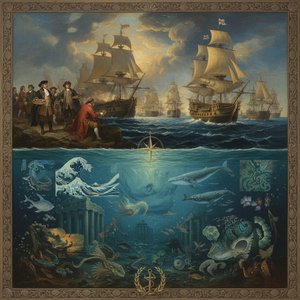
Gribble’s journey as an artist was one of profound specialization and singular focus. Although he possessed the versatility to paint evocative landscapes and intimate portraits, he found his true calling in the realm of marine subjects. He became a master storyteller of the high seas, utilizing both the fine tip of an illustrator's pen and the broad, expressive strokes of an oil painter to document the grandeur of naval history. His work often functioned as a bridge between historical record and romantic imagination, bringing to life the historical tableaux of great sailing vessels, the tension of naval engagements, and the bustling energy of ports at dusk.
A Mastery of Light, Motion, and Maritime Detail
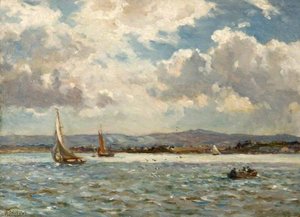
To observe a Gribble masterpiece is to experience the sensory reality of maritime life. His technique underwent a fascinating evolution, moving from the meticulous, almost scientific accuracy required for naval illustrations toward a more emotive, Impressionistic approach. In his later works, one can sense the influence of the Impressionist movement, where he began to prioritize the play of light upon water and the atmospheric haze of a coastal morning over rigid anatomical detail. This stylistic shift allowed him to capture not just the physical structure of a ship, but the very spirit of the sea itself.
His technical prowess was particularly evident in his handling of complex maritime elements:
- The Architecture of Ships: Gribble possessed an uncanny ability to render the intricate rigging, heavy hulls, and weathered textures of vessels ranging from ancient galleons to contemporary steam-powered ships.
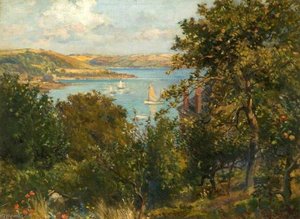
- Atmospheric Depth: Through a sophisticated use of color palettes—ranging from soft, muted tones in his Dorset landscapes to vibrant, fiery hues in scenes of naval combat—he could manipulate the viewer's perception of weather and time.
- The Dynamics of Water: Whether depicting the serene, glass-like surface of Poole Harbour or the violent, white-capped surges of a storm, his brushwork conveyed the weight and movement of the ocean with unparalleled realism.
Historical Significance and Enduring Influence
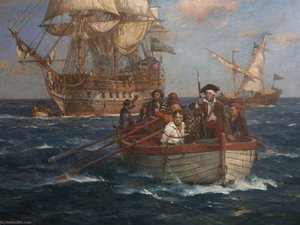
Gribble’s contributions to British art extend far beyond mere decoration; he served as a visual chronicler of an era defined by maritime expansion and naval prestige. His commissions from naval authorities and publishers ensured that his depictions of significant maritime events reached a wide audience, cementing his reputation as a premier illustrator of the sea. Works such as The Return of the Argosy Galleons and Lifeboat, 'Fredrick Angus' stand as enduring testaments to his ability to evoke both the heroism and the inherent peril of seafaring life.
As we look back on his prolific career, which spanned until his passing in 1962, Gribble remains a pivotal figure for collectors and historians alike. He did not merely paint ships; he painted the human relationship with the infinite ocean. His ability to blend the precision of an illustrator with the soul of an Impressionist ensures that his work continues to resonate, inviting every viewer to step onto the deck of a phantom vessel and sail into the golden light of a bygone maritime age.
Questions & Answers
Can I browse Bernard Finnigan Gribble's works by color palette?
Bernard Finnigan Gribble's works can be browsed by color palette on the artist's By Palettes page.
How do I find all works by Bernard Finnigan Gribble in a given medium?
The All Medium page groups Bernard Finnigan Gribble's artworks by technique.
Can I visit a virtual museum of Bernard Finnigan Gribble's works?
The 3D Museum of Bernard Finnigan Gribble is a page that displays the artist's artworks in a virtual three-dimensional gallery.