The Master of Neapolitan Shadows: The Life and Legacy of Baldassarre De Caro
In the vibrant, sun-drenched streets of 18th-century Naples, a period defined by intense artistic fervor and a profound connection to Spanish traditions, there emerged a painter capable of capturing the delicate tension between life and decay. Baldassarre De Caro (1689–1750) was not merely a chronicler of nature, but a poet of the tangible. His work stands as a cornerstone of the Italian Baroque, specifically within the specialized realm of still life, where he mastered the ability to render the textures of the natural world with an almost haunting precision. To gaze upon a De Caro canvas is to enter a space where the beauty of a blooming flower or the luster of a bird's feather exists in constant, dramatic dialogue with the inevitable shadows of mortality.
De Caro’s artistic journey was deeply rooted in the rich pedagogical traditions of his homeland. His early training under the esteemed Andrea Belvedere provided him with a foundational command of composition and light, but it was his immersion in a collaborative, experimental environment that truly forged his unique voice. He moved within a circle of talented contemporaries, including Tommaso Realfonso, Gaspable Lopez, and Nicola Casissa, creating a shared atmosphere of innovation. This period of his life was marked by an intense absorption of diverse European influences. While his heart remained Neapolitan, his eyes were trained on the meticulous Flemish traditions of Frans Snyders and Jan Fyt, as well as the somber, profound bodegones of the Spanish masters. The presence of Abraham Brueghel in Naples further enriched De Caro’s visual vocabulary, allowing him to blend Northern European realism with the dramatic chiaroscuro characteristic of the Italian Baroque.
A Symphony of Texture and Mortality
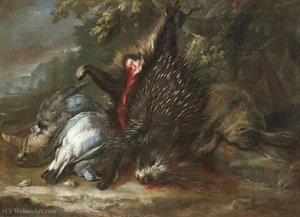
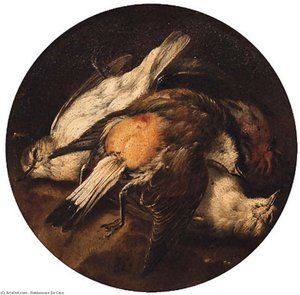
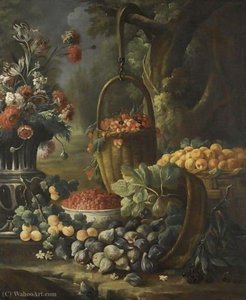
The true brilliance of De Caro lies in his technical virtuosity and his ability to imbue inanimate subjects with a sense of pulse and breath. His primary focus—the depiction of hunted game, flora, and various avian species—allowed him to explore the full spectrum of organic textures. Through the painstaking application of glazes and a masterful command of color, he achieved a level of realism that felt almost tactile. One can almost feel the dampness of a fallen leaf or the coarse weight of a plucked pheasant. His palette was often surprisingly vibrant, using brilliant hues to puncturing the deep, dramatic shadows that define his compositions.
Beyond mere technical skill, De Caro’s work is imbued with a profound symbolic depth. His paintings frequently navigate the thin line between the celebratory and the macabre. In works such as Still Life with a Woodcock and Other Birds, the artist presents a scene that is simultaneously magnificent and somber. This duality—the celebration of nature's bounty juxtaposed with the stark reality of the hunt—serves as a powerful memento mori. He captured the "beauty and brutality" of the natural world, ensuring that his subjects were never just objects, but characters in a silent, dramatic narrative about the fleeting nature of existence.
Historical Significance and Artistic Enduring Spirit
The historical importance of Baldassarre De Caro extends far beyond the borders of Naples. He played a pivotal role in establishing Neapolitan painting as a distinct and formidable stylistic voice within the broader European Baroque movement. By synthesizing the meticulous detail of Flemish masters with the emotional intensity of Italian and Spanish traditions, he helped create a localized style that was both internationally relevant and uniquely regional.
Today, De Caro’s legacy is preserved through his remarkable ability to evoke emotion through stillness. His contributions to the genre of still life remain a testament to an era when art sought to find the infinite within the finite. His works continue to fascinate collectors and historians alike, serving as windows into a world where every petal, feather, and shadow tells a story of life, death, and the enduring splendor of the natural order.
Questions & Answers
Can I explore Baldassare de Caro's works by keyword?
To find works by Baldassare de Caro on a specific theme, use the artist's By Keywords page, which groups the artworks by keyword.
Where are Baldassare de Caro's artworks grouped by palette?
Baldassare de Caro's works can be browsed by color palette on the artist's By Palettes page.
Where can I see Baldassare de Caro's artworks in chronological order?
The artist's Artwork Timeline page presents Baldassare de Caro's works ordered by date, year by year.