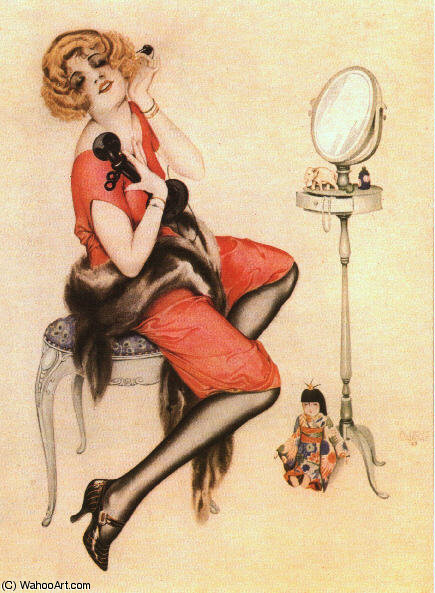
A Peruvian Legacy: The Life and Art of Alberto Vargas
Joaquin Alberto Vargas y Chávez, known to the world as Alberto Vargas, emerged from the artistic landscape of
late 19th-century Peru to become a defining voice in 20th-century American illustration. Born in Arequipa in 1896, his journey began under the tutelage of his father, Max T. Vargas, a respected photographer who instilled in him an early appreciation for visual composition and technique. This foundation proved crucial as young Alberto absorbed not only the mechanics of image-making but also a keen understanding of light, form, and the power of capturing beauty—elements that would become hallmarks of his celebrated style. Before fully embracing his destiny as a painter, Vargas embarked on studies in Europe, immersing himself in the artistic currents of Zurich and Geneva just prior to the upheaval of World War I. It was during this period he discovered *La Vie Parisienne* magazine and the work of
Raphael Kirchner, an encounter that ignited within him a fascination with pin-up illustration and set the course for his future artistic endeavors.
From Broadway Stages to the Pages of Esquire
Returning to
New York in 1916, Vargas initially navigated the world of commercial art, honing his skills on projects ranging from sewing patterns to photographic retouching. This period served as a crucial apprenticeship, allowing him to refine his technique and establish connections within the burgeoning entertainment industry. His talent soon caught the attention of the Ziegfeld Follies, where he contributed artwork for their lavish productions, and Hollywood studios, where he created striking imagery for film posters. One notable early work was a portrait of Olive Thomas, considered by many as one of the first “Vargas Girls,” foreshadowing the iconic figures that would later define his career. However, it was in 1940, with his appointment at *Esquire* magazine, that Vargas truly found his voice and cemented his place in American culture. Stepping into the role previously held by George Petty, he embarked on a prolific period of creation, producing approximately 180 paintings for the magazine over the next six years. These weren’t merely illustrations; they were carefully crafted fantasies—idealized depictions of feminine beauty that resonated deeply with a nation at war.
The Vargas Girl and Wartime Iconography
The “Vargas Girls” became more than just pin-ups; they were symbols of hope, longing, and the promise of normalcy amidst the chaos of World War II. Their elegant poses, flawless features, and often suggestive attire offered a momentary escape for American servicemen stationed across the globe. Vargas’s mastery of
watercolor and airbrush techniques lent his paintings a luminous quality, enhancing their allure and creating an almost
ethereal beauty. The impact extended beyond the magazine pages; his artwork frequently adorned the noses of Allied aircraft, serving as morale boosters for pilots and ground crews alike. This widespread dissemination transformed the “Vargas Girl” into a potent cultural icon, representing both American ideals of femininity and the yearning for peace. However, this success was shadowed by legal disputes with *Esquire* over the use of his name—a battle that resulted in financial hardship until a new opportunity arose.
A Second Bloom: Playboy and Lasting Influence
In 1959, Vargas found a renewed creative outlet at *Playboy* magazine, where he continued to produce stunning pin-up art for the next sixteen years, creating an additional 152 paintings. This period marked a flourishing of his career, leading to major exhibitions worldwide and solidifying his reputation as a master of glamour illustration. The death of his wife and muse, Anna Mae Clift, in 1974 deeply affected Vargas, causing him to largely withdraw from painting. However, the publication of his autobiography in 1978 sparked a resurgence of interest in his work, prompting a brief return to art that included album cover designs for The Cars ("Candy-O," 1979) and Bernadette Peters. Alberto Vargas passed away in 1982, leaving behind a legacy that continues to captivate audiences today. His artistic style—characterized by delicate brushwork, idealized forms, and a masterful use of
light and shadow—remains instantly recognizable and profoundly influential.
He is widely regarded as one of the finest artists in the pin-up genre, and his work serves as a testament to the enduring power of beauty, fantasy, and artistic skill. Many of his works are now held by the
Spencer Museum of Art at the University of Kansas, ensuring that future generations can appreciate the artistry of this Peruvian-American master.
His contribution extends beyond mere aesthetics; he captured a spirit of an era, offering a glimpse into the dreams and desires of a nation during times of both conflict and prosperity.