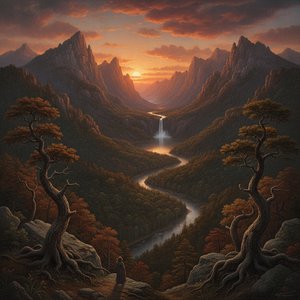
The Sublime and the Spirit: Defining the Hudson River School Movement 10 Iconic Hudson River School Masterpieces That Changed Landscape Art Forever Introduction To step into the world of the Hudson River School is to witness a profound romance betwee...
In the mid-nineteenth century, as the American identity began to coalesce from a collection of colonies into a burgeoning continental power, a profound dialogue emerged between the land and its people. This was not merely a period of territorial expansion; it was an era of spiritual discovery, where the untamed wilderness served as a canvas for the collective imagination. The Hudson River School emerged in the 1820s not as a formal institution, but as a shared way of seeing—a movement that sought to find the divine within the earth itself.
Long before the concept of a national landscape existed, European Romanticism was already teaching artists to reject rigid rationalism in favor of emotion and intuition. This intellectual shift arrived on American shores just as the Industrial Revolution began to reshape the world with iron and steam. While cities grew more crowded, painters like Thomas Cole turned their brushes toward the untouched, finding a spiritual sanctuary in the grandeur of nature. They sought the sublime, a state where beauty is inextricably linked to an overwhelming sense of greatness or even terror.
The movement found its roots in the rugged terrain of the Hudson River Valley, the Catskill, and Adirondack mountains. These artists did not merely document scenery; they composed narratives of discovery. By looking at the wilder edges of the continent, they were able to articulate a sense of national soul that felt both ancient and brand new.
Manifest Destiny on Canvas: Art as an Allegory of Expansion
American Progress is an 1872 painting by John Gast, a Prussian-born painter, printer, and lithographer who lived and worked during the 1870s in Brooklyn, New York. American Progress, an allegory of manifest destiny, was widely disseminated in chromol...
As the United States pushed westward, art became a powerful tool for articulating the concept of Manifest Destiny—the belief that the nation was destined to expand across the continent. This era of massive migration required a visual language that could justify and celebrate the movement of people into unmapped territories. The landscape was no longer just a place to inhabit; it was a mission to be fulfilled.
We see this clearly in John Gast’s 1872 work, American Progress. In this painting, Columbia, the female personification of the United States, moves from the settled East toward the darker, more mysterious West. She carries a schoolbook and lays telegraph wires, symbolizing the arrival of civilization. Behind her, the light of progress pushes back the shadows of the frontier, where bison and indigenous peoples are depicted retreating into the darkness. It is an allegory of movement, suggesting that expansion is an inevitable, even enlightened, force.
This historical echo of expansionism finds a parallel in how we view the American West today. While the paintings of the 19th century often romanticized this movement, they also documented the actual displacement and transformation of the land. The tension between the arrival of the settler and the disappearance of the wild remains a central theme in the study of American history, much like the way these canvases capture the precise moment before a landscape is irrevocly changed by the plow and the rail.
Luminism and Light: Capturing the Atmosphere of the Frontier
Landscape with Rainbow is an oil on canvas painting by the African-American artist Robert S. Duncanson. The Hudson River School landscape painting was completed in 1859, while Duncanson was living in Cincinnati, Ohio. It has been in the collection of...
To understand the technical heart of this era, one must look at the light. A related movement known as Luminism emerged, characterized by an almost religious devotion to luminosity and the subtle effects of atmosphere. These artists were masters of the fleeting moment—the way a setting sun pierces through an ancient canopy or how mist clings to a riverbank.
In works such as River Landscape in Summer by William Mason Brown, created in 1856, we see this focus on tranquility and balance. The light does not just illuminate the scene; it creates the atmosphere of peace. Similarly, Robert S. Duncanson’s Landscape with Rainbow from 1859 uses the setting sun to bathe a pastoral scene in a glow that suggests hope. For Duncanson, an African-American artist working in Cincinnati, the rainbow and the light served as symbols of peace during the tensions leading up to the Civil War.
This obsession with light mirrors the way we experience nature today, seeking moments of stillness in an age of digital saturation. Just as the Luminists used oil on canvas to capture the warmth of the sun or the coolness of the shade, modern viewers look to these works to find a sense of presence. The technique of layering paint to achieve depth allows the viewer to feel the weight of the air and the texture of the trees, offering a tactile connection to a world that feels increasingly distant.
Beyond the Horizon: The Evolution from Hudson Valley to the American West
Discover Thomas Cole’s iconic Hudson River School landscapes – romantic depictions of American nature & history. Explore his masterful oil paintings & influence on art.
While the movement began in the lush valleys of New York, it did not remain confined by geography. As the frontier moved, so did the artists. The second generation of the Hudson River School, including figures like Frederic Edwin Church and Albert Bierstadt, expanded their gaze toward the far reaches of the continent, from the Rockies to South America.
The scale of these works grew alongside the ambition of the nation. Painters began producing epic-sized canvases that reminded Americans of the vastness of their new territories. In Bierstadt’s Rocky Mountains, painted in 1863, the horizon catches sunset hues of amber and violet. The sheer size of such paintings was unexampled in earlier American art; they were designed to overwhelm the viewer, much like the mountains themselves.
This expansion reflects a broader historical pattern of exploration. Just as the early Hudson River painters moved from the Catskills into the White Mountains, later artists followed the trails of the pioneers into the Great Plains and beyond. The art evolved from documenting local scenery to constructing a grand, continental identity, proving that the landscape was not a static backdrop but a growing, living entity.
The Myth of the Wild West: From Fine Art to Traveling Shows
Wild West shows were traveling vaudeville performances in the United States and Europe that existed around 1870–1920. The shows began as theatrical stage productions and evolved into open-air shows that depicted romanticized stereotypes of cowboys, P...
As the 19th century drew to a close, the reality of the frontier began to merge with its myth. The era of the "Wild West" subperiod, spanning from the end of the Civil War to the 1890 census, saw the rise of a more sensationalized version of the frontier. This was the era of the traveling vaudeville performance, where history was transformed into entertainment.
William F. "Buffalo Bill" Cody became the architect of this new myth. His Wild West shows, founded in 1883, brought the imagery of the frontier to audiences in Europe and America through theatrical reenactments, trick shots, and wild animal displays. While artists like Cole and Church sought the sublime in nature, Cody sought the drama of the human encounter with the wild. The ruggedness of the West was packaged into a spectacle that could be consumed by millions, creating a lasting archetype of the cowboy and the scout.
This shift from fine art to popular spectacle creates a fascinating contradiction. On one hand, we have the meticulous, spiritual landscapes of the Hudson River School; on the other, we have the loud, energetic performances of the Wild West shows. Both, however, contributed to the same cultural foundation: the creation of a frontier myth that would define American identity for generations to come.
Enduring Legacies: How 19th-Century Landscapes Shape Modern Identity
A Chronicle of American Identity: The Smithsonian American Art Museum Nestled within the venerable Old Patent Office Building in Washington, D.C., the Smithsonian American Art Museum is more than simply a repository for artistic treasures; it’s a pro...
Today, the landscapes of the Hudson River School and the legends of the American West exist in a state of constant dialogue with our modern world. We see their influence in everything from the preservation of our National Parks to the way we conceptualize the "great outdoors." The works housed in institutions like the Buffalo Bill Center of the West in Laramie or the Smithsonian American Art Museum in Washington, D.C., act as both historical records and emotional anchors.
The tension between progress and preservation remains unresolved. We continue to grapple with the consequences of expansion—the loss of wilderness, the displacement of cultures, and the environmental shifts that began in the 19th century. Yet, when we stand before a painting like Landscape and River by Thomas Cole, we are invited to participate in that original moment of discovery.
At OriginalUniqueArt.com, we believe that art is a way to bridge these eras. Whether through a handmade oil reproduction that brings the texture of the past into a modern living room or a custom portrait that reimagines a personal memory in a classical style, we help you find your own connection to these enduring stories. The frontier may have closed in the census reports of 1890, but through the lens of art, the majesty of the American West remains wide open.
Discover the ethereal beauty of Luminism. Explore the serene landscapes of the Hudson River School through an expert lens, celebrating the mastery of light, atmosphere, and the enduring legacy of American landscape painting.
Explore the Hudson River School's mastery of the American sublime. Discover how 19th-century Romantic painters captured the soul of the wilderness through breathtaking landscapes, light, and scale in this definitive art history guide.

 Wild Frontiers: The Sublime Majesty of the American West through Hudson River School Masterpieces
 American Progress
 Landscape with Rainbow (Duncanson)
 Landscape and River
 Wild West shows
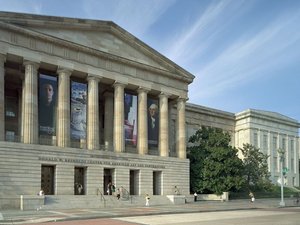 Smithsonian American Art Museum