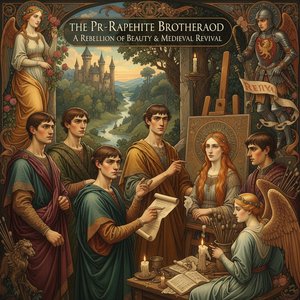
The Rebellion of 1848: Challenging the Royal Academy's 'Slosh' The Pre-Raphaelite Brotherhood: Rediscovering Romanticism, Mythological Depth, and Vivid Detail in Victorian Art The Rebellion Against Tradition: The Birth of the Pre-Raphaelite Brotherho...
In 1848, as political revolutions shook the foundations of continental Europe and social unrest via Chartism unsettled the British landscape, a different kind of uprising was forming in London. Within the rigid corridors of the Royal Academy, a small group of young, fervent students began to organize. They were not interested in the established way of painting, which they found increasingly stagnant and artificial. To these rebels, the prevailing style—characterized by heavy glazes, muted tones, and idealized, hollow forms—was nothing more than "slosh." This derogatory term was a direct critique of the mechanistic techniques favored by the successors of Raphael and Michelangelo, whom the group disparagingly referred to as "Sir Sloshua" in reference to the Academy's first president, Sir Joshua Reynolds.
This rebellion was far more than an aesthetic disagreement; it was a moral imperative. The seven founding members, including William Holman Hunt, John Everett Millais, and Dante Gabriel Rossetti, formed the Pre-Raphaelite Brotherhood (PRB) as a secret society to protect their radical mission of artistic renewal. They sought to strip away the layers of academic pretension to reveal a more profound, spiritual truth beneath. This impulse to reject the artificiality of the present mirrors the way later movements, such as the American Pre-Raphaelites, would eventually reject the idealized landscapes of the Hudson River School in favor of a more grounded, truthful representation of their own environments.
The Brotherhood’s early exhibitions often featured their cryptic "P.R.B." initials, a nod to their clandestine beginnings. By challenging the Academy's dominance, they paved the way for a new era where sincerity and directness were valued above polished, academic perfection.
The Botanical Eye: Scientific Precision and Natural Truth
Central to the Pre-Raphaelite mission was an unwavering commitment to "truth to nature." This was not merely a poetic sentiment but a rigorous technical practice. Influenced by the scientific advancements of the Victorian era, these artists approached the natural world with a meticulous, almost clinical gaze. They rejected the broad, sweeping brushstrokes of their predecessors in favor of intense observation and botanical accuracy. When painting a landscape or a floral arrangement, they aimed to capture the precise texture of a petal or the exact way light filtered through a leaf.
This dedication required immense patience and often necessitated painting en plein air, working directly from nature to ensure every detail was recorded with fidelity. This level of precision can be seen in the works of John Ruskin, the movement's most significant champion, who admired their ability to use a scientific gaze to reveal the divine complexity of the world. The influence of this meticulousness even crossed the Atlantic; American artists like Thomas Charles Farrer adopted similar principles, with some members of the American Pre-Raphaelite circle spending months perfecting the depiction of a single violet.
The result was a style that felt remarkably tactile and alive. In works such as Millais’s Ophelia, the river flora is rendered with such accuracy that the viewer can almost sense the dampness of the reeds and the weight of the water. This focus on the tangible world served to ground their often mythological or religious subjects in a reality that felt undeniably present.
A Victorian Sanctuary: The Architectural Grandeur of Royal Holloway Nestled within the serene, verdant embrace of the Surrey countryside, just a short journey from the bustling heart of London, lies Royal Holloway, University of London—a destination ...
To find the truth they believed had been lost, the Pre-Raphaelites looked backward. They found inspiration in the art of the late Middle Ages and the early Renaissance—the era before Raphael’s influence had supposedly introduced a corrupting sense of idealization into European painting. This fascination with the Quattrocento allowed them to embrace a luminous palette of bright colors and complex, often much more sincere, compositions. They saw in the works of earlier masters a spiritual and creative integrity that the modern, industrializing world seemed to be eroding.
This longing for a pre-industrial past was not merely about nostalgia; it was an attempt to reclaim a sense of moral clarity. By utilizing themes from Arthurian legend, the Bible, and Dante’s poetry, they created a visual language that felt both ancient and urgently relevant. This period of looking back to move forward finds a structural echo in the architecture of Royal Holloway, where the Founder’s Building was designed with an inspiration drawn from the Château de Chambord, using historical grandeur to inspire contemporary intellectual fervor.
The movement eventually branched into two distinct directions: the realists, like Hunt and Millais, who focused on naturalism, and the medievalists, led by Rossetti and Edward Burne-Jones, who leaned further into the dreamlike, much more ornamental aspects of the past. Regardless of this split, the shared reverence for a more sincere era remained the movement's heartbeat.
The Feminine Narrative: Muses, Portraits, and Identity
A Delicate Vision: The Life and Art of Emma Sandys Emma Sandys, born in Norwich in 1843 and passing away there in November 1877, remains a captivating yet often overlooked figure within the Pre-Raphaelite circle. Her life, though relatively short, yi...
While the Brotherhood was founded by men, the visual identity of Pre-Raphaelitism was profoundly shaped by the women who moved within its circles. These women were often much more than mere models; they were muses, collaborators, and in some cases, artists themselves. Figures like Elizabeth Siddal and Emma Sandys brought a unique emotional depth to the movement. Sandys, for instance, refined the existing portraiture traditions of her time, imbuing them with a quiet, romantic sensitivity that focused on the intimate lives of women and children.
The depiction of the female form in Pre-Raphaelite art often moved away from the idealized, classical beauty of the Academy toward something more enigmatic and psychologically complex. Rossetti’s paintings frequently featured striking female figures who embodied both earthly sensuality and an ethereal, melancholic beauty. These portraits were not just about likeness; they were explorations of identity and emotion. This era also saw a fascination with the "headless portrait" in photography, a strange Victorian fad that played with the boundaries of presence and absence, much like the way Pre-Raphaelite painters used facial expressions to suggest deep, hidden narratives.
Even within the domestic sphere, as seen in Millais’s Portrait of Mrs. Joseph Chamberlain, the movement captured the dignity and intellectual life of women. Through these portraits, the Pre-Raphaelites documented a changing social landscape where the roles of women were being subtly redefined through art and literature.
Visual Metaphor: The Language of Symbolism and Myth
Introduction To embark on a journey through the top 25 artworks of Dante Gabriel Rossetti is to enter a world steeped in beauty, longing, and a profound sense of mystery. These paintings are not merely images; they are portals into the soul of a Vict...
The final layer of the Pre-Raphaelite world was its dense, symbolic language. A painting by a member of the Brotherhood was rarely just a depiction of a scene; it was a puzzle intended to be solved. Every element—a lily for purity, a dove for the Holy Spirit, or even the specific way a piece of fabric draped over a chair—could carry profound religious or moral weight. This use of symbolism allowed artists to bridge the gap between the physical senses and the spiritual imagination.
This technique turned their canvases into narratives that invited deep engagement. In Dante Gabriel Rossetti’s Saint Catherine, the artist uses a shimmering, medieval grace to invite the viewer into a realm of sacred history. The heavy use of symbolism was not intended to obscure meaning but to enrich it, providing layers of interpretation for the observant viewer. This approach mirrors the way later collectors might look at an artwork today, searching for the hidden metaphors and the "soul" behind the brushstrokes.
Ultimately, the Pre-Raphaite movement was a complex intersection of rebellion, science, history, and myth. By rejecting the "slosh" of their era, they created a visual legacy that continues to resonate, offering a sanctuary of depth and permanence in an ever-changing world. For those looking to bring this sense of historical narrative into their own homes, OriginalUniqueArt.com offers exquisite hand-painted reproductions that capture the true texture and spirit of these remarkable works.
Discover the ethereal world of Pre-Raphaelite Romanticism. Explore the rebellion, medieval beauty, and symbolic mastery of Rossetti, Waterhouse, and more in this expert guide for classical art lovers.
Immerse yourself in the romantic beauty of Dante Gabriel Rossetti. Explore 25 iconic Pre-Raphaelite masterpieces, from soulful portraits to symbolic legends. Find museum-quality art reproductions and timeless decor inspiration. Discover all masterpieces on OriginalUniqueArt.com.
Explore the profound beauty of Victorian Naturalism. Discover how 19th-century masters captured botanical precision and raw landscapes through meticulous oil painting techniques and scientific observation.
Explore the captivating world of the Pre-Raphaelite Brotherhood! Discover their rebellion against academic art, iconic masterpieces, and lasting influence on Victorian aesthetics. Learn about Rossetti, Burne-Jones & more.

 The Pre-Raphaelite Brotherhood: Reclaiming Beauty, Truth, and Naturalism in Victorian Art
 Royal Holloway
 Emma Sandys
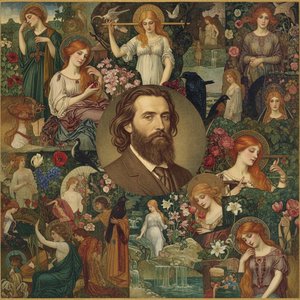 Dante Gabriel Rossetti's 25 Masterpieces: A Journey Through Victorian Art & Symbolism | OriginalUniqueArt