Introduction To step into a landscape painting is to do more than merely observe a view; it is to enter a conversation with the earth itself. Throughout history, the landscape has served as a profound mirror for the human soul, capturing not just the...
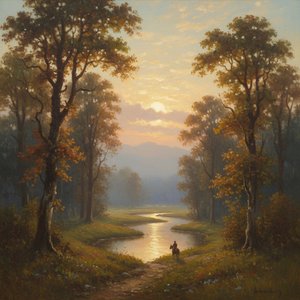
To step into a landscape painting is to enter a conversation with the earth itself. There is a specific, quiet gravity that settles over the world when the sun begins its descent, a moment where the sharp edges of reality soften and the air seems to thicken with color. This transition, often referred to as the golden hour, offers more than just a change in illumination; it provides a window into the shifting relationship between the physical world and our internal sense of peace. We do not merely observe these scenes; we inhabit them.
The evening sky, heavy with the weight of passing time, invites a particular kind of contemplation. As the light recedes, the boundaries between the land and the heavens begin to blur, creating a space where the viewer can find sanctuary from the noise of modern life. Whether it is the soft glow of a German oil painting like Karl Heffner’s Landscape, Evening or the more rugged, textured vistas of contemporary works, the goal remains the same: to capture that fleeting interval where the day finds its resolution.
In art, chiaroscuro (English: kee-AR-ə-SKOOR-oh, -SKURE-, Italian: [ˌkjaroˈskuːro]; lit. 'light-dark') is the use of strong contrasts between light and dark, usually bold contrasts affecting a whole composition. It is also a technical term used by a...
The true structure of a twilight scene is built not from stone or wood, but from the deliberate use of contrast. In the study of art, this is known as chiaroscuro—the application of strong light and dark to suggest volume and three-dimensional form. By managing the tension between shadow and illumination, an artist can guide the eye through a landscape, using the length of a shadow or the brightness of a cloud to create a sense of depth that feels tangible.
This technique is far more than a mere trick of visibility; it is a method of modeling reality. When we look at works that utilize chiarosc and light, we see how the division of shapes allows for a sense of weight and presence. In photography and painting alike, tracking these angles of light is essential for understanding tonal structure. It is through this interplay of value gradation that a flat canvas acquires the ability to breathe, allowing the viewer to perceive the heavy texture of a rock or the delicate translucency of a cloud at dusk.
The American Wilderness: Luminism and the Unspoiled Horizon
Twilight in the Wilderness is an 1860 oil painting by American painter Frederic Edwin Church. The woodlands of the northeastern United States are shown against a setting sun that intensely colors the dramatic altocumulus clouds. Church scholar John K...
In the mid-nineteenth century, a specific movement emerged in the United States that sought to capture the spiritual purity of the natural world. Known as Luminism, this style focused on an almost camera-like clarity, where the presence of the artist’s hand was intentionally minimized to let nature speak for itself. A primary example is Frederic Edwin Church’s 1860 work, Twilight in the Wilderness. Here, the woodlands of the northeastern United States are presented without any sign of human interference, save for a single small bird perched quietly in the frame.
Church utilized skillful gradations of purple, orange, and yellow to paint a sky that feels both immense and intimate. This approach was deeply connected to the cultural sentiment of the era—a reverence for the pristine, untouched wilderness. By focusing on the way light reflects off altocumulus clouds, these painters achieved a sense of divine presence within the landscape. The result is a view that feels unmediated, as if we are witnessing the very breath of the American continent during its most tranquil hour.
Northern Renaissance Foundations: The Birth of the World Landscape
A Pioneer of the Northern Renaissance Landscape Joachim Patinir, a name often whispered alongside that of Albrecht Altdorfer as a foundational figure in landscape painting, emerged from the artistic milieu of the Low Countries during the early 16th c...
Long before the Luminists sought the American horizon, the foundations of landscape painting were being laid in the Low Countries. Artists like Joachim Patinir, working in the early sixteenth century, began to move the landscape from a mere background detail to a central, independent subject. Patinir was a pioneer of what became known as the "world landscape," an expansive way of seeing that combined naturalistic observation with a sense of vast, panoramic scale.
Influenced by the imaginative depth of Hieronymus Bosch but steering away from pure allegory, Patinir and his contemporaries established a tradition of treating the earth as a narrative force. Their works often featured high perspectives that allowed for a sweeping view of terrain, where distant mountains and winding waterways suggested an infinite world. This era taught us that a landscape could hold its own weight, capable of conveying meaning through its sheer scale and the subtle way light moves across a rugged topography.
Atmospheric Depth: Sfumato and the Dissulating Edge
Introduction Close your eyes for a moment and imagine the scent of damp earth after a summer rain, or the way the golden light of a setting sun dissolves the sharp edges of a distant forest into a soft, amber haze. To gaze upon a landscape is to do m...
As we move through the history of the genre, we encounter techniques designed to mimic the very air that surrounds us. Leonardo da Vinci utilized sfumato—a soft, smoky blurring of edges—to create atmospheric perspective. In his works, distant mountains do not sit sharply against the sky; instead, they dissolve into a hazy, blue-toned dreamscape. This technique acknowledges a fundamental truth of the twilight hour: as distance increases, detail fades and color shifts.
This dissolution of the boundary between humanity and the earth is essential for creating a sense of geological time. When the edges of a forest or a mountain range are softened, the painting gains a sense of moisture and breath. It prevents the scene from feeling like a static map and instead turns it into a living environment. This mastery of atmosphere ensures that the landscape feels as though it exists within a continuous, breathing space, rather than being trapped behind a glass frame.
The Modern Pulse: Texture, Emotion, and Abstracted Dusk
The Soulful Resonance of Color: The Life and Art of Wayne Bennett To understand the visual language of Wayne Bennett , one must first listen to the rhythm of the blues. Born in Memphis, Tennessee, on December 13, 1932, Bennett’s early life was define...
In more recent centuries, the approach to the landscape has shifted toward the tactile and the emotive. Artists like Wayne Bennett brought the rhythmic energy of the blues to the canvas, using heavy impasto to create surfaces that catch the light in unpredictable ways. In his work, the landscape is not a photographic record but an exploration of intensity. The thick layers of oil paint provide a physical weight that mirrors the dramatic shifts found in nature itself.
Similarly, contemporary voices like Lisa Sanditz use the landscape to explore the intersection of culture and environment, sometimes introducing the unsettling presence of human intervention into otherwise lush scenes. Even in the more abstract or monochromatic works, such as those by Frank Harold Hayward, the focus remains on the power of texture and tone to evoke solitude. These modern approaches remind us that a landscape can be a vessel for internal emotion, using the physical properties of paint to communicate what words cannot.
Reflecting on Permanence: Finding Stillness in the Evening Sky
Discover "Landscape With A Lake" by George Barret Sr., a serene Romantic landscape painting of rolling hills & tranquil waters. Explore its classical style & timeless beauty.
Ultimately, the study of twilight landscapes is an exercise in observing the ephemeral. Whether we are looking at the structured, civic-minded collections found in places like the Hart District Council or the sweeping, romantic vistas of George Barret the Elder, there is a shared reverence for the moment of transition. These works offer us a sanctuary of stillness, inviting us to reconnect with the rhythms of a world that persists far beyond our own hurried lives.
As we wander through these various scenes—from the biblical landscapes of Bruegel to the quiet, Scottish-inspired reflections of Donald Pass—we find a common thread: the search for permanence within the transient. The evening sky may change every minute, but the way it moves us remains constant. In the careful application of pigment and the deliberate placement of shadow, these artists have captured a sense of peace that invites us to stop, look closer, and simply remain.
At OriginalUniqueArt.com, we believe that bringing these moments of tranquility into your home can transform your living space into a place of reflection. Whether you are drawn to the heavy textures of an oil reproduction or the soft light of a custom commission, our goal is to help you find the piece that speaks to your own sense of wonder.
Discover how the dramatic interplay of chiaroscuro and light can transform your home. Learn to use shadow, contrast, and masterful art reproductions to create a sophisticated, soulful interior with expert design insights from OriginalUniqueArt.com.
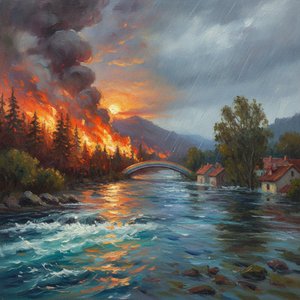
Immerse yourself in the breathtaking drama of nature through an Impressionist lens. Discover how masters like Monet captured the ephemeral beauty of fire and flood. At OriginalUniqueArt.com, we offer exquisite hand-painted reproductions and expert consultations for the discerning collector.
Journey through history with 10 iconic landscape paintings. From Impressionist light to Romanticism's drama, explore the stories behind these timeless masterpieces. Find museum-quality art reproductions and decor inspiration at OriginalUniqueArt.com. Discover all masterpieces online.
Explore the profound landscapes of George Inness, a leading American artist-philosopher. Discover his spiritual approach to painting, influences, and lasting legacy with OriginalUniqueArt.

 10 Masterpiece Landscape Paintings That Will Transform Your Perspective
 Chiaroscuro
 Twilight in the Wilderness
 Joachim Patinir
 10 Breathtaking Masterpieces That Redefine the Landscape Genre
 Wayne Bennett
 Landscape With A Lake