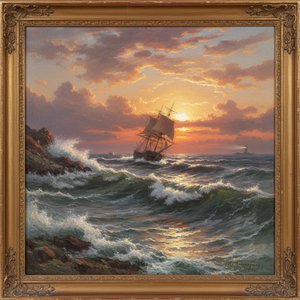
The Sublime Encounter: Nature’s Unbridled Power and the Romantic Ideal
 Shipwreck off Nantucket (also known as Wreck off Nantucket, after a Storm)
A Tempestuous Vision of Resilience: William Bradford’s Shipwreck Off Nantucket William Bradford's "Shipwreck off Nantucket," painted in 1861, stands as a cornerstone of American Romanticism—a testament to both artistic innovation and the profound con...
To gaze upon a tempestuous seascape is to engage in a silent, profound dialogue with the infinite. For centuries, the ocean has served as the ultimate stage for the drama of existence, acting simultaneously as a sanctuary of peace and a formidable display of overwhelming power. In the late 18th and 19th centuries, this duality found its most exquisite expression through the lens of Romanticism. This movement, emerging as a passionate response to the rationalism of the Enlightenment, sought to elevate subjectivity, imagination, and the awe-inspiring grandeur of the natural world. Within the frame of a masterwork, the sea is no longer merely water; it becomes a mirror for the human soul, reflecting our deepest fears, our resilience, and our reverence for the uncontrollable forces that govern our universe.
The concept of the Sublime—that intoxicating mixture of terror and beauty—is central to this artistic pursuit. When we observe works like William Bradford’s Shipwreck off Nantucket, we are not merely witnessing a maritime disaster; we are experiencing the profound tension between human vulnerability and the indomitable spirit of nature. The artist captures a moment frozen in time, where the scale of the storm dwarfs the vessels caught within its grasp, inviting the viewer to contemplate their own place within the vast, cosmic order. It is this emotional gravity that transforms a seascape from a mere landscape into a spiritual encounter.
Chiaroscuro and Chaos: Technical Mastery in Depicting Turbulent Waters
 List of paintings by J. M. W. Turner
This is an incomplete list of the oil paintings of J. M. W. Turner (23 April 1775 – 19 December 1851), a master noted for his skill in the portrayal of light, and in the painting of maritime scenes. See M. W. Turner Catalogue Raisonné, 1982, Joll and...
Capturing the ephemeral energy of a storm requires more than mere observation; it demands a sophisticated command of light, texture, and shadow. The masters of the maritime genre utilized chiaroscuro—the dramatic contrast between light and dark—to intensify the sense of urgency and peril. By manipulating light, artists like J.M.W. Turner could render the atmosphere not as a static backdrop, but as a living, breathing entity. In his most celebrated works, light becomes a fluid element, dissolving solid forms into a swirling vortex of mist, spray, and sunbursts, effectively communicating the chaotic motion of a gale.
Beyond the play of light, the tactile quality of the paint itself plays a crucial role in conveying the sea's ferocity. The use of impasto—thick, textured applications of oil paint—allows the artist to physically sculpt the crest of a wave or the spray of salt against a hull. This technique provides a palpable sense of depth and movement that no flat print can replicate. When observing the works of Ivan Aivazovsky, one finds a breathtaking mastery of translucency; his ability to layer glazes creates the illusion of light passing through the very heart of a wave, capturing the translucent, emerald depths of a churning sea with scientific precision and poetic grace.
From Navigation to Narrative: The Historical Evolution of the Seascape Genre
 Masterpieces of the Sea: An Authoritative Guide to Iconic Maritime Artworks and the Eternal Horizon
The Genesis of the Seascape: From Navigational Records to Aesthetic Expression The Allure of the Horizon: A Comprehensive Exploration of Seascape Art Through History & Emotion The Genesis of Seascape: From Maritime Records to Artistic Expression For ...
The genesis of seascape art was rooted in the cold, precise necessity of commerce and exploration. Long before the ocean became a subject of aesthetic contemplation, it was documented through the functional lens of maritime records, ship logs, and navigational charts. These early visual encounters were driven by the need to map trade routes and document the vessels that served as the lifeblood of empires. During the Dutch Golden Age, artists such as Jacob Adriaensz Bellevois began to transition these utilitarian depictions into a sophisticated genre of fine art. Influenced by pioneers like Jan Porcellis, these painters focused on the verisimilitude of maritime life, portraying working craft navigating the everyday realities of the North Sea with meticulous detail.
As maritime technology evolved, so too did the narrative depth of the genre. The sea transitioned from a resource to be exploited into a canvas for profound storytelling. What began as the "ship portrait"—a celebration of naval strength and global trade—evolved into complex compositions exploring themes of survival, loss, and discovery. This evolution allowed the seascape to move beyond the literal documentation of hulls and rigging, embracing instead the atmospheric and psychological weight of the maritime experience, eventually leading to the grand, emotive landscapes that define the pinnacle of the Romantic era.
The Emotional Horizon: Finding Resonance and Tranquility in Maritime Masterpieces
 Moonlit Seascape With Shipwreck
A breathtaking Moonlit Seascape by Ivan Aivazovsky! Romantic Realism captures a dramatic shipwreck & lighthouse scene. Oil on canvas, 1863. Stunning detail & atmospheric beauty.
There is a primal, almost magnetic pull toward the horizon—that ethereal boundary where the liquid expanse meets the infinite sky. To study the history of the seascape is to witness a journey of emotional resonance. While some works focus on the harrowing tension of a shipwreck, others seek the profound tranquility found in the stillness of a moonlit sea. The ability of maritime art to evoke such a wide spectrum of human emotion is what makes it an enduring cornerstone of fine art collections. A well-executed seascape can act as an emotional anchor, providing a sense of meditative escape and deep reflection.
For the discerning collector, these works offer more than visual interest; they provide a window into the eternal. Whether it is the rugged, coastal soul captured by Thomas Henry Roskell or the luminous, moonlit shipwrecks of Aivazovsky, the genre invites us to engage in a silent meditation on the nature of time and existence. The subtle movement of a wave or the shifting hues of a bruised sky under a gathering storm allows the viewer to connect with the elemental forces of our world, finding a sense of peace within the very heart of the tempest.
Curating the Tempest: Integrating Dramatic Seascapes into Luxury Interiors
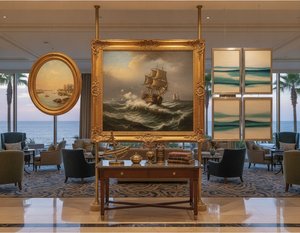 Premium Nautical & Maritime Art: High-Quality Seascape Reproductions for Luxury Hotel and Professional Interiors
The Emotional Resonance of Maritime Art in Hospitality Design Bring the Ocean Home: Captivating Maritime Paintings to Transform Your Space with Timeless Elegance The Allure of the Horizon: Finding Emotional Resonance in Seascape Art The Allure of the...
In the realm of high-end interior design and hospitality, maritime art serves as a powerful tool for establishing atmosphere and prestige. The integration of a dramatic seascape can provide a unique emotional anchor, offering a sense of depth and grandeur that can soften the sharp, modern architectural lines of a contemporary estate or a luxury hotel lobby. For designers working on professional interiors, these paintings offer the ability to create immersive environments that resonate with the human spirit's primal connection to the water.
When curating such pieces, one must consider the dialogue between the artwork and the surrounding space. A large-scale, multi-panel seascape can transform a wide wall or a grand staircase into a breathtaking focal point, creating a sense of movement that guides the eye through a room. The deep tonal ranges and rich textures of hand-painted oil reproductions bring a level of sophistication and authenticity that mass-produced decor simply cannot achieve. By selecting works that reflect the desired emotional tone—be it the tranquil blue of a calm horizon or the dramatic, dark energy of a storm—designers can establish a profound sense of place, bringing the salt-kissed atmosphere of a distant coastal retreat directly into an urban interior.
At OriginalUniqueArt.com, we specialize in preserving this legacy of maritime excellence. We offer museum-quality, hand-painted oil reproductions that capture the true essence of the masters, from the light-drenched brilliance of Turner to the dramatic textures of Aivazovsky. Whether you are an interior designer seeking to transform a luxury hotel or a private collector looking for a bespoke masterpiece, our artisans use traditional techniques on 100% cotton canvas to ensure every brushstroke conveys the raw power of the sea. Discover our curated collection and experience the timeless elegance of the ocean, delivered with our global commitment to excellence.